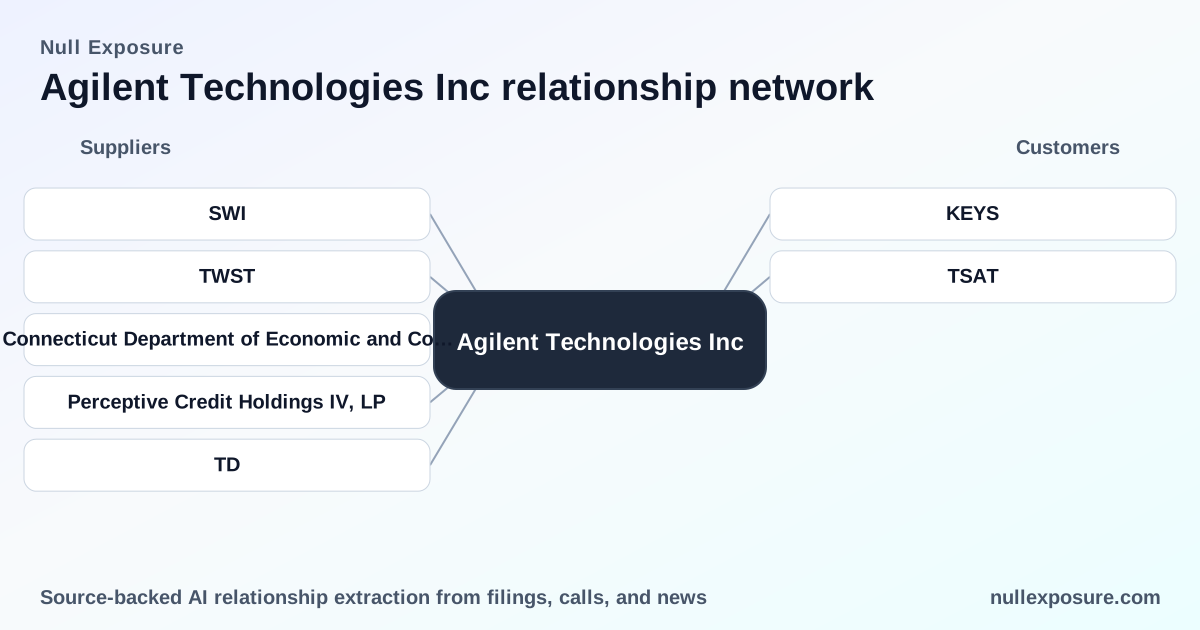
Agilent’s customer footprint: concentrated capabilities, diversified counterparties
Agilent Technologies sells analytical instruments, software, consumables, services and CDMO manufacturing to laboratories, biopharma companies, governments and academic customers, monetizing through equipment sales, recurring service contracts, software/licenses and contract manufacturing. Its business mixes one‑time hardware revenues with high‑margin consumables and multi‑year service/licensing obligations, creating predictable near‑term revenue while preserving exposure to end‑market cycles in pharmaceuticals and public sector spending.
Explore the full relationship map and signals at https://nullexposure.com/ — the following analysis synthesizes public filings and contemporaneous reporting to make that customer picture actionable for investors.
How Agilent’s customer model operates in plain terms
Agilent combines capital equipment sales with a broad aftermarket and service layer: instruments drive initial sales, consumables and reagents drive recurring revenue, and software/licenses plus extended warranty and SaaS contracts provide durable cash flow. The company also runs a specialty CDMO (contract development and manufacturing) business for oligonucleotide therapeutics, positioning Agilent as both a supplier of lab infrastructure and a direct manufacturing partner to pharmaceutical customers.
- Contracting posture: Agilent reports sizable remaining performance obligations, including long‑term contracts; the company disclosed $437 million of remaining obligations with original terms >1 year, most recognized within 12 months, indicating a mix of short and multi‑year revenue visibility.
- Revenue mix and stickiness: Software licenses and maintenance, annual service contracts, and SaaS contribute recurring revenue; instrument and OEM sales remain significant but are complemented by consumables and service margins.
- Concentration: No single customer accounted for 10% of revenue in recent years, signaling low counterparty concentration.
- Global footprint: Sales are truly global with material revenue from Americas, EMEA and APAC, which both diversifies and exposes Agilent to regional macro cycles.
- Role diversity: Agilent acts as seller, service provider, manufacturer (CDMO), and reseller partner in different contexts, supporting operational flexibility and multiple monetization paths.
Customer relationships you should care about
Below are the public counterparties that appear in filings and reporting, with concise takeaways and source references.
Keysight Technologies (KEYS)
Agilent reported income from site service costs and lease income tied to Keysight, totaling $3 million in FY2026 and $12 million in FY2025, reflecting landlord/service arrangements rather than core product sales. This is a modest, non‑strategic revenue line that shows Agilent extracts ancillary income from commercial real‑estate and site services. (Source: Agilent FY2026 10‑Q filing, March 2026; and FY2025 Form 10‑K, year ended Oct 31, 2025.)
Moderna (MRNA)
Agilent’s instruments and tools support major U.S. biopharma customers including Moderna, linking part of Agilent’s performance to the cadence of domestic drug development and clinical pipelines. This exposure underscores Agilent’s sensitivity to R&D and commercial activity in the large biopharma segment. (Source: Q2 earnings overview reporting, May 2, 2026.)
Pfizer (PFE)
Like Moderna, Pfizer is cited as a user of Agilent tools; ongoing demand from large pharmaceutical firms underpins consumables and service revenue and ties Agilent’s growth to pharmaceutical R&D and manufacturing throughput. (Source: Q2 earnings overview reporting, May 2, 2026.)
Labcorp (LH)
Labcorp announced nationwide availability of Agilent’s PD‑L1 IHC 22C3 pharmDx companion diagnostic, the only FDA‑approved test to identify certain ovarian cancer patients eligible for KEYTRUDA. This places Agilent’s diagnostics products into clinical workflows and payer‑facing channels, increasing the commercial relevance and revenue durability of the companion diagnostics business. (Source: PR Newswire, Labcorp press release, May 3, 2026.)
Transportation Security Administration (TSA / TSAT)
Agilent disclosed that a new instrument secured a $9 million TSA contract during the quarter, indicating direct government procurement for applied‑markets instrumentation and reinforcing the company’s presence in public‑sector laboratory and security testing. (Source: Q1 FY2026 earnings call transcript reporting, March 2026.)
What these relationships imply for investors
- Diversified end markets, low customer concentration. Agilent works across pharmaceuticals, diagnostics, academia/government and applied markets; management explicitly reports no customer >10% of revenue, reducing single‑counterparty risk.
- Recurring revenue anchor. The mix of annual service contracts, SaaS, software licenses and consumables provides a recurring base that cushions quarterly equipment cyclicality. The company’s RPO disclosure ($437 million for >1‑year obligations) underpins near‑term revenue visibility.
- Pharma exposure is a double‑edged sword. Relationships with Pfizer and Moderna link Agilent to secular R&D spend and to biotech cycle volatility — positive when pipelines expand, negative when clinical activity slows.
- Government contracts and diagnostics lift margins and credibility. TSA awards and FDA‑cleared companion diagnostics (adopted by Labcorp) add high‑visibility, mission‑critical revenue and can act as anchors for longer service contracts.
- Operational flexibility through multiple roles. Acting as manufacturer (CDMO), seller, service provider and licensor broadens monetization opportunities and raises switching costs for customers who adopt Agilent across hardware, consumables and software.
Risks and monitoring checklist
- Monitor quarterly indicators of pharmaceutical R&D spending and instrument order trends, which are leading signals for consumables and services.
- Track the composition of remaining performance obligations and the cadence of software/license revenue recognition to assess recurring revenue growth.
- Watch for concentration shifts; while immaterial today, large CDMO or diagnostic contracts could change counterparty significance.
- Geopolitical and regional macro disruptions in APAC/EMEA could pressure product shipments despite diversified geography.
Bottom line
Agilent’s customer footprint blends durable recurring revenue from services, consumables and software with opportunity‑driven equipment sales tied to pharma and public‑sector budgets. The relationship map — from Keysight lease income to TSA instrument contracts and adoption of Agilent companion diagnostics by Labcorp — confirms a business that is diversified in counterparty type but strategically linked to the health of global life‑sciences and public‑sector testing markets.
For a deeper look at these signals and ongoing tracking of Agilent’s customer relationships, visit https://nullexposure.com/.