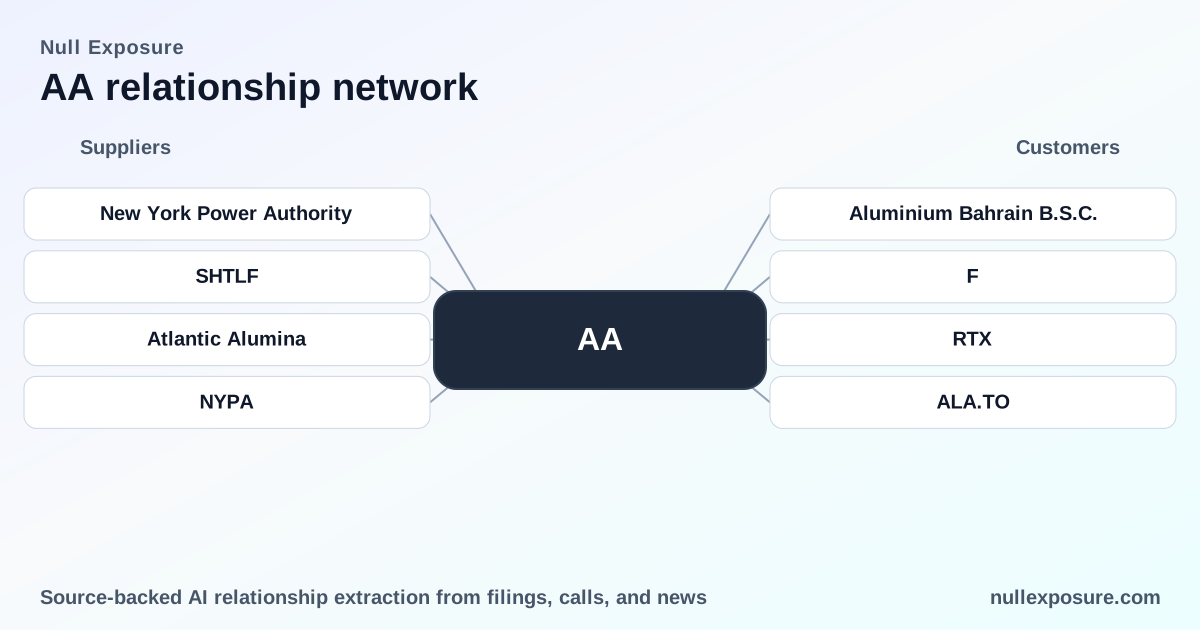
Alcoa (AA): Industrial supplier, brownfield redeployer, and how customers shape risk and upside
Alcoa Corporation is a vertically integrated aluminum producer that monetizes across the value chain—bauxite mining, alumina refining, primary aluminum smelting/casting, and energy generation—selling both to its own smelters and to external industrial customers priced mostly to spot markets or multi‑year contracts. Revenue derives from commodity-priced alumina and aluminum sales, strategic asset dispositions, and brownfield redeployment services that convert high‑power industrial sites into revenue‑generating infrastructure. Investors should evaluate customer concentration, contract mix, and the ongoing monetization of idled sites as primary drivers of near‑term cash flow and optionality. For a company analysis toolkit tuned to industrial counterparty risk, see https://nullexposure.com/.
How Alcoa actually makes money and why customers matter
Alcoa’s business model is commodity plus industrial services. The core economic engine is the production and sale of alumina and primary aluminum, with pricing heavily influenced by published spot benchmarks; the company also sells energy and delivers value‑added aluminum alloys to OEMs. Profitability and cash generation depend on three interlinked customer dynamics:
- Contracting posture: most alumina sales are spot‑referenced, creating revenue exposure to short‑term price swings; a minority of aluminum volumes trade under multi‑year supply agreements that stabilize cash flow.
- Concentration and internalization: a material share of alumina is consumed internally (about one‑third in 2024), making internal flows critical to consolidated margins.
- Asset repurposing optionality: Alcoa is actively monetizing idled smelters and power envelopes through sales or redevelopment for data center, crypto mining, or green energy projects—creating non‑operating cash flow and strategic flexibility.
These characteristics produce a hybrid risk profile: cyclical commodity exposure combined with low‑frequency, high‑value asset transactions that can materially shift balance‑sheet metrics when realized.
Operating constraints and company‑level signals investors should track
The company filings and commentary surface clear operating constraints that shape counterparty risk and commercial strategy:
- Spot pricing dominates alumina sales. The 2024 10‑K indicates roughly 95% of smelter‑grade alumina sold to third parties was priced on an adjusted API or fixed spot basis—this drives short‑term revenue volatility.
- Long‑term aluminum contracts exist but are limited. Primary aluminum agreements range from spot to multi‑year, providing partial revenue smoothing where present.
- Global footprint with regional concentration. Alcoa operates 26 locations across nine countries; sales and assets are materially present in North America, APAC, EMEA and LATAM.
- Material internal demand. Internal smelters accounted for approximately 32% of alumina shipments in 2024, a structural source of captive volume.
- Role diversity across transactions. Alcoa acts as seller, manufacturer, buyer (of energy), and service provider (receivables servicing and brownfield redevelopment), indicating multiple counterparty exposures and contract forms.
These constraints are company‑level signals for revenue cyclicality, counterparty credit dynamics, and the timing of large one‑off proceeds from site sales.
Customers and counterparties to note (what the record shows)
Below is a concise, relationship‑by‑relationship review of every counterparty reference in the available results.
Aluminium Bahrain B.S.C.
Alcoa’s 2024 Form 10‑K references alumina sales that were purchased by Aluminium Bahrain B.S.C. as arm’s‑length transactions, cited in the context of tax authority review of historic sales. According to the FY2024 10‑K, these sales were consistent with prices paid by other third‑party alumina customers.
NYDIG
Multiple media reports in April–May 2026 identify NYDIG as the prospective buyer of Alcoa’s idled Massena East smelter site in upstate New York, with management saying a deal was near and expected to close mid‑year; Bloomberg and follow‑ons reported advanced talks. A May 2026 Bloomberg‑referenced report noted Alcoa CEO Bill Oplinger’s comment that an agreement with NYDIG was nearing close.
Coinmint / North Country Colocation Services
The Massena East site has hosted bitcoin mining operations since 2018 under a 10‑year lease originally with Coinmint (later operating as North Country Colocation Services), establishing a historical tenant relationship and third‑party utilization model for the site. News coverage from May 2026 recalled that legacy lease when discussing new transaction prospects.
Ford Motor Co.
Alcoa supplies lightweight aluminum alloys to Ford—including volumes for F‑150 truck bodies—positioning Ford as a major OEM customer for value‑added aluminum products; this supplier role was noted in analyst commentary published in late 2025. A December 2025 industry piece highlighted Alcoa’s supplier relationship to Ford for automotive body components.
RTX Corporation (Pratt & Whitney)
Alcoa is a supplier of specialty aluminum alloys used in aerospace components such as Pratt & Whitney jet engine parts, making RTX a strategic industrial customer for high‑spec alloy volumes. Analyst commentary from late 2025 referenced Alcoa’s role supplying RTX’s Pratt & Whitney operations.
AltaGas Ltd (ALA.TO)
Canadian energy company AltaGas was identified in March 2026 reporting as the purchaser of Alcoa’s closed Intalco Works smelter, a transaction that sparked speculation about converting the site to green hydrogen or other energy projects. Regional press in March 2026 covered the announced sale and the potential redevelopment angle.
Amazon
Alcoa’s internal brownfield redevelopment division is described as offering turnkey power‑envelope solutions to hyperscalers, with Amazon noted among target customers for repurposed industrial infrastructure in March 2026 coverage. A March 2026 industry piece positioned Amazon as a prospective end user of Alcoa’s redeveloped sites.
Microsoft
Microsoft is similarly cited as a potential hyperscaler customer for Alcoa’s brownfield repurposing services, reflecting a strategy to sell or lease high‑power industrial sites to large cloud providers; this appeared in March 2026 financial media commentary.
Kaiser Aluminum Corporation
Alcoa agreed to sell its Warrick rolling mill operations to Kaiser Aluminum for approximately $670 million (cash plus assumption of liabilities), an explicit disposition of a rolling mill business line reported in May 2026 transactional coverage. The sale was covered in late‑April/early‑May 2026 industry reports.
What this means for investors: opportunity and risk
- Opportunity: Asset sales and site redeployments—Massena, Intalco, Warrick—offer tangible non‑operating proceeds that can accelerate deleveraging or fund returns of capital; the brownfield service capability creates recurring monetization optionality with hyperscalers and energy firms.
- Risk: High spot‑market exposure for alumina revenue translates into earnings volatility; successful monetization of idled sites depends on timing and counterparties completing transactions (NYDIG, AltaGas, Kaiser). Customer concentration from internal smelters and a relatively small set of large OEMs and energy partners amplifies single‑counterparty impact.
Key near‑term metrics to monitor: completion of announced site sales, realized proceeds and accounting treatment, alumina and aluminum spot pricing trends, and the mix between spot and contracted volumes.
For a closer, investor‑grade read on customer contract risk and counterparty profiles, explore our analytical tools at https://nullexposure.com/.
Bottom line
Alcoa’s cash‑flow outlook is the composite of cyclical commodity sales and strategic asset transactions. The company’s reliance on spot‑referenced alumina pricing increases near‑term revenue volatility, while ongoing asset sales and brownfield repurposing create asymmetric upside if counterparties complete deals and realize value. Monitor transaction closures and the balance between contracted and spot volumes to assess whether Alcoa is converting optionality into durable shareholder value.