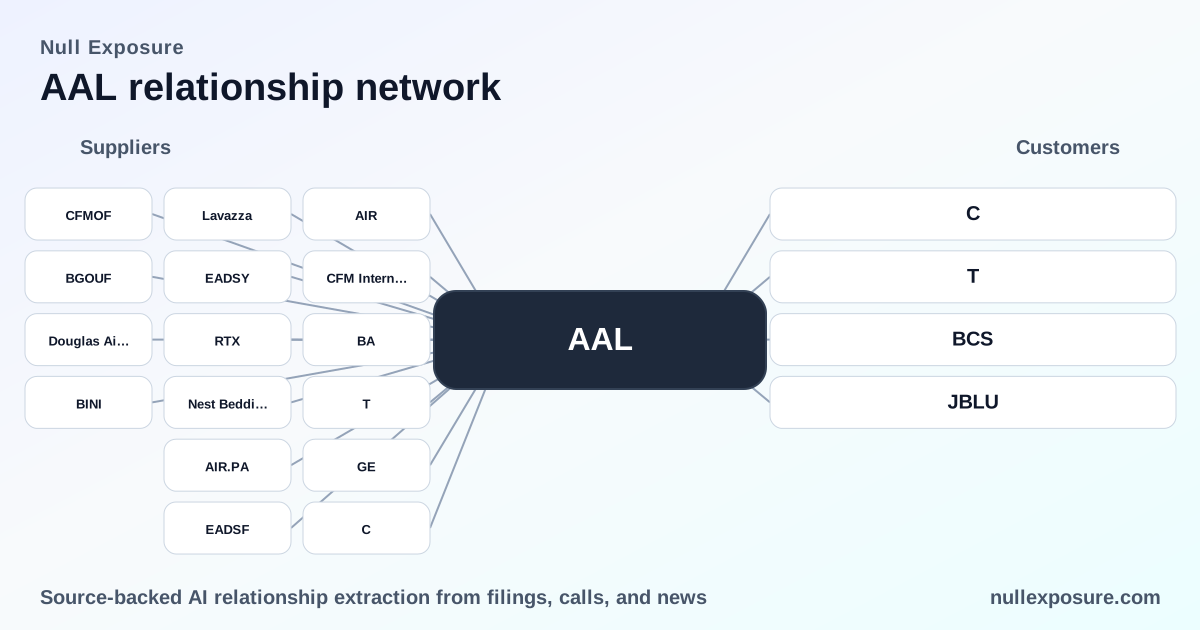
American Airlines (AAL): Customer Relationships that Drive Cash Flow and Risk
American Airlines operates a global network carrier that monetizes travel and loyalty in two distinct ways: ticket and ancillary sales for scheduled passenger transport, and the sale of AAdvantage miles to financial partners, which produces high-margin, recurring cash flow through co-branded credit card agreements. For investors and operators, the AAdvantage bank relationships and a handful of commercial sponsors are the primary levers that transform airline seat capacity into predictable liquidity. For deeper relationship-level signals, visit https://nullexposure.com/.
The short thesis: how American turns seats into steady cash
American sells transportation (short-term, usage-linked contracts) to individual passengers and converts loyalty economics into large, high-margin cash inflows by selling miles to banks and corporate partners. The co-branded card economics — concentrated with a small number of banks — is a material earnings driver and a strategic asset that underpins liquidity and margin resilience.
How American’s operating model shapes counterparty exposure
American’s business model embodies a mixed contracting posture: ticket revenue is short-term and usage-based, recognized as travel is provided and often deferred for trips sold in advance; loyalty economics are multi-year, contract-based partnerships with banks and sponsors. Company-level signals from filings and disclosures indicate:
- Contracting posture: Passenger tickets are generally one-year contracts, and mileage accrual is usage-linked to spend and flown segments (company disclosures).
- Customer concentration and criticality: Loyalty partnerships are concentrated and high-impact — selling miles to banks generates billions and supports margins independent of seat yields.
- Counterparty mix: Primary customers include millions of individual passengers (scale) and a smaller set of corporate/financial partners that buy miles (concentration).
- Geographic footprint and sensitivity: Revenue remains North America‑heavy but with meaningful exposures to Latin America, Pacific/APAC and Atlantic/EMEA routes (2024 revenue breakdown).
- Relationship maturity and role: Passenger contracts are short/mature; loyalty contracts (co-branded cards) are longer-term and strategic, while sponsors and service providers can be active commercial partners.
These signals explain why airline unit economics and liquidity assessments must treat passenger revenue and loyalty program cash flows differently.
Relationship rundown — every partner flagged in the collected results
Citi / Citigroup (C)
American has an exclusive ten‑year co‑branded credit card agreement with Citi that went into effect January 1, and Citi purchases AAdvantage miles as part of that arrangement, producing multi‑billion dollar cash flows for American. According to American’s Q4 2025 earnings call and subsequent coverage, Citi is positioned to generate $10 billion‑plus annually for American over the coming years through card economics and mile purchases (earnings call; Finterra and Fortune reporting, Jan–Mar 2026).
Sources: American Q4 2025 earnings call (2025 Q4) and Finterra / Fortune coverage (Jan–Mar 2026).
Barclays (BCS)
Barclays was a prior co‑branding partner that provided in‑flight and airport acquisition channels that American transitioned to Citi in Q4, and Barclays remains referenced as a key buyer historically; American manages the conversion of customers from Barclays channels into the Citi program. The transition was described on the Q4 2025 earnings call and in analyst write‑ups as a deliberate operational shift toward Citi for card acquisitions (earnings call; Finterra, Jan 2026).
Sources: American Q4 2025 earnings call (2025 Q4) and Finterra deep dives (Jan 2026).
AT&T (T)
AT&T sponsors complimentary high‑speed satellite Wi‑Fi for AAdvantage members across narrow‑body fleets, regional jets, and new Boeing 787‑9s, reinforcing connectivity as a customer benefit and brand partner rather than a revenue‑scale buyer. This commercial sponsorship was disclosed during the Q4 2025 earnings commentary (earnings call, 2025 Q4).
Source: American Q4 2025 earnings call (2025 Q4).
Blade (BLDE)
Blade partners with American on premium traveler services in markets like Los Angeles, enabling escorted transfers between helicopter services and American flights under a branded service arrangement; the linkage positions Blade as a hospitality/last‑mile partner rather than a scale revenue buyer (Vertical Magazine / press release; FY2019 reference).
Source: Blade / Vertical Magazine press release (FY2019).
Peabody Energy (BTU)
Peabody (BTU) appears in the results as part of unrelated industry news items that surfaced alongside other references; these items concern Peabody’s terminated acquisition of Anglo American coal assets and are not a customer relationship for American Airlines. Treat Peabody mentions as extraneous context in the collected feed rather than a direct AAL commercial partner (Investing.com, Bloomberg, IEEFA, FY2025 reporting).
Sources: Investing.com / Bloomberg / IEEFA reporting on Peabody (FY2025).
JetBlue (JBLU)
JetBlue shows up in coverage as a peer and potential partner comparison, cited in commentary about previously pursued cooperative arrangements that were halted by regulators; JetBlue is referenced when discussing American’s partnership strategy and alliance expansion rather than as a buyer of miles (Fortune, Trader’s Union, FY2026 notes).
Sources: Fortune coverage and TradersUnion reporting (FY2026).
What investors should extract from these relationships
- Loyalty partnerships are central to cash generation. The Citi co‑brand is a strategic, multi‑year revenue stream that materially alters cash flow volatility compared with ticket sales.
- Concentration risk is real but manageable. A small set of banks (Citi, historically Barclays) buys the bulk of AAdvantage miles; this concentration creates single‑counterparty sensitivity but also gives American bargaining power over program economics.
- Contracts are heterogeneous. Passenger contracts are short‑term and usage‑based, while card arrangements are longer and strategic, producing different risk and valuation profiles.
- Sponsor relationships support customer experience, not necessarily core cash. Deals like AT&T’s Wi‑Fi sponsorship enhance product differentiation but do not replace mile‑sale economics.
- Noise in newsfeeds requires filtering. Not every entity that surfaces (for example, Peabody) is a customer; investors should isolate direct commercial counterparties from unrelated industry items.
For a structured view of relationship-level exposures and to track contract transitions (for example, Barclays → Citi conversion dynamics), see more at https://nullexposure.com/.
Final takeaways
- AAdvantage mile sales to banks are the single most consequential customer relationship for American’s free cash flow profile.
- Citi’s ten‑year co‑brand represents a structural revenue shift away from passenger yield‑only reliance and into predictable, high‑margin partnership cash.
- Operational risk remains tied to short‑term ticketing cycles and geographic exposure, but loyalty partnerships materially de‑risk near‑term liquidity.
Bold, observable relationship changes—card conversions, sponsorship rollouts, or regulatory shifts affecting airline partnerships—will move the valuation needle faster than routine traffic trends.