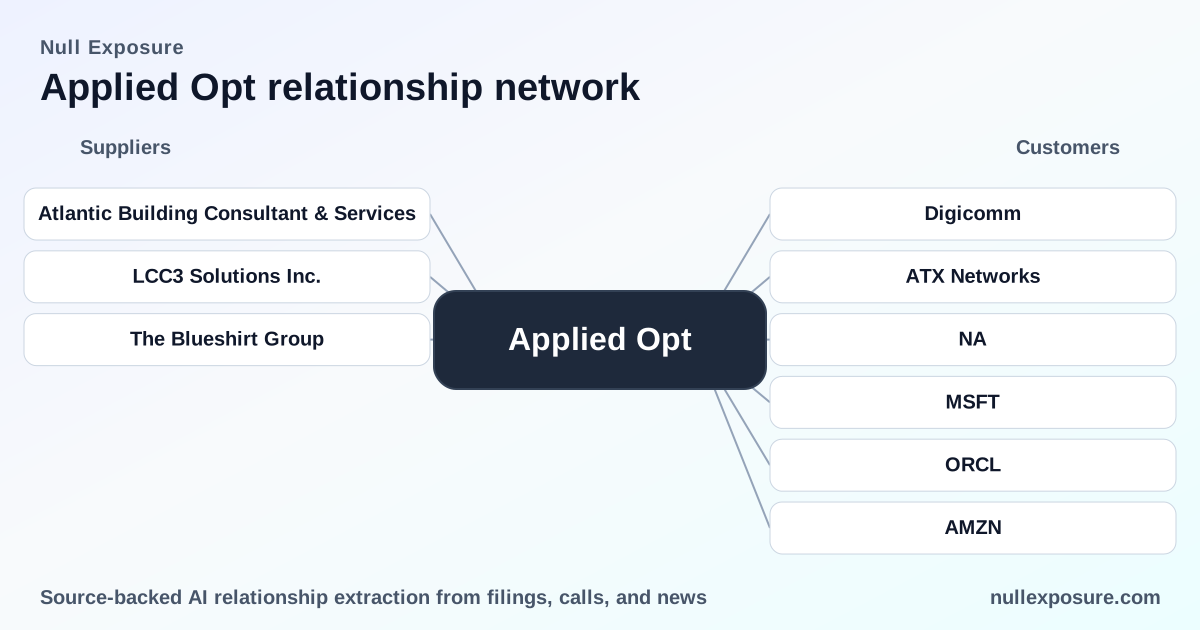
Applied Optoelectronics (AAOI): who pays the bills and how that shapes risk
Applied Optoelectronics designs and manufactures fiber‑optic components and transceivers and monetizes by selling hardware to OEMs, CATV operators and hyperscale internet data centers on a purchase‑order basis. Revenue is concentrated in a handful of large customers that buy point‑in‑time shipments rather than long‑term contracted volumes, creating both upside from large orders and downside from customer concentration. For access to the primary filings and signals cited here, visit https://nullexposure.com/.
The investor thesis in one paragraph
AAOI is a specialized hardware supplier whose revenue profile is driven by cyclical, high‑value transceiver orders from hyperscalers and a small number of CATV and OEM customers. When large cloud or internet customers place multi‑hundred‑million dollar orders AAOI scales rapidly; absent those orders revenue falls back quickly, because the company sells mostly by short‑term purchase orders and does not rely on long multi‑year purchase commitments.
What the filings and market stories collectively tell us
AAOI’s 10‑K disclosures and recent market coverage paint a consistent operating model: short‑term, PO‑driven sales to very large customers concentrated in the internet data center market, with significant geographic manufacturing exposure in Asia. News coverage in 2026 highlights large orders (reports of a ~$200M transceiver order) and the centrality of Microsoft and Digicomm to recent revenue flows.
- According to AAOI’s FY2025 10‑K, the company sells largely on purchase orders without long‑term commitments, with many customers in large internet‑scale operators and OEM channels.
- Market reporting in 2026 links these dynamics to near‑term upside from AI‑driven 400G/800G demand and calls out customer concentration as the principal revenue risk.
Constraints that shape the business model
These signals from the company filings explain AAOI’s operating posture and commercial constraints:
- Contracting posture — short‑term/spot sales. AAOI states it does not have long‑term purchase commitments in excess of one year and generally sells by short‑term purchase orders, with recognition at shipment, which limits revenue visibility but allows rapid scaling when demand arrives (AAOI 10‑K FY2024–FY2025).
- Concentration — revenue is highly concentrated. AAOI reports its top five and top ten customers represented the vast majority of revenue in recent years, a structural feature that makes large orders transformational and losses material (10‑K FY2024).
- Counterparty profile — large and hyperscale buyers. Filings identify customers as hyperscale internet data center operators and major OEMs, a buyer mix that both drives large order sizes and increases negotiating leverage for customers (AAOI 10‑K).
- Geographic footprint — manufacturing and sales in APAC and global markets. The company discloses sales and manufacturing exposure in the U.S., Taiwan and China, which concentrates production and revenue recognition in APAC (10‑K FY2024).
- Materiality and criticality — customers are revenue‑critical. Top ten and top five customer statistics show customer relationships are material to AAOI’s results; large customers account for the majority of revenue (10‑K FY2024).
- Product and segment maturity — hardware and manufacturing. AAOI derives revenue from manufacturing fiber‑optic networking products and modules, positioning the business in capital‑intensive, hardware‑driven segments where product cycles and customer adoption determine growth (10‑K).
- Relationship roles — supplier to OEMs, distributors and resellers used selectively. The company uses a direct sales force for key accounts and distributors to expand reach, and describes customers who incorporate, use, or resell AAOI products (10‑K).
For more structured access to the underlying documents and news signals used in this review, visit https://nullexposure.com/.
Relationship inventory — what every mentioned customer or counterparty is doing for AAOI
Below is a plain‑English summary for every relationship entry present in the pulled results, each with a direct source reference.
- NA — AAOI’s FY2025 10‑K records customer breakdown language that references named customers and percentages, indicating the filing includes grouped disclosures that were parsed into an unnamed record; the same 10‑K details Digicomm and ATX Networks revenue shares (AAOI 10‑K FY2025).
- Digicomm — Digicomm was AAOI’s key CATV customer and accounted for 53.1% of revenue in 2025 after rising from 34.1% in 2024 and 11.3% in 2023, underscoring a recent dramatic concentration shift (AAOI 10‑K FY2025 and FY2024).
- ATX Networks — ATX Networks accounted for 15.6% of revenue in 2023 per AAOI’s disclosures; historical contributions from ATX have been material in certain years even as mix shifted later (AAOI 10‑K FY2025 and FY2024).
- Microsoft — Microsoft is identified as a key internet data center customer; AAOI reports Microsoft accounted for 28.8% of revenue in 2025 after larger shares in prior years, and market reports tie Microsoft to multi‑year supply agreements and significant transceiver orders (AAOI 10‑K FY2025; FinancialContent reporting April 2026).
- ORCL — Oracle is listed in AAOI’s filings as a meaningful IDC customer, with 12.4% of revenue in 2024, and has been mentioned in market reports as a likely participant in large 2026 orders (AAOI 10‑K FY2024; StockstoTrade/Finterra coverage 2026).
- MSFT — The MSFT‑labeled entry duplicates the Microsoft relationship in the filings and shows the same FY2025 revenue attribution to Microsoft in AAOI’s 10‑K (AAOI 10‑K FY2025).
- Oracle — The Oracle entry mirrors ORCL: Oracle accounted for 12.4% of AAOI revenue in 2024, and press coverage identifies Oracle as a potential buyer in the reported ~$200M order (AAOI 10‑K FY2024; StockstoTrade April 2026).
- AMZN — Market coverage cites Amazon as a historic and potential customer for high‑bandwidth transceivers, with reporting that Amazon drove earlier 40G/100G demand and is referenced in 2026 stories about growth opportunities in 400G and 800G products (StockstoTrade and FinancialContent, March–April 2026).
- Amazon — Same as AMZN: Amazon is repeatedly noted in market narratives as an early driver of transceiver demand and a cited beneficiary of AAOI’s product roadmap (FinancialContent and StockstoTrade coverage 2026).
- NVIDIA — News outlets referenced NVIDIA in the context of AI data center demand lifting AAOI’s market relevance; headline coverage highlighted AAOI stock moves tied to AI‑data‑center interest (247WallSt April 2026).
- NVDA — The NVDA entry duplicates the NVIDIA references in market commentary noting AI demand for lasers and transceivers supports AAOI's commercial opportunity (247WallSt and other 2026 articles).
- FB — TradingView commentary included FB as a named party in investor discussion about customer losses or retention, signaling market sensitivity to whether AAOI retains past large buyers (TradingView March–May 2026).
- META — The META entry mirrors FB: forum and idea posts have raised questions about the status of Facebook/Meta as a customer, reflecting investor concern over customer churn and revenue sustainability (TradingView May 2026).
Bottom line for portfolio and operations teams
AAOI is a high‑bet, high‑concentration supplier: when hyperscalers place large orders the company can grow rapidly, but the lack of long‑term purchase commitments and the very high share of revenue tied to a few customers creates sharp revenue volatility and counterparty risk. Operational diligence should prioritize order pipeline verification, customer contract scope (PO vs. supply agreement), and geographic manufacturing exposures noted in filings.
For a deeper dive into AAOI’s filings and the signal set used here, explore primary sources and curated analyses at https://nullexposure.com/.