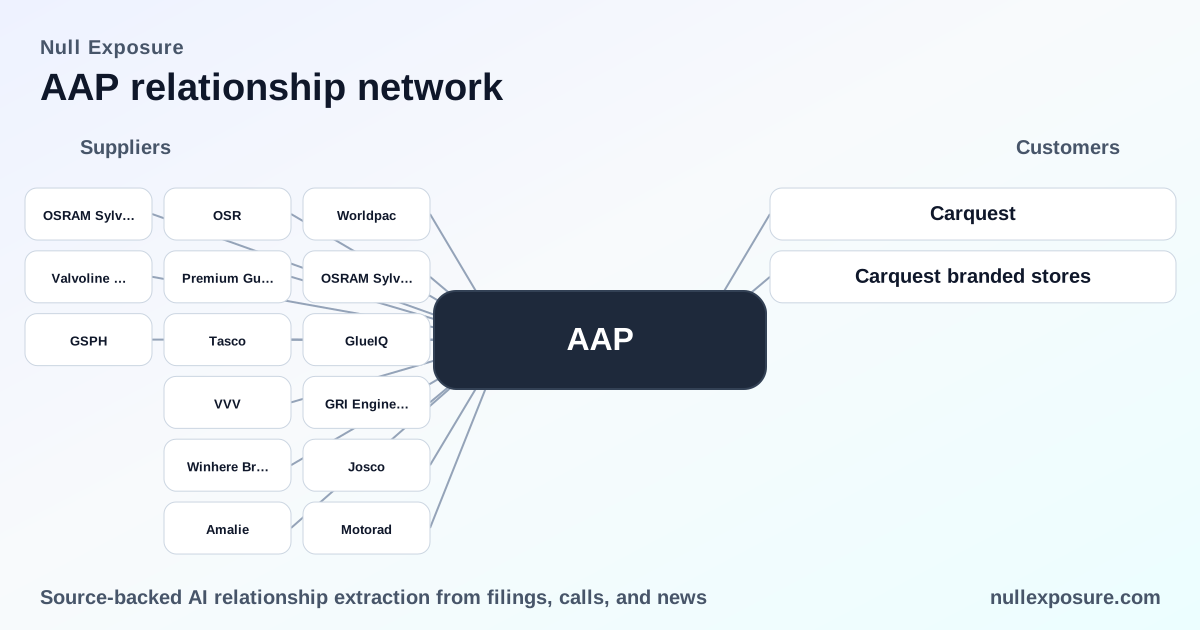
Advance Auto Parts (AAP) — How Carquest fits into the revenue engine
Advance Auto Parts operates and monetizes as a retail and wholesale supplier of automotive replacement parts, batteries and consumables across a network of company-owned stores and independently owned dealers. The firm sells directly to walk-in DIY customers and to professional installers and independent operators, recognizing revenue at point of sale or same‑day delivery, with payment terms generally in the one‑to‑thirty‑day range; professional channels account for roughly half of company sales, making channel partnerships strategically important. For deeper coverage of customer relationships and sourcing signals, see https://nullexposure.com/.
Why the Carquest channel matters to investors
Advance’s relationship with Carquest is less a single counterparty risk and more an extension of its multi‑channel distribution strategy. Advance supplies inventory and fulfillment services to independently owned Carquest‑branded stores, supports branded product rollouts across both Advance and Carquest locations, and leverages marketing partnerships to maintain brand awareness. That combination preserves revenue scale (professional sales ~50% of sales) while diluting concentration risk—no single customer accounted for 10% or more of consolidated net revenues in the company filings cited —even as the company remains heavily North America‑centric.
- Short payment terms and immediate revenue recognition (one to thirty days; point‑of‑sale or same‑day delivery) reduce working capital exposure to customers and accelerate cash conversion.
- Channel mix is material: professional and independent operators collectively drive about half of revenue, making distributor and reseller relationships strategically significant for margins and inventory turns.
- Geographic concentration in North America concentrates macro risk but simplifies logistics and SKU assortments.
If you want a consolidated view of customer relationships and sourcing signals for AAP, visit https://nullexposure.com/ for our research feed.
Customer relationship inventory: the public record summarized
Carquest — Advance supplies and supports independently owned Carquest stores
Advance Auto Parts supplies and supports a network of independently owned Carquest‑branded stores across North America, Mexico and Caribbean markets; press coverage in FY2026 reported the company served roughly 809–814 independently owned Carquest stores in the year, and noted that Advance also operates 4,305 company stores across the U.S., Canada and territories. According to a Globe and Mail press release dated May 2, 2026, Advance supplied 809 Carquest stores as of January 3, 2026, and media outlets in March–May 2026 repeated similar store counts and geographic reach. (Source: Globe and Mail press release, May 2, 2026; corroborating coverage in TradingView and Baystreet, March–May 2026.)
Carquest‑branded stores (ARGOS rollout and exclusivity)
Advance announced product strategy decisions that affect Carquest locations directly: media reports in FY2026 state that the owned brand ARGOS will be sold exclusively at all Advance and Carquest U.S. stores and online, indicating Advance uses the Carquest channel for proprietary brand distribution and cross‑store merchandising. (Source: StockTitan press release summary, March 2026.)
What the constraints tell an investor about operating posture
The public constraints extracted from filings and coverage form a cohesive picture of how Advance structures customer relationships and the operational implications for investors.
-
Contracting posture — short‑term, transactional: Revenue recognition language and payment‑term excerpts describe sales as point-of-sale or same‑day delivery with payment terms generally ranging one to thirty days, indicating short‑term commercial relationships with limited receivable duration. That reduces extended counterparty credit exposure relative to long‑dated contracts.
-
Counterparty mix — individual operators and professionals: Filings classify customers as professional installers, DIY consumers and independently owned operators; this mix creates diversified demand drivers but requires servicing multiple buyer constituencies (trade credit for professionals, walk‑in retail volume for DIY).
-
Geographic concentration — North America focus: Repeated references to the U.S., Canada, Puerto Rico, U.S. Virgin Islands, Mexico and Caribbean islands show a regional footprint centered on North America, which simplifies supply chain design but concentrates economic and regulatory exposure regionally.
-
Materiality signals — channel significance but low counterparty concentration: Professional sales represented about 50% of sales (2022–2024), making the B2B channel material to results; at the same time, filings note no single customer accounted for 10% of consolidated net revenues, which materially reduces large‑counterparty risk.
-
Relationship roles — seller, distributor/reseller, service provider: Filings explicitly state Advance ships directly to independently owned Carquest stores from distribution centers, supporting a distributor/reseller relationship for those outlets; the company also performs in‑store services such as battery installation and diagnostics, which function as customer retention tools enhancing foot traffic and cross‑sell.
-
Relationship stage and product focus — active and core: The relationship stage is listed as active and tied to Advance’s core product groups (parts and batteries comprise the majority of product sales). This underscores steady recurring revenue from replacement parts rather than project‑based or seasonal contracts.
Collectively, these constraints signal a mature, high‑volume retail/distribution model: short contractual durations, diversified but material professional channels, and logistics‑driven reseller relationships geared toward scale rather than bespoke long‑term contracts.
What investors should watch next
- Store counts and branded distribution: FY2026 press reports show variation in the count of Carquest stores (reports of 809, 814 and historical figures such as 934), so track Advance’s formal disclosures for consistent store counts and the role of proprietary brands like ARGOS in margin expansion. (Source: Baystreet, StockTitan, Globe and Mail, March–May 2026.)
- Channel profitability: Given professional sales represent half of revenue, margin trends in the B2B channel and the performance of owned brands will drive operating leverage.
- Receivables and trade credit: Short payment terms limit credit exposure, but monitoring days‑sales‑outstanding in professional channels will be important as Advance extends trade credit to independently owned dealers.
Bottom line
Advance Auto Parts leverages the Carquest network as a scalable reseller and distribution channel that supports product rollouts and sustains a material professional sales base while avoiding concentrated single‑customer risk. The company’s operating model—short‑term transactional contracts, North American footprint and active reseller/distributor relationships—favors cash conversion and inventory turnover, but keeps exposure tied to regional auto aftermarket demand and execution on owned‑brand strategies. For a centralized view of customer relationships and ongoing signal updates for AAP, visit https://nullexposure.com/.