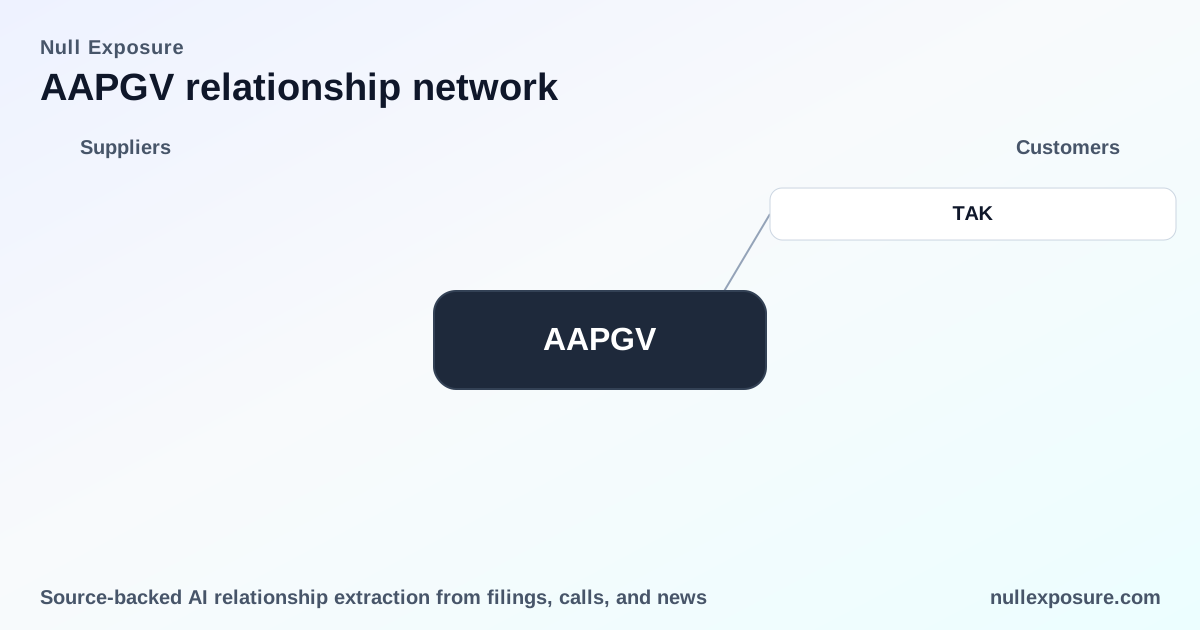
AAPGV customer relationships: what the market signals about partner economics and execution
AAPGV’s documented customer footprint in public reporting centers on large strategic licensing and option agreements that convert near-term optionality into upfront cash and backloaded milestone economics. Revenue recognition for these customer relationships will be driven by upfront payments, milestone schedules and the commercialization success of partnered assets; investors should therefore value AAPGV on the basis of counterparty credit, milestone probability ladders and the timing of recognition rather than recurring subscription-like revenue.
Explore a concise snapshot of the partnership evidence and implications at https://nullexposure.com/.
What the reported customer links actually show
Two discrete records in the customer scope identify the same strategic counterparty under slightly different name forms—TAK and Takeda—documented in third‑party reporting about a large option/licensing deal. Both records reference the same event: a significant upfront payment and a potential multibillion-dollar milestone stream tied to a clinical-stage asset. These entries signal a partnership-model revenue base: large, lumpy cash inflections followed by contingent, high-upside milestone receipts.
TAK (in the feed as "TAK")
TAK is listed as a customer relationship in the feed; The Pharma Letter reported that Takeda paid $100 million upfront and committed up to $1.2 billion in milestones under an option agreement related to Ascentage’s lead program, olverembatinib (The Pharma Letter, March 9, 2026). This transaction structure—upfront cash plus long-tail milestones—is the commercial template reflected in the customer record.
Source: The Pharma Letter article on Ascentage’s US offering and the Takeda option agreement (March 9, 2026) — https://www.thepharmaletter.com/ascentage-pharma-sets-terms-for-149-million-dollar-us-ipo
Takeda (same counterparty, alternate name)
The alternate-name record shows the identical disclosure: Takeda executed an option agreement with a $100 million upfront payment and up to $1.2 billion in milestones tied to Ascentage’s lead asset (The Pharma Letter, March 9, 2026). The duplicate entry reinforces that the relationship is strategic, counterparty-led and milestone‑dependent rather than a high-volume, low-value customer relationship.
Source: The Pharma Letter coverage of the option agreement and IPO context (March 9, 2026) — https://www.thepharmaletter.com/ascentage-pharma-sets-terms-for-149-million-dollar-us-ipo
What these relationships imply about AAPGV’s operating and business model
With constraints data empty in the extraction, there are no contract-level red flags captured here; that absence is itself an informative company-level signal. From the relationship evidence we can extract operational characteristics that shape investor due diligence:
- Contracting posture: The commercial approach is strategic partnership and licensing, not transaction volume. Agreements are structured as option/licensing deals with material upfront payments and contingent milestone compensation.
- Concentration: The customer set documented here is concentrated in a small number of high-value partners; a single deal can materially move cash flows in a period.
- Criticality: Counterparty validation (global pharma firms) drives both financing and development timelines; partner decisions determine milestone realization and commercialization pathways.
- Maturity: Revenue patterns are typical of biopharma partnering—near-term inflections from upfront payments and longer-term, binary payoff potential contingent on clinical and regulatory events.
- Company-level signal on constraints: No constraint clauses or limitations were extracted for AAPGV in this view, which suggests either limited public disclosure on contractual constraints or that constraints are not captured in the current feed; investors should therefore treat contractual visibility as incomplete until further filings or filings-level review.
Collectively, these characteristics create a highly asymmetric cash flow profile: meaningful initial liquidity followed by volatile milestone risk.
How to read counterparty risk and revenue visibility
For investors evaluating AAPGV, the correct valuation approach weights a few key variables more heavily than headline revenue multiples:
- Upfront cash certainty: Upfront payments are the most reliable short-term contributor to free cash flow. The reported $100 million upfront payment in the cited Takeda option demonstrates cash realization separate from milestone outcomes.
- Milestone probability and timing: The $1.2 billion figure is a ceiling, not guaranteed revenue; model with conservative achievement curves and discount extended payout horizons heavily.
- Counterparty credit and strategic alignment: Large pharma partners reduce commercialization execution risk but bring decision points that can delay or terminate milestone paths.
- Concentration risk: Heavy reliance on single or few partners increases sensitivity to individual negotiation outcomes and corporate priorities.
Investors should therefore allocate milestone upside as probabilistic contingent assets and treat upfront receipts as the primary near-term valuation lever.
Risks that demand active monitoring
- Event risk: Clinical or regulatory setbacks to the partnered asset can collapse milestone streams rapidly.
- Counterparty reprioritization: Strategic shifts at a partner—portfolio reprioritization or M&A—can alter payment timing or terminate optionality.
- Disclosure gaps: The feed shows no extracted constraints; absence of contract-level disclosures elevates the premium on primary-source filings and direct company statements for contract terms and recognition policy.
Bottom line and recommended next steps
AAPGV’s customer records in this collection point to strategic, high-value licensing relationships that produce upfront cash and contingent, back-loaded upside. The model is attractive for episodic liquidity events but produces earnings volatility tied to partner execution and clinical outcomes.
For focused due diligence:
- Review primary filings and partner contracts for explicit milestone schedules, termination rights and revenue recognition triggers.
- Stress-test valuation models on milestone achievement rates and extended payment timing.
- Monitor partner corporate announcements and regulatory timelines to reprice contingent value in real time.
For a broader view of how these partnership patterns affect portfolio construction and credit exposure, see the company overview at https://nullexposure.com/.
If you want a tailored briefing that maps these partner cash flows into scenario-based valuation lanes, reach out through the homepage and we will prepare a focused memo.