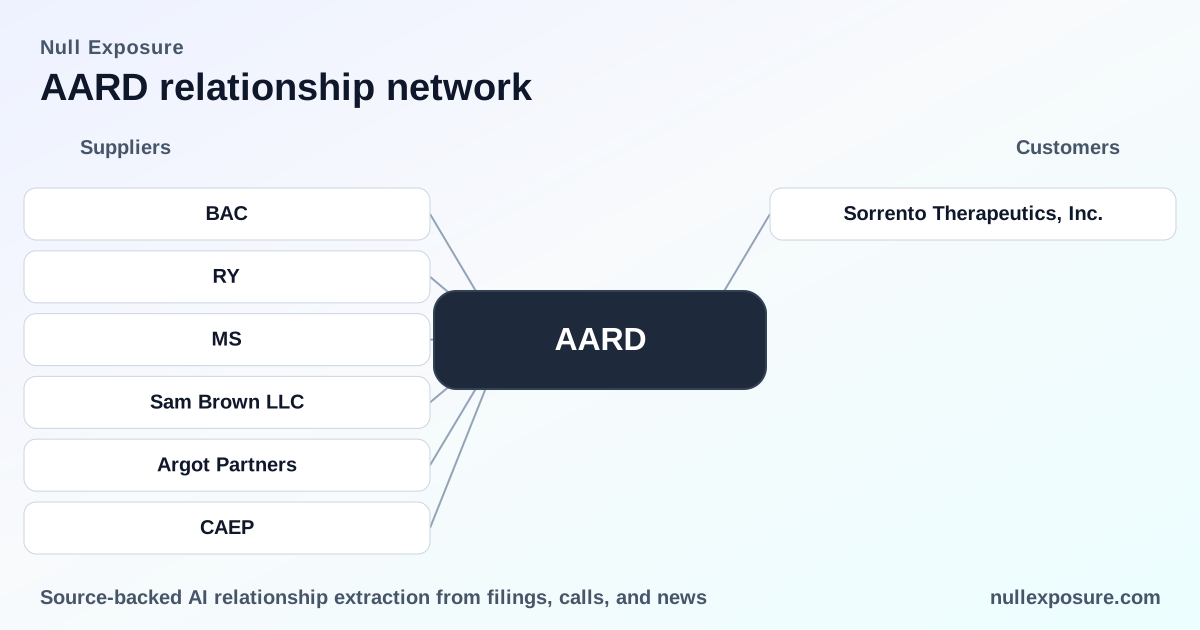
AARD customer map: what investors need to know about counterparties, cash flow and contractual posture
AARD operates as a hybrid specialty-services and biopharma IP originator: the company generates revenue both by monetizing intellectual property through licensing and sale, and by acting as a services provider for operational contracts (notably transition services and parts/overhaul arrangements). Monetization has three visible channels in the public record — upfront consideration and milestone/royalty economics from IP transfers, fee income and invoicing under transition services, and vendor-style fixed-rate parts and overhaul contracts with commercial customers. These channels create a mixed revenue and counterparty profile that is important for forecasting cash receipts, credit exposure, and contract durability. For full relationship tracing and original filings, see Null Exposure.
Executive takeaway: concentrated, mixed-cashflow model with service and licensing legs
AARD’s public disclosures show a concentration of material counterparties and materially different contract types: licensing deals that produce upfront and contingent receipts alongside service relationships that produce recurring invoicing but carry collection risk. Key implications for investors:
- Licensing transactions deliver milestone upside and long-tail royalties but are lumpy and dependent on the licensee’s development progress and commercial execution.
- Service and transition agreements deliver short- to medium-term fee flows but create operational credit exposure — AARD has recorded unreimbursed costs and write-offs against these arrangements.
- Contract maturity is mixed: the company has entered long-term financings and notes on one hand, and time-limited transition services that have terminated on the other, shifting cost and revenue recognition dynamics.
If you want the public-record documents that underpin this analysis, visit Null Exposure.
Relationship inventory: the counterparties on file
Below are the two counterparties explicitly cited in the company’s customer-scope results, with concise, source-linked summaries.
Sorrento Therapeutics, Inc.
AARD sold patent rights to Sorrento in April 2021 for 616,655 shares of Sorrento common stock valued at roughly $4.7 million on the transaction date, and retained contingent economics — up to $23.0 million in development/commercial milestones plus low single-digit royalties on net sales. This is a classic IP licensing/sale structure that provided near-term equity value and preserves upside through milestones and royalties. According to AARD’s FY2024 10‑K filing, these terms remain a material part of the company’s monetization strategy (FY2024 10‑K, AARD).
RJET
RJET’s FY2024 disclosures list AAR among a set of third‑party vendors used for heavy airframe and engine maintenance, fixed‑rate parts procurement and component overhaul services for RJET’s fleet. RJET specifically cites reliance on AAR and Aviall for fixed‑rate parts procurement and overhaul services, indicating an ongoing vendor relationship where AARD provides maintenance and parts services under fixed-rate terms (RJET FY2024 10‑K, filed Sep 30, 2024).
What the constraints tell us about AARD’s operating model
Public constraint signals extracted from filings and excerpts paint a composite picture of AARD’s contracting posture, concentration and maturity.
- Contracting posture: mixed long-term and transactional. Evidence shows a long-term financing instrument (a seven‑year convertible promissory note with 5.0% interest) and time-limited transition services agreements. This indicates AARD can enter both long-dated financial commitments and short-term operational contracts that align with spin-off and integration activity.
- Commercial mix: licensing and services co-exist. The company-level signal for licensing is explicit in the Sorrento transaction (upfront equity plus milestones and royalties). Separately, the company has provided transition services and vendor-style maintenance services, demonstrating a dual revenue architecture.
- Concentration and spend scale: material but bimodal. Spend‑band signals range from $1M–$10M (e.g., invoiced transition-service amounts of ~$1.4M and a $1.0M promissory note) to $10M–$100M (e.g., $85M in Series C financing and IPO participation amounts cited in filings). This suggests AARD sits in engagements that are financially meaningful to both its balance sheet and counterparties.
- Maturity and lifecycle: terminated legacy services and active development. Transition services that supported a spin‑off have terminated (May 31, 2024), removing a prior source of fee revenue and reimbursement, while the company’s lead product candidate (ARD‑101) has advanced to Phase 3, representing longer-term potential revenue tied to licensing or commercialization.
- Operational criticality and collection risk. The company recorded unreimbursed costs of ~$1.4M that were written off as of Dec 31, 2024, which underscores counterparty credit risk within its service relationships and the possibility of volatile cash collection timing.
How these dynamics affect valuation and risk assessment
- Earnings predictability is limited. Licensing provides high upside but irregular timing; services create recurring but potentially non‑recurring flows that are sensitive to contract termination and receivables credit risk.
- Counterparty risk is material and visible. The write-off of $1.4M of invoiced transition‑service receivables is a concrete example of exposure that depresses near-term cash flow and increases working‑capital volatility.
- Concentration in a few counterparties increases idiosyncratic risk. With large financing events and a small set of documented commercial relationships, any single counterparty event (e.g., delayed milestone payments, termination of service contracts) will have outsized effects.
- Upside remains tied to clinical and commercialization milestones. The Sorrento deal preserves up to $23.0M in milestones and ongoing low-single-digit royalties, anchoring future optionality to development and market outcomes beyond AARD’s direct control.
Practical read for operators and investors
- For credit-sensitive investors, monitor receivable aging and any future write-offs tied to service contracts; the record already shows a material uncollectible amount.
- For equity investors, progress on licensee development and the realization of milestone payments is the primary value driver from the IP side.
- For strategic acquirers or partners, the coexistence of contractual services capability and owned/transferable IP creates optionality: AARD can be evaluated both as a services vendor and an IP owner with monetizable biotech assets.
Closing: the immediate checklist for due diligence
- Verify milestone timelines and the status of Sorrento’s development programs that trigger the $23.0M potential payments (AARD FY2024 10‑K).
- Review the termination terms and any residual obligations from the May 31, 2024 Transition Services Agreement that could produce catch-up invoicing or liabilities.
- Assess counterparty credit profiles for major service customers and reconcile receivable provisions to cash collections.
For deeper document-level tracing and continuous monitoring of these counterparty relationships, visit Null Exposure to see the primary filings and relationship timelines referenced in this note.
Bold takeaway: AARD runs a hybrid monetization model — licensing offers upside through milestones and royalties (Sorrento), while services deliver near-term fees but expose the company to collection and concentration risk (notably in transition services and vendor contracts with commercial customers such as RJET).