Allied Gold (AAUC) — Buyer landscape and what the Zijin transaction means for investors
Allied Gold operates as a gold producer and developer that monetizes through mine-level cash flows and strategic asset sales; its current commercial orientation is dominated by a single-transaction outcome — the agreed all-cash sale to Zijin — which converts operating economics into a definitive liquidity event for shareholders. This piece reviews every customer/partner mention in the captured coverage, explains how the deal reshapes Allied’s contracting posture and concentration profile, and presents the practical implications for investors and operators.
If you want a consolidated view of counterparties and document-level references for M&A-driven credits and exposures, visit https://nullexposure.com/ for direct access and deeper cross-reference tools.
Market context: the takeover is the dominant driver Zijin’s acquisition offer for Allied Gold at C$44 per share valued Allied at roughly C$5.5–5.7 billion Canadian dollars and is the primary commercial relationship surfaced across press coverage in early 2026. That transaction transforms Allied from a stand-alone mid‑tier producer into a target whose near-term valuation and counterparty risk are defined by a single strategic buyer.
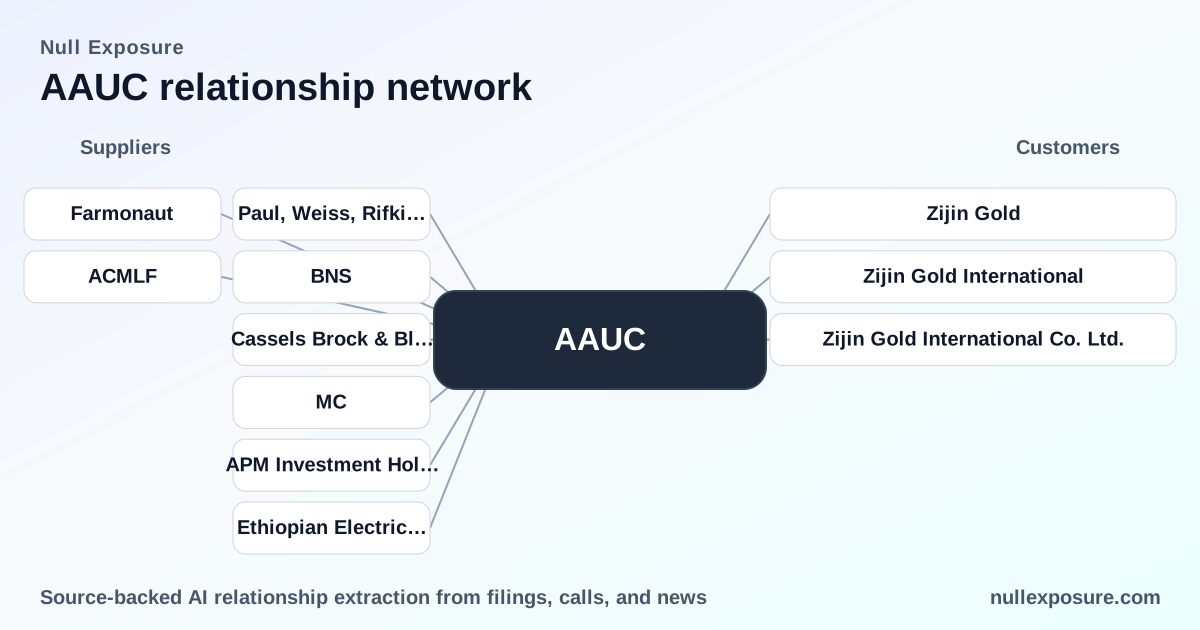
How the sources line up and what they say The universe of captured relationships is concentrated exclusively on Zijin in its various name permutations. Below I cover every name variant present in the results and give the concise, verifiable takeaways investors and operators need.
Zijin Gold International Company Limited
Zijin Gold International Company Limited has agreed to acquire all issued and outstanding common shares of Allied Gold for C$44.00 per share by way of a statutory plan of arrangement under Ontario law. Source: GlobeNewswire, Management Information Circular filing and press release (March 9, 2026) — https://www.globenewswire.com/news-release/2026/03/09/3252343/0/en/Allied-Gold-Announces-Filing-and-Mailing-of-Management-Information-Circular-in-Connection-with-the-Proposed-Arrangement-with-Zijin-Gold-International.html
Zijin Mining
Zijin Mining (ticker referenced as ZIJMF in some feeds) is the corporate parent implicated in the financing and strategic rationale for the acquisition; press coverage frames the deal as a roughly C$5.5 billion (US$4 billion) cash purchase that materially alters Allied’s shareholder-economic pathway. Source: Intellectia.ai summary reporting on shareholder approval and deal terms (FY2026) — https://intellectia.ai/news/stock/allied-gold-shareholders-approve-zijin-minings-c55b-buyout
Zijin Gold
Coverage from mainstream business outlets describes the transaction as a friendly, all-cash takeover by Hong Kong–listed Zijin Gold, emphasizing the immediacy of the liquidity event relative to Allied’s standalone production ramp. Source: BNN Bloomberg reporting on the acquisition announcement (January 26, 2026) — https://www.bnnbloomberg.ca/business/company-news/2026/01/26/allied-gold-says-cash-deal-with-chinese-buyer-outweighs-gold-rally/
Zijin Gold International
Regional and commodity press frame the transaction as a strategic bid — Zijin Gold International will pay CAD 44 per share, representing a premium to recent trading and positioning Ethiopia (Kurmuk) as a target of Chinese downstream investment in gold assets. Source: The Reporter (Ethiopia) coverage on the Kurmuk project implications (March 2026) — https://www.thereporterethiopia.com/48784/
Zijin Gold International Co. Ltd.
Industry construction and resource press also reported a friendly agreement valued at roughly C$5.5 billion, reinforcing that the counterparty is a strategic, cash-capable buyer executing a cross-border consolidation of gold assets. Source: ConstructConnect / JOC resource news (January–March 2026) — https://canada.constructconnect.com/joc/news/resource/2026/01/zijin-gold-signs-deal-to-buy-allied-gold-for-5-5-billion-in-cash
What these relationships collectively signal about Allied’s operating model
- Concentration: The commercial profile is now highly concentrated — a single acquirer dominates the counterparty map in the public record. That concentration compresses counterparty risk into a binary execution event (close vs. failed transaction), which supersedes ongoing mine-by-mine counterparties for near‑term valuation.
- Contracting posture: Allied’s contracting posture shifts from being an independent producer negotiating sales, offtake, and project funding, to being the target of a strategic buyer with the leverage to dictate timing and terms of exit; shareholder value realization is now governed by the terms of the arrangement.
- Criticality: For Allied’s shareholders and many operational stakeholders, the Zijin relationship is critical — it determines cash-out value and the allocation of future capital and operational stewardship of Kurmuk and other assets.
- Maturity and execution risk: Public filings and proxy recommendations (included in the GlobeNewswire package) indicate completion conditions and regulatory steps typical for statutory plans of arrangement; execution is a procedural risk but the volume of supportive coverage (including proxy advisor recommendations) is a positive signal for close.
Constraints and company-level signals There are no discrete operational constraints captured in the review set that attach to specific counterparty relationships; the available coverage focuses on the acquisition terms, proxy materials, and commentary on strategic rationale. Presently that generates two company-level signals:
- Deal-dominant exposure: Allied’s commercial risk and shareholder return profile are transaction-dependent until completion; operating cash flows are subordinate to the legal and regulatory steps required to effect the arrangement.
- Regulatory and geopolitical sensitivity: Cross-border M&A in the mining sector introduces regulatory review and geopolitically sensitive optics that could affect timing and conditions of close, a company-level operational constraint inherent to large international resource transactions.
Investment implications — concise and actionable
- Short-term: The C$44 cash bid sets a de‑facto valuation floor for shareholders; trading dynamics will be primarily arbitrage and deal-close sensitivity until regulatory clearance and shareholder votes are final. Catalyst risk is concentrated on deal execution.
- Medium-term: Operators and creditors should plan for a transition to new corporate stewardship under Zijin’s capital allocation and operational playbook; contract novations, management retention, and capital spend priorities will reset post-close.
- Risk factors: Regulatory approvals, any material adverse change disclosures, and geopolitical headlines related to cross-border Chinese investment in mining are the principal deal execution risks cited across coverage.
Middle‑article resource For a consolidated counterparty and document trace that supports diligence and exposure mapping, see https://nullexposure.com/ — the platform centralizes filings, press releases, and proxy materials relevant to deal-driven credits.
Bottom line The public record for AAUC in early 2026 is unambiguous: Zijin (in its corporate permutations) is the single dominant counterparty and the determinant of Allied Gold’s near-term value realization. Investors should treat Allied as a deal‑dependent instrument until the plan of arrangement completes, and operators should prioritize transition planning for asset stewardship under new ownership.
If you need a tailored counterparty dossier or structured exposure report for AAUC transaction counterparties and relevant filings, visit https://nullexposure.com/ to request a focused packet of documents and source links.