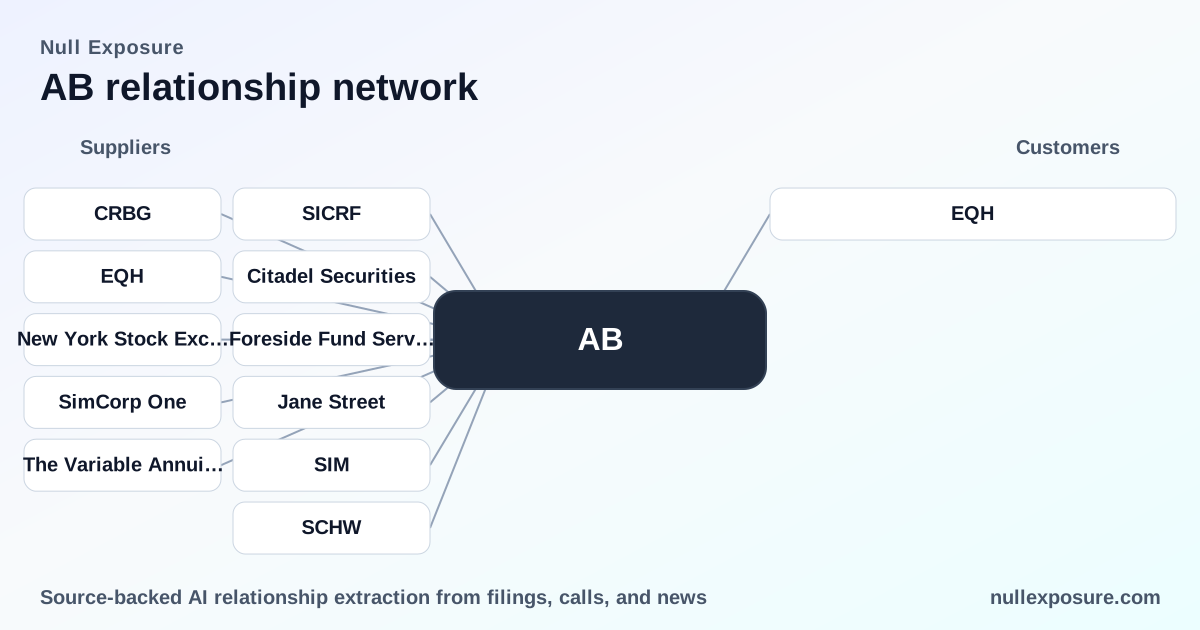
AllianceBernstein (AB): Customer Map and Commercial Implications
AllianceBernstein operates as an asset manager that earns fees tied to assets under management (AUM) across institutional, retail and private-wealth channels. The company monetizes through usage‑based investment management and advisory fees, supplemented by ancillary services (reporting, treasury, valuation) to large insurance and institutional clients; a meaningful portion of revenue is earned from affiliated insurer Equitable/ EQH. For investors, the customer set combines long-duration insurance flows and diversified public-sector and retail clients, creating scale benefits with concentrated counterparty exposure that directly influence fee sensitivity and revenue cyclicality.
For a concise company overview and platform materials, visit the Null Exposure homepage: https://nullexposure.com/.
How AB’s operating model shapes customer economics
AllianceBernstein’s client relationships reflect a short‑term, usage‑based contracting posture: investment mandates are generally terminable on short notice and fees move with AUM. That structure makes revenue highly correlated to market performance and client flows rather than fixed long-term contracts. AB’s client base is global and multi‑segmented—public pension plans, governments, non‑profits, high‑net‑worth individuals and insurance companies—so product mix and distribution are core drivers of margins.
- Contracting posture: Investment management agreements are typically terminable at will; AB recognizes variable consideration based on AUM and earns fees over time rather than under fixed, long-term contracts. (Company 10‑K, FY2025.)
- Concentration and criticality: Equitable Holdings (EQH) and its affiliates are a material, active client and represent a single concentrated revenue and AUM relationship that is both large and strategically important to the business. (Company 10‑K, FY2025.)
- Service model and maturity: AB functions primarily as a service provider—managing assets and delivering ancillary operational services to large institutional insurers—consistent with mature asset‑management operating models that emphasize scale and operational integration.
- Geography and counterparty mix: AB operates globally and serves governments, non‑profits, institutions and individuals, which diversifies market exposure but preserves concentration risk where large insurance relationships exist.
If you want a structured, research-ready view of AB’s customer relationships, see additional company materials at https://nullexposure.com/.
Relationship-by-relationship: the customer ledger investors must track
XCHG
AllianceBernstein is identified as the primary advisor to XCHG in contemporaneous market coverage. This indicates a fiduciary/advisory role for that listed vehicle. Source: TradingView coverage, March 2026.
Corebridge Financial (ticker CRBG)
Recent reporting on the Equitable–Corebridge merger shows that AllianceBernstein will receive over $100 billion of Corebridge’s general and separate account assets after the transaction, substantially expanding AB’s insurance‑asset footprint. Source: Investing.com, May 2026.
Corebridge (alternative label CRBD)
Multiple news outlets covering the Equitable/Corebridge deal report the same transfer expectation — the combined company expects to shift roughly $100 billion of Corebridge assets into AllianceBernstein over time, reinforcing the strategic scale gains in insurance asset management. Source: AdvisorHub and ReinsuranceNews, May 2026.
Equitable / Equitable Holdings, Inc. (EQH)
Equitable Holdings and its subsidiaries are AB’s largest client, historically representing a material share of AUM and roughly 4% of AB’s net revenues in recent years; AB provides investment management plus ancillary accounting, valuation and treasury services for Equitable’s general and separate accounts. That relationship is active, high‑value (evidence of $165,840k in fee/servicing figures), and explicitly named in AB’s 2025 10‑K. Source: AB 2025 Form 10‑K (filed Dec 31, 2025) and Marketscreener summary, FY2025–FY2026.
Equitable (onboarding of long‑duration assets)
Management commentary and earnings transcripts confirm AB is onboarding more than $10 billion of Equitable’s commercial mortgage and long‑duration assets in near term execution, highlighting operational integration and product expansion into long-duration insurance liabilities. Source: Equitable Holdings earnings call transcript coverage and InsiderMonkey, Q4 2025 / FY2026 commentary.
AllianceBernstein Global High Yield Fund (AWF)
AllianceBernstein operates and markets its own retail and closed‑end funds; AB manages the Global High Yield Fund as part of its retail product lineup and earns management and distribution fees on that vehicle. Source: StockInvestor profile of AB’s fund lineup, May 2026.
AllianceBernstein National Municipal Income Fund (AFB)
AB manages the National Municipal Income Fund, another retail/closed‑end vehicle that contributes fee revenue and helps distribute AB’s fixed‑income capabilities across retail channels. Source: StockInvestor fund coverage, May 2026.
What the constraints tell us about risk and optionality
The structured evidence in AB’s reporting produces clear corporate signals about operating risk and opportunity:
- Revenue sensitivity: Because fees are usage‑based and variable with AUM, AB’s top line expands and contracts with market valuations and client flows rather than fixed contractual escalators. This amplifies cyclicality but preserves margin optionality as AUM grows.
- Short‑notice termination risk: Most investment management agreements are terminable on short notice, which keeps client retention a central operating KPI and places a premium on distribution, product performance and client servicing.
- Global diversification vs. concentrated counterparties: AB’s client footprint is global—covering governments, non‑profits and individuals—reducing geographic single‑market exposure; however, Equitable/EQH concentration is a material counterparty signal and a key source of both scale and concentrated risk. (EQH references in AB 2025 10‑K.)
- Service provider posture: AB’s role extends beyond pure investment selection to ancillary services (accounting, valuation, treasury) for major clients, increasing switching costs for some relationships but also adding operational complexity.
- Large spend band: Evidence of six‑figure fee/service line items for Equitable indicates multi‑hundred‑million dollar scale commercial arrangements at the company level, confirming institutional spend concentration.
Investment implications and near-term catalysts
- Scale infusion from Equitable/Corebridge activity is transformational. The announced shift of roughly $100 billion of Corebridge/Equitable assets materially increases AB’s insurance AUM and strengthens fixed‑income scale advantages. Source: Investing.com and multiple industry reports, May 2026.
- Revenue will remain cycle‑sensitive. Usage‑based fees and terminable contracts ensure short‑term volatility: markets and flows drive revenue more than contractual retention. Source: AB 2025 10‑K.
- Execution risk is operational, not contractual. The primary risks to realize value from new insurance assets are integration and platform capacity—onboarding long‑duration assets and expanding treasury/valuation services at scale. Source: Equitable call transcript and AB disclosures, FY2026 commentary.
- Concentration tradeoff: EQH’s role as a large, active client is both a strategic asset and a concentration risk; investors must monitor related‑party economics and client retention metrics reported in future filings. Source: AB 2025 10‑K.
For a curated view of AB’s client exposures and to track updates to these relationships, visit our research hub at https://nullexposure.com/.
Bold takeaways: AllianceBernstein earns fees that scale with AUM; the Equitable/Corebridge transactions unlock material insurance inflows that increase AUM and fee potential but simultaneously raise concentration and execution risk. Investors should weigh the revenue upside from transferred assets against the cyclicality inherent in usage‑based, terminable investment mandates.