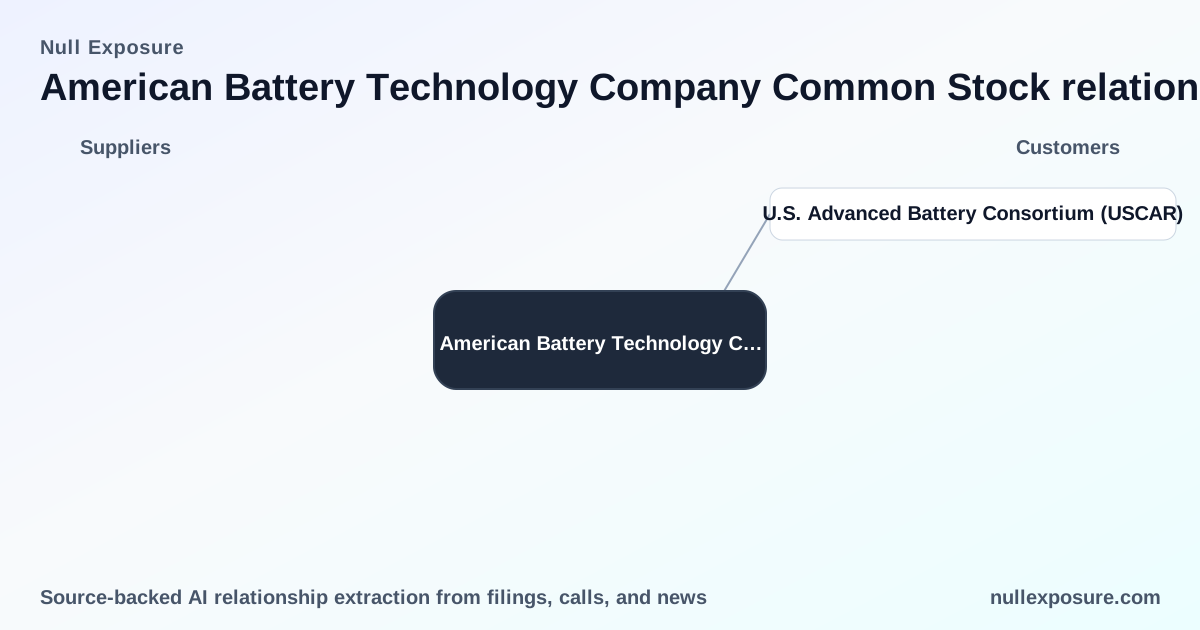
ABAT customer map: concentration, spot sales, and one notable consortium engagement
Thesis: ABAT monetizes by selling recycled battery materials and metal byproducts—principally black mass and ferrous/nonferrous scrap—recognizing revenue when title transfers to the buyer. The company operates predominantly as a seller into largely spot markets with pockets of offtake, and it is heavily revenue-concentrated: three customers accounted for 74% of FY2025 revenue, creating both upside from rapid commercial traction and downside from customer concentration risk. For deeper vendor- and counterparty-level diligence, visit https://nullexposure.com/.
What the record shows about the U.S. Advanced Battery Consortium (USCAR)
A short, explicit relationship note
U.S. Advanced Battery Consortium (USCAR): The results record states that during FY2025 ABAT completed all requirements under a contract with USCAR, an industry consortium that includes the U.S. Department of Energy, General Motors, Ford, and Stellantis. According to a company press release posted on March 9, 2026, the contract closeout was documented as part of FY2025 activity. (Source: American Battery Technology Company press release, March 9, 2026.)
Why this matters: engagement with a consortium of OEMs and DOE-aligned partners signals industrial validation and potential opening for future qualification work, even if the transaction is now closed.
All customer relationships surfaced in the record
The dataset returned a single named counterparty entry—USCAR—and the related press narrative above is the only explicit external relationship documented in the results. Below is the plain-English treatment investors and operators need to incorporate into diligence.
- U.S. Advanced Battery Consortium (USCAR): As noted, the FY2025 entry shows contract completion with USCAR; the announcement is logged in a March 2026 press release from the company. This relationship represents programmatic engagement with OEM and DOE stakeholders and a completed contractual phase rather than an ongoing long-term offtake. (Source: American Battery Technology Company press release, March 9, 2026.)
How ABAT actually sells and delivers — constraints that shape valuation and risk
The company-level operating signals in the record are as important as any single counterparty. These contract and revenue characteristics define cash flow behavior, working capital demand, and bargaining power with buyers.
-
Contracting posture: predominantly spot sales. Multiple excerpts indicate that the majority of sales are recognized at the point-in-time when title transfers—typically upon release to the shipper—consistent with spot market transactions for recycled metals and black mass. This structure drives rapid cash conversion in good times, but it amplifies revenue volatility when commodity prices or demand shift.
-
Some long-term offtake exists but is limited. The record also references offtake agreements for scrap byproducts; however, the confidence level is lower and references are isolated. Treat long-term contracts as a complementary—not primary—channel.
-
Role: seller of physical goods. The company’s performance obligations are transfers of physical materials (recycled metals and black mass), cementing ABAT’s position as an upstream materials supplier rather than a services integrator.
-
Concentration and criticality: high. Revenue from three major customers accounted for 74% of FY2025 revenue. That degree of concentration is a critical company-level risk that directly affects valuation multiple and covenant structures for lenders.
-
Relationship maturity: mix of active commercial sales and pilot-stage qualification. The company is running both active commercial deliveries (spot/byproduct sales) and pilot programs to qualify battery-grade lithium output—useful for future volume contracts and higher-margin sales but not yet a substitute for existing customer revenue.
-
Core product focus: black mass and metal byproducts. Net sales disclosed for FY2025 are concentrated in black mass and recovered metal byproducts—this is the operational engine that drives near-term cashflow until battery-grade lithium production scales.
Investment implications and operator priorities
Investors and operators should calibrate expectations to these structural facts.
-
Revenue volatility is baked into the model. Predominant point-in-time revenue recognition tied to physical shipments means quarter-to-quarter swings, especially since a small number of counterparties drive most revenue.
-
Customer concentration requires active mitigation. The 74% concentration to three customers is a valuation discount driver. Operators should prioritize diversifying buyers, securing multi-year offtakes where possible, and negotiating minimum volumes or floors.
-
Pilot success is a strategic optionality, not immediate replacement. The pilot plant for lithium qualification is valuable long-term upside: successful delivery of battery-grade lithium opens higher-margin channels and OEM qualification pipelines. Until qualification converts to binding offtakes, treat pilot outcomes as optionality in valuation models.
-
Commercial posture favors quick conversion but limited pricing power. As a seller of commodity-like recovered materials, ABAT competes on availability, quality, and logistics; long-term margin improvement requires moving up the value chain (e.g., battery-grade output) or locking in premium offtakes.
Practical due-diligence checklist for investors and operators
- Obtain the top-customer ledger and contract copies for the three largest buyers to validate the 74% concentration and determine renewal/notice provisions.
- Review terms around title transfer and freight responsibility; with point-in-time revenue recognition, the precise delivery and acceptance clauses control revenue timing.
- Examine any offtake agreements for price floors, minimums, and duration to understand downside protections.
- Monitor pilot plant commissioning milestones, qualification timelines, and sample delivery/acceptance criteria tied to OEM qualification.
- Stress-test cashflow under scenarios of one large customer loss, and model working capital needs for scaling lithium production.
Final read: risk vs. runway
ABAT is a seller-centric recycling and recovery business with early commercial traction in black mass and metal byproducts and a high-risk, high-reward optionality in battery-grade lithium. The business monetizes quickly through point-in-time transfers, which supports fast cash collection but produces revenue sensitivity to a small set of counterparties and commodity movements. Operators who lock multi-year offtakes or materially advance pilot qualification will materially recomposition the risk profile; absent that, customer concentration remains the key valuation haircut.
For ongoing counterparty monitoring and structured diligence tools, see practical resources at https://nullexposure.com/.