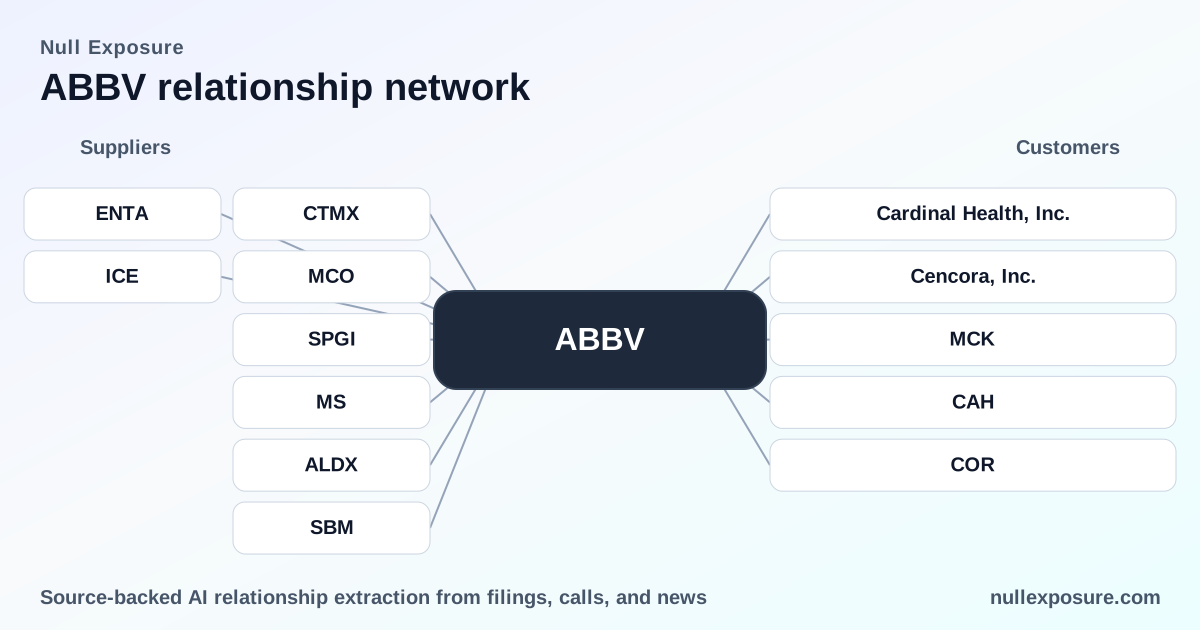
AbbVie’s customer footprint: concentrated U.S. distribution and a web of licensing partners
AbbVie monetizes a global pharmaceutical portfolio primarily through product sales to wholesale distributors, supplemented by targeted licensing and collaborative arrangements that extend asset value and geographic reach. The company’s U.S. revenue and receivables are heavily concentrated in three wholesalers, while an array of smaller licensing and manufacturing relationships handle clinical assets, ex-U.S. commercialization and specialized manufacturing. For counterparty and concentration risk analysis, this mix implies a high dependence on a few distribution partners alongside diversified, lower‑revenue collaborations. For a mapped view of these counterparties and primary sources, see https://nullexposure.com/.
Why the three wholesalers matter — the distribution backbone of AbbVie’s U.S. business
AbbVie routes the bulk of its U.S. pharmaceutical sales through independent wholesale distributors rather than direct retail channels. In both 2024 and 2025, McKesson, Cardinal Health and Cencora accounted for substantially all U.S. pharmaceutical product sales, and AbbVie disclosed that three U.S. wholesalers represented 81% of total net accounts receivable as of December 31, 2024. That configuration creates high counterparty concentration and operational criticality in the U.S. supply chain, which investors must treat as a material operational risk. These facts are stated explicitly in AbbVie’s Form 10‑K filings for FY2024 and FY2025.
Licensing and collaboration: augmenting revenues and pipeline value
Beyond distribution, AbbVie monetizes R&D through licensing and manufacturing arrangements. Smaller biotechs license clinical-stage assets from AbbVie to pursue new indications or combinations, and AbbVie provides manufacturing or co-development support in select cases. These partnerships are strategic revenue multipliers rather than primary sales channels, and they reduce single-customer concentration while exposing AbbVie to reputational and programmatic risk tied to partner performance.
If you want a concise counterparty risk brief or a visualized map of these relationships, visit https://nullexposure.com/ for a focused report.
Relationship inventory — each named counterparty and what they mean for investors
-
Cencora, Inc. (FY2024 / FY2025) — Cencora is one of the three wholesale distributors that accounted for substantially all of AbbVie’s U.S. pharmaceutical sales in 2024 and 2025, forming a core distribution channel and a major receivable counterparty according to AbbVie’s Form 10‑K statements (FY2024, FY2025).
-
Cardinal Health, Inc. (FY2024 / FY2025) — Cardinal Health is likewise one of the three dominant U.S. wholesalers; AbbVie reports that these distributors are the primary route for U.S. product shipments and a principal source of accounts receivable in its 2024 and 2025 10‑Ks.
-
McKesson Corporation (MCK) (FY2024 / FY2025) — McKesson is the third named U.S. wholesale distributor; AbbVie’s filings list McKesson alongside Cardinal and Cencora as accounting for substantially all U.S. pharmaceutical product sales and a large share of receivables (AbbVie 10‑K FY2024, FY2025).
-
Sionna Therapeutics (SION) (FY2024–FY2026 coverage in press) — Sionna licensed three clinical‑stage CFTR modulators from AbbVie in 2024 and is evaluating combinations with its NBD1 stabilizers; this licensing arrangement was reported in analyst commentary and Sionna press materials in 2026, highlighting AbbVie’s role as an originator of assets that continue in development under partner stewardship (Pharmaceutical‑Technology, Quartr, CysticFibrosisNewsToday, March–May 2026).
-
Neurocrine Biosciences (NBIX) (FY2026) — Neurocrine’s announced acquisition of Soleno referenced a collaboration “in collaboration with AbbVie,” reflecting a co-development or partnership role cited in a PR Newswire release in May 2026; this signals selective programmatic alliances where AbbVie provides joint development support or shared intellectual property.
-
Editas Medicine (EDIT) (FY2022 coverage in news) — Historical reference: Editas had an alliance with AbbVie’s Allergan unit that spanned multiple ophthalmology programs and was terminated in 2020; this past collaboration was cited in reporting on Editas’ portfolio posture (Pharmaphorum, 2026 recap).
-
Ironwood Pharmaceuticals (IRWD) (FY2026 news coverage) — Ironwood commercializes linaclotide ex‑U.S. through a strategic collaboration with Allergan (now part of AbbVie), illustrating AbbVie’s role in enabling partner commercialization in selected geographies, as noted in MarketBeat coverage in March 2026.
-
Enanta Pharmaceuticals (ENTA) (FY2025) — Enanta disclosed that manufacturing for glecaprevir is conducted by AbbVie, indicating AbbVie’s facility footprint and CMO role for certain partner products, according to Enanta’s FY2025 10‑K filed September 30, 2025.
Operating model constraints investors should model
The relationship data and AbbVie disclosures imply a clear operating posture:
-
Concentration (U.S. focus): AbbVie’s U.S. revenue and receivables are highly concentrated in three wholesalers, producing large counterparty exposure within North America. This is a company‑level concentration signal supported by the 2024/2025 10‑Ks.
-
Counterparty mix (multiple customer types): AbbVie sells to individuals (direct consumer/aesthetic sales), government agencies, managed care organizations and distributors globally, which diversifies buyer types but does not remove the wholesaler concentration in the U.S.
-
Materiality and criticality: The wholesaler relationships are critical to AbbVie’s results of operations; the company explicitly warns that distributor difficulties could adversely affect results. That makes distributorship counterparty risk a first‑order factor in scenario analysis.
-
Role and maturity: Distribution is the dominant role (seller → distributor), and the distributor relationships are mature, operationalized through long‑standing logistics and receivable arrangements rather than nascent collaborations.
-
Segment posture: AbbVie operates as both a manufacturer and seller; it also functions as a contract manufacturer for partner products in select cases (e.g., Enanta’s glecaprevir).
Investment implications and concise takeaways
- Primary risk: U.S. distributor concentration is the single largest bilateral counterparty risk; model scenarios where disruption to any one of the three wholesalers increases working capital absorption and collection risk.
- Secondary upside: Licensing and co‑development deals (Sionna, Neurocrine, other biotechs) provide optionality and non‑linear upside to pipeline value without materially diluting the distribution revenue base.
- Operational lever: AbbVie’s manufacturing and CMO capacity (e.g., Enanta) is a strategic asset that sustains partner activity and incremental revenue.
For a structured counterparty map, risk scoring and alerts tailored to AbbVie counterparties, visit https://nullexposure.com/ where you can request a focused analysis and visualization tailored to investment and operational due diligence.