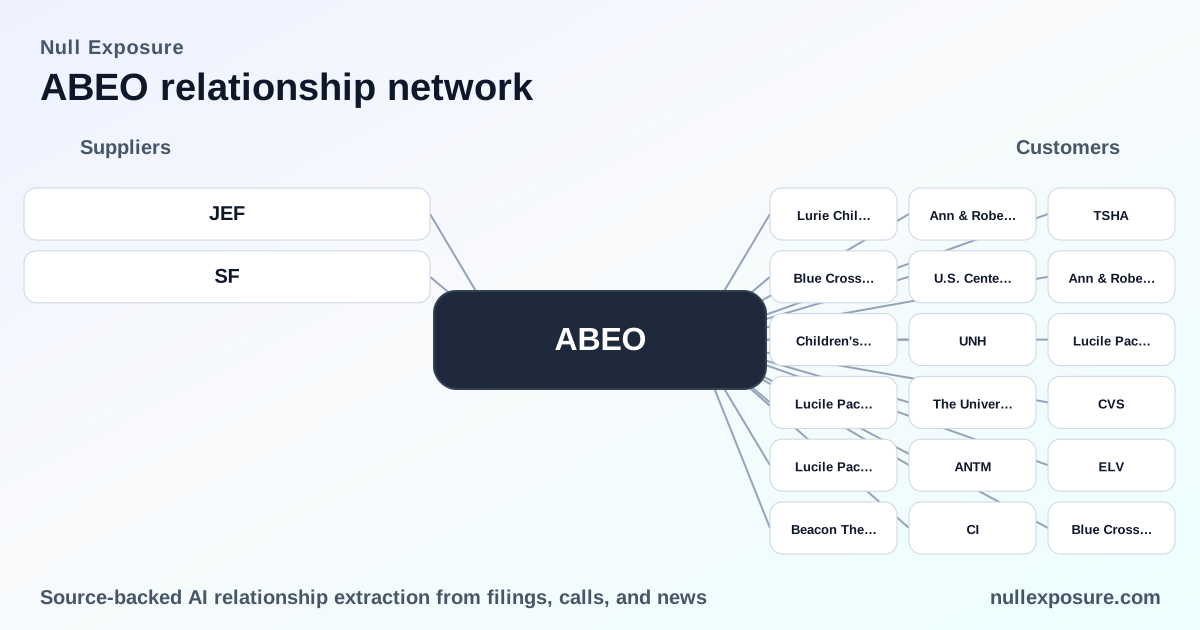
Abeona (ABEO): Commercial Footprint and Customer Relationships — What Investors Need to Know
Abeona Therapeutics operates as a clinical-stage biopharmaceutical company that commercializes a first-of-its-kind autologous gene-modified cell therapy (ZEVASKYN / ZivaSkin) for recessive dystrophic epidermolysis bullosa (RDEB) and monetizes through product sales to qualified treatment centers, licensing and sublicense arrangements, milestone payments, and one-time inventory sales. Revenue mix is already showing license and milestone recognition alongside nascent product revenue from a constrained roll‑out via Qualified Treatment Centers (QTCs). For more structured intelligence on counterparty exposures and contract signals, visit https://nullexposure.com/.
Executive snapshot: commercial posture and go‑to‑market
Abeona’s commercial model is centered on a controlled, center‑of‑excellence launch. The company limits administration of ZEVASKYN to a small network of QTCs and pursues broad payer coverage via top commercial insurers and a National Drug Rebate Agreement with CMS to fast‑track reimbursement across Medicaid. Near-term revenue will be lumpy — driven by licensing milestones and constrained center throughput — while longer‑term scaling depends on adding QTCs and maintaining payer policies.
- Key monetization channels: direct product sales through QTCs, licensing / sublicense fees, clinical milestones, and inventory purchase agreements.
- Commercial constraints: early concentration of delivery sites, high payer dependence for reimbursement, and a staged geography strategy that targets the U.S. first with EU regulatory ambitions noted in corporate filings.
If you evaluate counterparty concentration or revenue durability, Abeona’s public disclosures and calls present a compact set of counterparties and explicit market‑access milestones worth monitoring. For a structured view of these relationships, see https://nullexposure.com/.
What the network of customers and partners looks like
Abeona’s disclosed relationships split between clinical delivery partners (Qualified Treatment Centers) and payer/partner relationships that secure coverage and licensing revenue. Below I summarize each relationship disclosed in company communications and press releases — one short, investor‑oriented sentence per relationship with the cited source.
Ann & Robert H. Lurie Children’s Hospital of Chicago (Lurie)
Abeona has designated Lurie as one of its early Qualified Treatment Centers where ZEVASKYN is available and where initial patient treatments and biopsies were performed. Source: Abeona press releases and the company’s Q3 2025 earnings call (reported in Nov 2025 / Mar 2026).
Lucile Packard Children’s Hospital at Stanford (Lucile Packard)
Lucile Packard is a QTC and hosted the company’s first commercial patient treatment; management reports that early patient treatments and biopsies came from Lucile Packard and Lurie. Source: Abeona press release (QuiverQuant coverage) and Q4/Q3 2025 earnings discussion (InsiderMonkey transcript, FY2026 reporting).
Children’s Hospital Colorado
Children’s Hospital Colorado was activated as a Qualified Treatment Center, expanding the QTC footprint to additional U.S. centers. Source: Company press release (Oct 8, 2025) and Q3 2025 earnings call remarks (Mar 7, 2026).
NewYork‑Presbyterian / Columbia University Irving Medical Center
NewYork‑Presbyterian/Columbia was announced as an activated QTC for ZEVASKYN, supporting expansion into the New York market. Source: Abeona press release on GlobeNewswire (Apr 2, 2026).
The University of Texas Medical Branch (UTMB) at Galveston
UTMB (Galveston) was activated as the fourth QTC in December 2025 and is expected to contribute to the company’s biopsy and treatment cadence. Source: Company announcements (December 11, 2025; reported in SAHM Capital / StockTitan coverage).
Beacon Therapeutics
Beacon exercised an option to license Abeona’s AAV204 capsid for potential retinal gene therapies, representing a licensing monetization of Abeona’s capsid assets. Source: Abeona corporate update reported on GlobeNewswire (Aug 14, 2025).
UnitedHealthcare (UNH)
UnitedHealthcare published a favorable coverage policy for ZEVASKYN aligned to the FDA label with no additional restrictions, representing the most notable commercial‑payer milestone cited by management. Source: Abeona press releases and Q2/Q3 2025 earnings comments (GlobeNewswire coverage, Q2 earnings transcript).
Cigna
Cigna is listed among major commercial payers that published coverage policies for ZEVASKYN, contributing to broad commercial access (~80% of commercially covered lives referenced by management). Source: Q3 2025 earnings call remarks and company press materials (Mar–Nov 2025 disclosures).
Aetna
Aetna published coverage for ZEVASKYN as part of the group of major commercial payers supporting the launch; this is included in management’s market‑access commentary. Source: Abeona press releases reporting FY2025 results (GlobeNewswire, Nov 2025).
Anthem
Anthem is reported as a major commercial payer that has published a coverage policy for ZEVASKYN and is cited in the company’s market‑access updates. Source: Abeona Q3 2025 reporting and press releases (GlobeNewswire).
Blue Cross Blue Shield plans
Most Blue Cross Blue Shield plans are reported to have published coverage policies for ZEVASKYN, supporting broad commercial availability beyond single carriers. Source: Company press releases and earnings call statements (Nov 2025 / Mar 2026).
CVS (Aetna / PBM overlap)
CVS (as Aetna’s parent / PBM influence) is referenced along with other major payers in management commentary on coverage policies. Source: Q3 2025 earnings call excerpts (Mar 2026).
U.S. Centers for Medicare and Medicaid Services (CMS)
Abeona entered the National Drug Rebate Agreement (NDRA) with CMS to facilitate expedited coverage and reimbursement across state Medicaid programs and Puerto Rico. Source: Abeona press release and EpidermolysisBullosaNews reporting (Aug 2025 / Mar 2026).
Taysha Gene Therapies (TSHA)
Abeona has a long‑standing sublicense and inventory purchase relationship with Taysha dating to August 2020; license and other revenues in 2025 were driven by a clinical milestone under that sublicense and related inventory sales. Source: Abeona 2024 Form 10‑K (Dec 31, 2024) and FY2025/FY2026 press disclosures (GlobeNewswire / QuiverQuant).
ELV (inferred symbol)
Management references include an inferred ticker "ELV" alongside Anthem in earnings commentary; this is an inferred identifier tied to management’s public disclosures and transcript tagging. Source: Q3 2025 earnings call transcripts (Mar 2026).
Operating model and contract signals investors should weight
Abeona’s public constraints and disclosure language yield clear company‑level signals about contracting posture and maturity:
- Licensing orientation and monetization mix: The company explicitly reports multiple licensing and sublicense arrangements (for example, with Taysha and historical agreements involving Ultragenyx), supporting recurring milestone and license revenue as a material complement to product sales. Source: Abeona 2024 Form 10‑K and recent press updates.
- Spot/inventory transactions: Abeona documented an inventory purchase arrangement tied to a sublicense with Taysha, which represents one‑time transactional revenue (inventory sale) in addition to license fees and milestones. Source: 10‑K language cited by management.
- Geographic focus and regulatory path: Management signals a U.S. first commercial strategy with intentions to pursue EU approvals — a two‑region regulatory path that creates staged scaling opportunities (NA first, EMEA as follow‑on). Source: company filings.
- Relationship stage and delivery model: The QTC roll‑out is early and deliberate (prospect/onboarding stage for additional centers); center concentration drives short‑term throughput limits but enforces quality control in a high‑complexity therapy. Source: management commentary describing onboarding discussions with 5–7 centers in early disclosures.
- Single‑segment focus: The company operates in a single business segment focused on late‑stage cell and gene therapies, implying high product concentration risk tied to the commercial performance of ZEVASKYN and licensed programs. Source: Abeona corporate filings.
Bottom line: how to position relative to risk and upside
Abeona’s near‑term upside is driven by payer coverage gains, QTC throughput, and licensing milestones (Taysha milestone already contributed to revenues). The most immediate risks are topical concentration in a small QTC network, reliance on a handful of large commercial payers for reimbursement, and lumpy milestone recognition. For investors modeling revenue, apply conservative cadence assumptions for QTC biopsy/treatment throughput and treat license/milestone receipts as event‑driven contributions to cash flow.
For a deeper breakdown of Abeona’s counterparty map, revenue signaling, and exposure analytics, visit https://nullexposure.com/ — the report you need to benchmark counterparties and contract types against comparable launches.
(End of investor brief.)