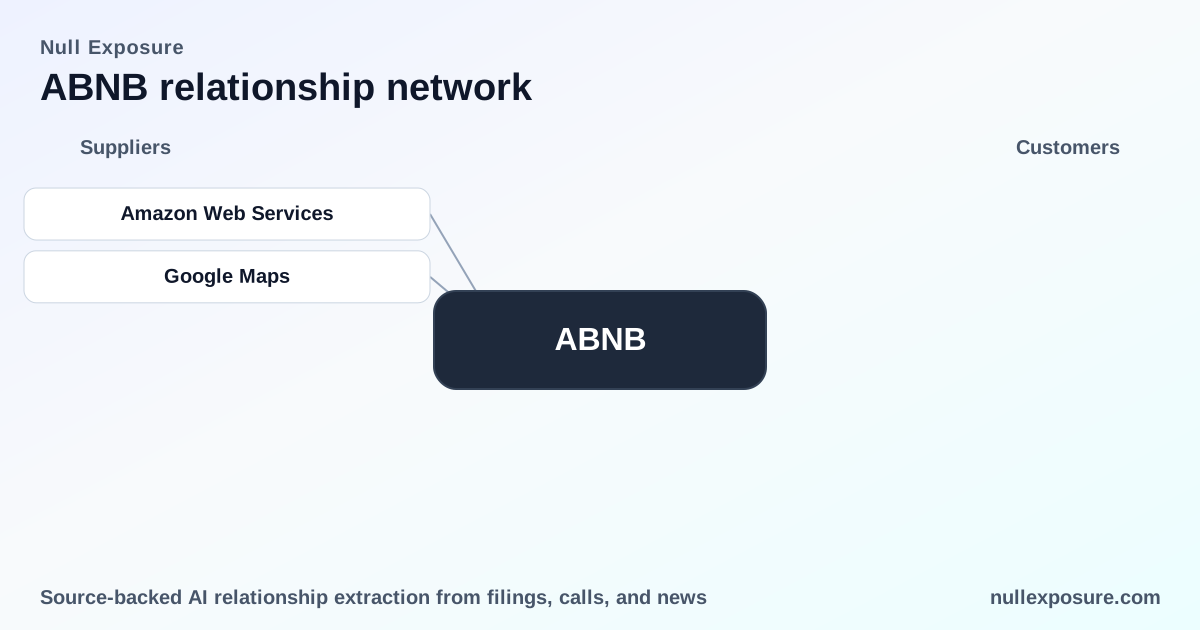
Airbnb (ABNB) — customer relationships and what they mean for investors
Airbnb operates a global two-sided marketplace that connects guests (buyers) with hosts (sellers) for stays, experiences, and related services, and monetizes primarily through transaction fees on bookings and value-added services. The company reports substantial network effects: stays account for the core revenue stream, supported by protection and software features that increase host liquidity and guest retention. Investors should view Airbnb as a asset-light platform with geographically diversified revenue and a growing suite of services that deepen per-booking monetization. For a concise view of customer signals across relationships, visit https://nullexposure.com/.
The investor thesis in one paragraph
Airbnb delivers scale economics from a marketplace structure: high GMV on stays, fee-based take rates, and incremental revenue from services (AirCover, cleaning/insurance) and software-mediated personalization. Revenue concentration skews to North America and EMEA, but international growth in APAC and LATAM is accelerating, supporting margin expansion through higher utilization and product-led retention. Market valuation reflects durable growth expectations (Market Cap ~$82.6B; Revenue TTM ~$12.24B) and a premium multiple consistent with platform economic characteristics.
What Airbnb’s customer relationships look like in practice
Airbnb’s operating model centers on short-duration transactions with an important long-duration segment and recurring platform engagement. Important characteristics for investors:
- Contracting posture — marketplace, largely transactional. Airbnb does not typically lock hosts or guests into long-term bilateral contracts; instead it facilitates bookings on a per-stay basis while offering continuity through features and protections that encourage repeat usage. However, Airbnb recognizes a distinct long-term stay category (guest stays of 28+ nights), which carries different economics and distributional risk for occupancy and pricing.
- Concentration and diversification — dominated by NA and EMEA but broad-based. Airbnb discloses revenue by listing location showing North America and Europe/EMEA as the largest contributors, with meaningful and rising receipts from APAC and LATAM, indicating regional diversification alongside concentration in developed markets.
- Criticality — platform is mission-critical for many independent hosts and an important demand channel for partners. Core value accrues from marketplace liquidity; services such as AirCover enhance host willingness to list and reduce friction for higher-value stays.
- Maturity and product mix — mature core stays plus growing services and software-led capabilities. Substantially all revenue comes from stays, while services (insurance, cleaning protection) and software features (app redesign, AI personalization in 2025) expand monetization and stickiness.
These constraints come from Airbnb’s public disclosures: the company defines long-term stays as 28+ nights, provides a 2023–2025 revenue breakdown by region, and details AirCover and 2025 app upgrades in its filings and shareholder communications.
Regional footprint: growth where it matters
Airbnb’s filings present revenue by listing location for 2023–2025, showing North America and Europe/EMEA as the largest pools, with APAC and LATAM growing in absolute terms—evidence of both concentration and expansion into higher-growth markets. According to Airbnb’s revenue tables for 2023–2025, North America generated approximately $4.6B (2023) rising to $5.2B (2025), while Europe/EMEA increased from about $3.6B to $4.7B over the same period. This pattern implies that top-line sensitivity to travel cycles in NA and EMEA will dominate near-term outcomes, while APAC and LATAM provide upside to growth and diversification.
Product and monetization constraints investors should watch
Airbnb’s commercial model is centered on stays, which constitute the vast majority of revenue, while complementary services and software improvements raise lifetime value per guest and reduce host churn. Key, actionable signals:
- Core stays drive cash flows. Management emphasizes that substantially all revenue is generated by stays booked on the platform.
- Services increase monetization per booking. AirCover for Hosts offers up to $3M property damage protection and $1M liability coverage, which supports host participation and pricing power.
- Software investments are strategic. A 2025 app redesign introduced unified search/booking and AI-powered personalization, which supports better conversion and cross-sell between stays and experiences.
Collectively, these points indicate a mature platform with incremental monetization levers that reduce reliance on pure listing volume growth.
If you want a deeper, company-level signal map for customer relationships, see our platform: https://nullexposure.com/.
Notable customer relationship: UMH
UMH recently partnered with Airbnb to let prospective residents trial living at a new development in Sebring, Florida, illustrating a property-level collaboration that leverages Airbnb’s stay marketplace to market longer-stay residential product. A REIT.com news article (March 2026) reported that UMH is allowing potential residents to “test the waters” via Airbnb at its Sebring development, signaling a non-traditional host partnership that layers marketing and demand-generation on top of standard listings. (Source: REIT.com news, March 10, 2026)
How to read individual partnerships versus company-level constraints
Partnerships like the UMH arrangement are opportunistic, low-capex ways for property owners and other real-estate operators to use Airbnb as a demand channel. These relationships are generally:
- Transactional and promotional rather than exclusive: Airbnb’s marketplace model allows property operators to list inventory without long-term exclusivity obligations.
- Strategically useful for supply diversification: Operators can sample market reception with short-term trials (including long-term 28+ night stays) before committing to conventional leasing strategies.
Company-level constraints — long-term stay definitions, regional revenue splits, role of services and software — shape how management will prioritize product features and partnership types, but they do not require exclusivity with a partner such as UMH.
Investment implications and risk checklist
- Revenue concentration risk: Heavy weighting to North America and EMEA means macro shocks in these regions materially affect top-line growth. Use regional travel trends to model sensitivity.
- Platform leverage and margin upside: Software-led personalization and service attach rates improve take-rates and margins over time; monitor AirCover uptake and app-driven conversion metrics.
- Operational risk from changing stay mix: Growth in long-term stays (≥28 nights) changes revenue recognition, pricing power, and customer lifetime value; investors should track the mix shift between short-term and long-term bookings.
- Partner diversification: Non-traditional hosts (e.g., UMH) demonstrate alternative supply sources and marketing synergies, reducing dependence on individual host segments but increasing exposure to institutional owner behavior.
Bottom line
Airbnb’s customer relationships combine a high-frequency marketplace with strategically valuable services and software investments. The firm’s economics will continue to hinge on regional travel demand and the company’s ability to increase monetization through services and product improvements. Tactical partnerships such as the UMH trial in Sebring highlight Airbnb’s role as a marketing and demand engine for property operators—not as a replacement for traditional leasing models. For a structured view of customer signals and partner-level intelligence, visit https://nullexposure.com/.