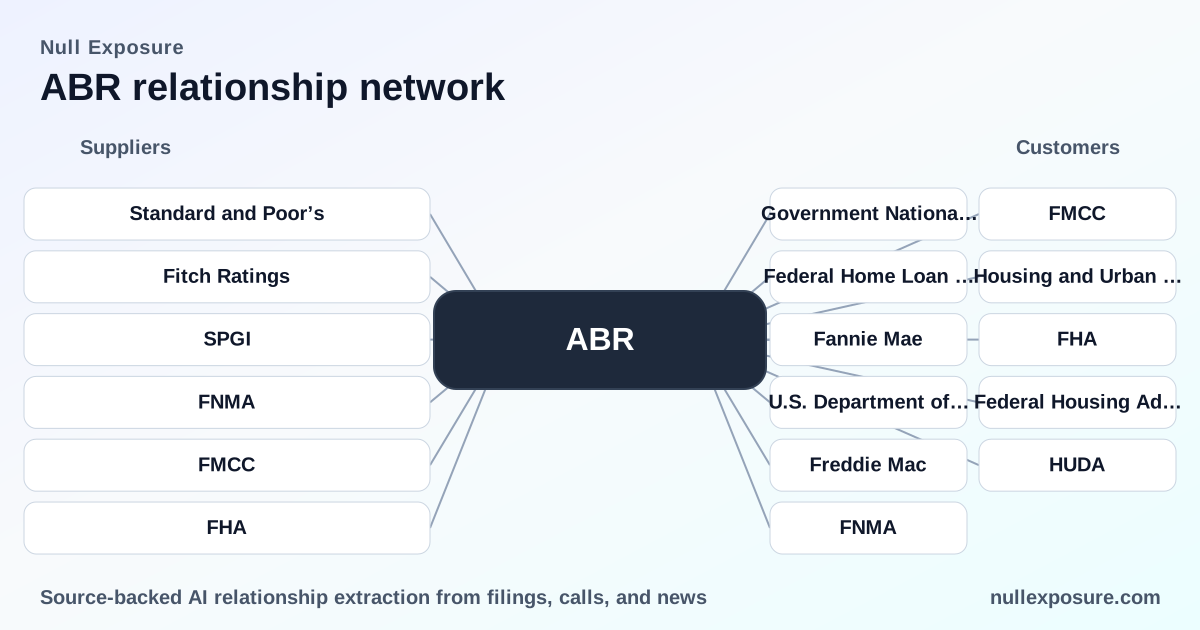
Arbor Realty Trust — Agency Customers, Contracts and Capital Implications
Arbor Realty Trust operates as a nationwide REIT and direct lender that originates, sells and services multifamily and commercial mortgage loans, and monetizes through loan origination gains, servicing fees and retained investment positions. The company’s Agency Business is core to revenue and liquidity planning: Arbor sells loans into GSE and HUD programs while retaining servicing rights and servicing-related revenue streams, and underwrites balance-sheet exposure where it participates in loss-share arrangements and pledges restricted liquidity against potential agency losses. For a concise institutional view of Arbor’s customer relationships and the operational constraints they create, see more at https://nullexposure.com/.
Why the agency franchise matters to investors
Arbor’s relationship architecture is structured and concentrated. The firm acts both as a seller (originator and lender) and as a servicer (ongoing cash-flow conduit) for government-sponsored enterprises and federal housing programs. That dual role creates recurring fee income, but also finite liquidity obligations: servicing agreements require asset management, advances and loss sharing that directly affect cash flow volatility and collateral demands. Arbor’s public filings show it has pledged tens of millions of restricted liquidity against billions of agency-related UPB, making these counterparties both revenue drivers and potential sources of material operational risk.
If you track counterparties and contract terms, two practical investor implications are immediate: agency approvals are mission-critical and concentrated, and contract tenor mixes include both short-term loan sell-downs and long-term servicing commitments. For investors who want a deeper relationship map, NullExposure’s customer intelligence is available at https://nullexposure.com/.
Contracting posture, concentration and maturity — how the constraints read
Arbor’s contracts reflect a blended operating model. The company sells many loans quickly (GSE loans held-for-sale are typically sold within 60 days and many non-GSE loans within 180 days), which creates short-turn origination revenue. Simultaneously Arbor underwrites and services long-term permanent loans and retains servicing and asset-management responsibilities that carry long-term operational commitments (servicing advances, escrows, MSR amortization). The 10‑K discloses a master loss-sharing agreement with Fannie Mae that requires funding of delinquencies and advances up to defined thresholds — a framework contract that amplifies counterparty risk tied to agency program participation. Arbor’s servicing portfolio ($33.47 billion UPB disclosed as a key metric) and pledged restricted liquidity ($91.5 million) indicate materiality and measured capital allocation to agency engagements rather than incidental business lines.
- Contract tenor: mix of short-term loan sales and long-term servicing obligations.
- Counterparty profile: dominated by government entities and large GSEs, which both stabilize volumes and create approval concentration risk.
- Materiality: Agency servicing fees and loss-sharing exposures are explicitly material to results and liquidity.
The relationship map — every customer relationship cited in source materials
Below are the counterparties that appear in Arbor’s filings and press coverage, with a plain-English summary and a concise source citation for each.
Federal National Mortgage Association (Fannie Mae / FNMA)
Arbor is a leading Fannie Mae DUS® lender: the company originates multifamily loans for sale to Fannie Mae and retains servicing rights and risk-sharing obligations, including a master loss-sharing agreement that requires funding of delinquencies and servicing advances under specific thresholds. Source: Arbor’s 2024 Form 10‑K and multiple 2026 company press releases and filings citing DUS status and the master loss-share arrangement.
Federal Home Loan Mortgage Corporation (Freddie Mac / FMCC)
Arbor operates as a Freddie Mac Optigo® seller/servicer and acts as subservicer on Freddie Mac-designated securitizations, collecting fees and performing borrower administration while Freddie Mac or third parties serve as master or special servicer. Source: Arbor’s 2024 Form 10‑K and 2026 press releases describing Optigo® Seller/Servicer designation.
Government National Mortgage Association (Ginnie Mae)
Arbor originates and services multifamily loans that participate in Ginnie Mae structures, providing a conduit between HUD‑insured loans and Ginnie Mae securitizations and thereby earning servicing fees tied to government-guaranteed pools. Source: Arbor’s 2024 Form 10‑K disclosure on Agency Business participation with Ginnie Mae.
U.S. Department of Housing and Urban Development (HUD / HUDA)
Arbor underwrites and sells HUD-insured multifamily loans and retains servicing responsibilities; loans under HUD programs often require Arbor to advance payments to investors if borrowers are delinquent, creating a direct liquidity obligation under servicing agreements. Source: 2024 Form 10‑K disclosures referencing HUD program servicing rules and advance requirements.
Federal Housing Administration (FHA)
Arbor is an approved FHA Multifamily Accelerated Processing (MAP) lender and participates in FHA-backed lending programs, which expands product distribution while adding program compliance and approval risk that the company highlights in regulatory filings. Source: Company press materials and 2026 news releases noting FHA MAP approval and Arbor’s status as an FHA lender.
ABR‑P‑E (Arbor preferred security reference)
A 2026 press release referenced Arbor’s preferred equity tranche (ABR‑P‑E) in the context of ratings and investor communications, indicating the company’s capital-structure instruments are rated and discussed alongside operating updates. Source: GlobeNewswire press release (February 2026) noting ratings commentary and investor messaging tied to Arbor’s preferred stock.
Key investment takeaways and risk lens
- Revenue durability anchored in servicing: Arbor’s servicing fees represent a predictable, fee-based portion of revenues, but they are tied to agency approvals and servicing terms that include advance and loss-share obligations. Source: 2024 10‑K servicing revenue metrics and agency program descriptions.
- Concentration and contractual criticality: A substantial portion of originations and servicing is routed through Fannie Mae, Freddie Mac and HUD programs, and regulatory or approval changes at those counterparties would be material to Arbor’s operations. Source: 2024 Form 10‑K materiality disclosures and pledged liquidity statements.
- Liquidity mechanics are explicit: Arbor discloses restricted liquidity pledges ($91.5 million) against $22.73 billion of UPB under risk-sharing — a sign that capital reserve and collateral management is an ongoing sponsor-level requirement. Source: 2024 Form 10‑K restricted liquidity disclosure.
Final read for investors
Arbor’s commercial position is agency-centric: originations fund loan-sales gains and servicing fees, while long-term servicing and loss-share frameworks create recurring obligations that lean on capital and approvals. For investors evaluating yield, governance and downside protection, the critical questions are whether Arbor’s restricted liquidity and operational controls sufficiently cover servicing advance and loss-share exposures, and how durable agency approvals will remain under changing regulatory or credit cycles. For ongoing tracking of customer relationships and material constraints, visit NullExposure’s coverage at https://nullexposure.com/.