Arbor Realty Trust (ABR-P-D): Customer relationships that drive a preferred-holder’s yield
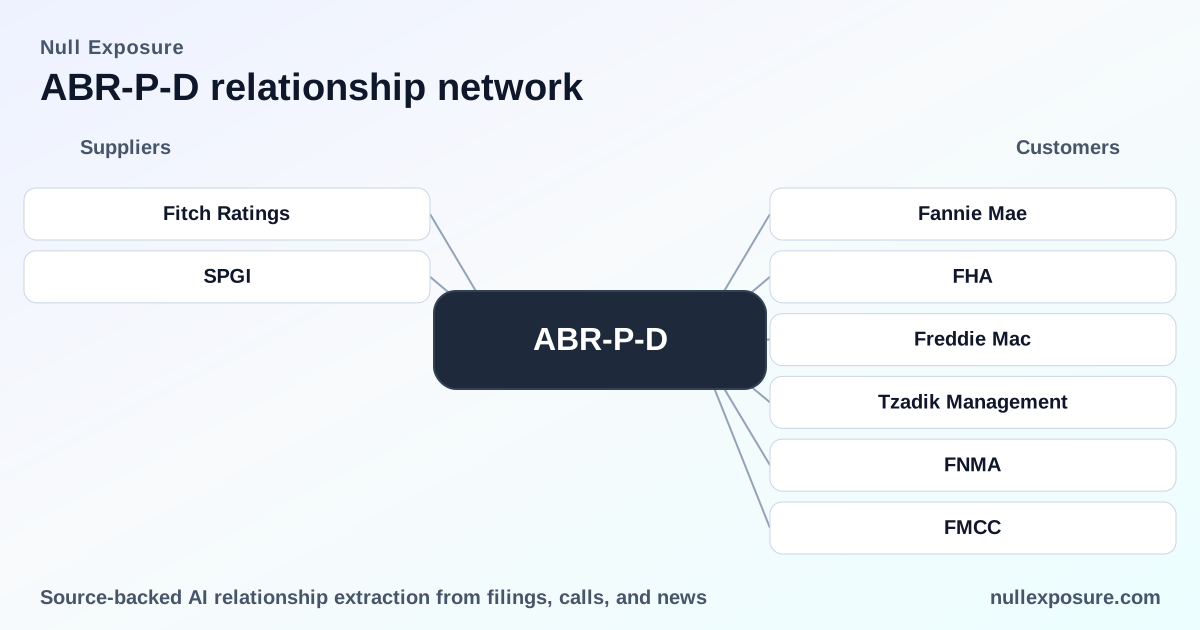
Arbor Realty Trust operates as a mortgage REIT that originates, acquires and services multifamily and commercial real estate loans, then monetizes those activities through interest spread generation, servicing fees and structured finance transactions; its 6.375% Series D cumulative preferred (ABR-P-D) is a fixed-income instrument that captures yield exposure to those cash flows while leaving credit and operational risk with the firm. Arbor’s business depends on deep operational access to government-sponsored and government-backed channels, which support originations, liquidity and fee income for the platform. For investors evaluating counterparty concentration and operational durability, the customer relationships below are the primary signals to track. Learn more at https://nullexposure.com/.
Why GSE access is the structural driver of Arbor’s model
Arbor’s role as an approved lender and seller-servicer to the GSEs and federal programs is not a peripheral detail — it is a core revenue and distribution channel. Access to Fannie Mae’s DUS® program, Freddie Mac’s Optigo® platform and FHA MAP underwriting translates into scalable origination pipelines, lower funding friction and recurring servicing fees, but it also creates concentrated counterparty exposure and program-compliance obligations that directly affect loan flow and margin. Market participants should treat GSE approvals as operational infrastructure: they enable origination volume and secondary-market exits, and they impose operational and regulatory disciplines on Arbor’s processes.
Relationship details: line-by-line
-
Freddie Mac — Arbor is an approved Freddie Mac Optigo® Seller/Servicer, which authorizes the firm to originate and deliver multifamily loans to Freddie Mac’s execution platform and to perform servicing functions on delivered loans; this status supports both warehouse-to-securitization workflows and recurring fee income. According to Arbor’s public releases and investor notices in 2025–2026, the company lists Freddie Mac Optigo® seller/servicer status as a key certification (see GlobeNewswire and QuiverQuant notices, FY2025–FY2026).
-
Fannie Mae (FNMA) — Arbor is a leading Fannie Mae DUS® lender, qualifying it to originate and deliver whole loans into the DUS® pipeline and participate in DUS® securitizations, which provides predictable secondary-market execution for multi-family assets. Arbor’s press statements and earnings schedules from 2024–2026 repeatedly reference its DUS® lender role (see StockTitan and GlobeNewswire releases, FY2024–FY2026).
-
FHA (MAP) — Arbor is an approved FHA Multifamily Accelerated Processing (MAP) lender, enabling FHA-insured loan originations that expand the firm’s addressable market to properties eligible for federal insurance and different leverage profiles. Company announcements in 2025–2026 highlight MAP approval alongside Fannie and Freddie credentials (see GlobeNewswire and QuiverQuant, FY2025–FY2026).
-
Tzadik Management — Arbor provided bridge financing to Tzadik Management beginning around 2019 for multifamily acquisitions in Sioux Falls, South Dakota, demonstrating Arbor’s role as a direct lender for sponsor-driven transactions as well as its exposure to sponsor credit and execution risk. The Real Deal reported on the relationship and subsequent disputes in a November 2023 article that recounts the origin of the loans and later tensions (The Real Deal, Nov 2023).
What these relationships tell investors about Arbor’s operating posture
With the constraints dataset silent in this feed, treat the absence of explicit constraint notes as a company-level signal: Arbor’s operating model is partner-heavy and approval-dependent. The relationships above imply the following characteristics of the business model:
- Contracting posture: Arbor operates as a counterparty to large, standardized programmatic buyers (Fannie Mae, Freddie Mac, FHA), so contracts emphasize compliance, documentation standards and program performance rather than bespoke borrower pricing. This posture limits idiosyncratic pricing flexibility but provides scale advantages.
- Concentration: Arbor’s origination and exit channels are concentrated among a small set of government-backed programs; this concentration increases operational leverage to policy or program changes while offering predictable liquidity pathways in stable markets.
- Criticality: These counterparty approvals are operationally critical — loss of GSE or FHA approvals would materially constrain origination volume and securitization options, affecting interest and fee income available to service preferred dividends.
- Maturity and governance: Repeated public references to DUS®, Optigo® and MAP approvals across FY2023–FY2026 indicate a mature, institutionalized relationship set rather than ad hoc or one-off engagements.
Risks to monitor and operational watchlist
- Counterparty/regulatory risk: Changes in GSE policy, program uptake or underwriting standards would have immediate top-line and execution implications. Monitor Fannie/Freddie guidance and FHA MAP rule changes.
- Execution and compliance: Maintaining seller/servicer and MAP status requires ongoing operational controls; enforcement actions or remediation requirements would strain capital and management bandwidth.
- Sponsor credit and litigation: Direct lending to sponsors (example: Tzadik) exposes Arbor to borrower-specific credit events and reputational/legal friction that can surface outside standardized program channels.
Key items to watch: upcoming earnings calls, regulator or GSE program announcements, and borrower dispute developments for large sponsor exposures. These indicators drive both origination cadence and fee margins that ultimately support ABR-P-D distributions.
What investors should do next
- Track Arbor’s quarterly and press communications for any change to DUS®/Optigo®/MAP certifications and for updates on sponsor loan performance; these are the proximate drivers of earnable cash flow for preferred shareholders (see Arbor’s GlobeNewswire and QuiverQuant releases, FY2025–FY2026).
- For a concise source of relationship monitoring and counterparty signals, visit https://nullexposure.com/ to subscribe to alerts and research coverage.
Conclusion: Arbor’s customer footprint is dominated by government-backed channels that enable scale and recurring fee income but concentrate operational risk. For holders of ABR-P-D, the security’s fixed coupon is supported by a business model that depends on continued GSE/FHA access and disciplined servicing execution; changes to those relationships are the primary material event risk to monitor.