Arbor Realty Trust (ABR-P-E): Agency Channels Underpin Preferred Income
Arbor Realty Trust operates as a mortgage REIT focused on multifamily and commercial real estate finance, originating, acquiring and servicing agency-eligible loans and structured products. The firm earns interest spread, origination fees and servicing income through its approved agency platforms, and its 6.25% Series E cumulative preferred shares trade on that income profile—an investor play on steady coupon capture anchored to agency business volume. Learn more at https://nullexposure.com/.
Agency lending is the operating engine — and the monetization path
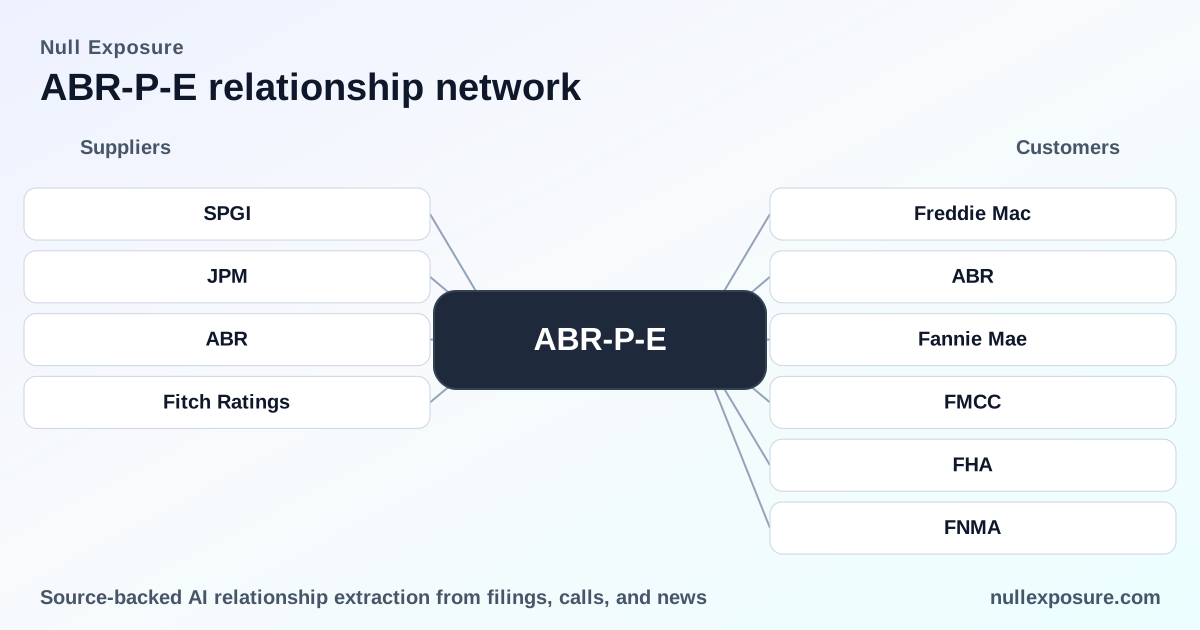
Arbor’s line of business is straightforward: originate or acquire multifamily loans, deliver agency-compliant loans into agency programs (or retain agency-serviced assets), and collect spread and fee income. Agency approvals—Fannie Mae DUS®, Freddie Mac Optigo®, and FHA MAP—convert originations into distributable liquidity and recurring servicing revenue, which supports preferred dividend coverage and stabilizes cash flow in a capital-intensive REIT model. Recent company announcements reiterate that agency lending remains central to Arbor’s go-to-market and capital-marketing strategy (see relationship map below).
Operating posture and business-model characteristics investors should price in
No contract-specific constraints are present in the filings collected here, so view the following as company-level signals derived from Arbor’s public communications: Arbor maintains formal, approved seller/servicer status with major agencies, reflecting a contracting posture geared to long-term, standardized agency engagements rather than bespoke bilateral lending. That posture implies:
- High counterparty concentration: agency platforms dominate distribution and capital access, concentrating execution risk around a small set of counterparties.
- Criticality of agency relationships: agency approvals are operationally critical—loss of an agency channel would materially reduce origination volume and servicing income.
- Mature, institutionalized relationships: repeated public references to agency roles indicate long-standing, operationally embedded arrangements rather than nascent partnerships.
- Standardized contracting and adherence demands: ongoing compliance, underwriting and operational investment is required to maintain seller/servicer status and MAP approval.
These characteristics define both the upside (stable fees, predictable securitization paths) and the structural risk (regulatory/agency policy shifts, operational compliance burdens) for holders of ABR preferreds.
Relationship map: what every investor needs to know
Fannie Mae
Arbor is a leading Fannie Mae DUS® lender, a designation that positions the firm to originate and deliver multifamily loans into Fannie Mae’s delegated underwriting securitization platform, creating a consistent conduit to capital and recurring servicing mandates. This relationship is repeatedly referenced in Arbor press releases and SEC-proxy materials (see GlobeNewswire releases and the company proxy filings, FY2026). Source: GlobeNewswire press release (Mar 30, 2026) and Arbor’s definitive proxy filing discussed on StockTitan (FY2026).
Freddie Mac
Arbor operates as a Freddie Mac Optigo® Seller/Servicer, enabling the firm to place and service Freddie Mac-eligible multifamily loans and monetize origination and servicing workflows under Freddie Mac programs. The Freddie Mac role is emphasized alongside Fannie in Arbor’s corporate announcements and executive hiring disclosures in FY2026. Source: GlobeNewswire press release (Mar 30, 2026) and related company announcements in February–March 2026.
FHA (Multifamily MAP)
Arbor holds approval as an FHA Multifamily Accelerated Processing (MAP) lender, giving the firm access to FHA-insured multifamily lending channels that broaden capital-placement options and diversify product flow beyond conventional agency conduits. Public releases list FHA MAP approval as part of Arbor’s agency platform credentials in FY2026. Source: GlobeNewswire and supporting press coverage (Feb–Mar 2026).
ABR (Arbor Realty Trust – internal reference)
Arbor’s own filings and executive disclosures confirm that the firm organizes its agency lending business under a centralized leadership team that oversees originations, credit, underwriting, capital markets and agency operations; recent executive appointments explicitly tie to agency platform stewardship. This internal structure underpins Arbor’s ability to scale agency pipelines and service portfolios. Source: Arbor proxy/press releases and the Feb 2026 executive appointment disclosure (StockTitan and GlobeNewswire, FY2026).
What these relationships imply for preferred-stock investors
- Revenue durability: Agency approvals supply a predictable origination and servicing revenue stream that supports preferred dividend coverage. Arbor’s repeated public emphasis on agency platforms signals that preferred coupons are anchored to these predictable channels.
- Concentration risk: Reliance on a small set of agency counterparties concentrates counterparty and policy risk; changes in agency purchasing criteria or program economics will directly influence Arbor’s origination throughput and margins.
- Operational leverage: Arbor’s governance choices—centralized agency leadership and investment in underwriting/operations—reduce execution risk but increase fixed cost commitments, making volume stability essential for preferred coverage.
Headline risks and what to watch next
- Loss or restriction of agency seller/servicer status would compress liquidity and origination capacity, pressuring preferred coverage.
- Agency policy shifts (credit overlays, loan-to-value limits, or program availability) will transmit quickly to Arbor’s margin and volume.
- Mortgage-rate volatility and multifamily valuation cycles will affect both origination demand and the credit performance of retained assets.
Key monitoring indicators: agency program participation statements, quarterly servicing balances, and executive commentary on agency pipelines.
Bottom line for investors
Arbor’s business model monetizes agency access: approvals with Fannie Mae, Freddie Mac and FHA are the structural backbone that supports the Series E preferred coupon. That positioning buys income stability but embeds concentration and policy dependence risk that investors must incorporate into valuation and stress scenarios.
If you want a concise companion brief that maps Arbor’s agency exposures against cash-flow sensitivity scenarios, visit https://nullexposure.com/ for additional research and model-ready summaries.