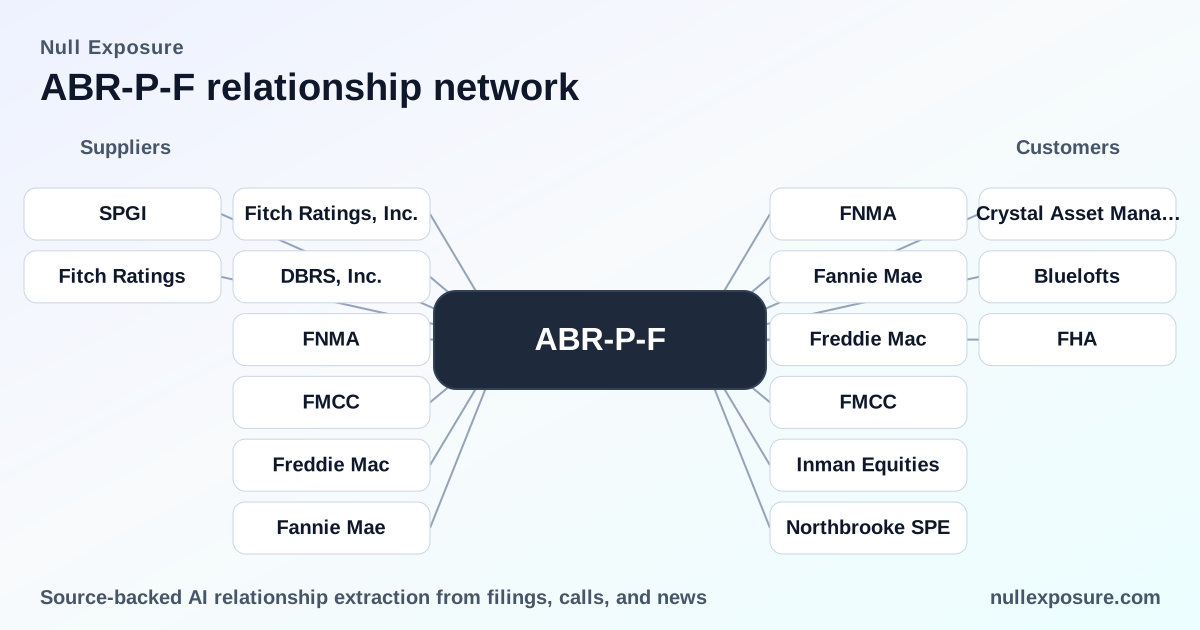
Arbor Realty Trust (ABR-P-F) — Customer relationships, operating posture, and what investors should know
Arbor Realty Trust is a specialty REIT that originates, finances, securitizes and services multifamily and commercial mortgage loans, and monetizes through loan yields, servicing fees, sale gains and structured financings; its 6.25% Series F cumulative preferred (ABR-P-F) is positioned as an income instrument backed by that platform. Arbor’s business model depends on agency conduit channels, private securitizations and active workout/servicing capabilities to convert lending volume into recurring cash flow for holders of both common and preferred capital. For a concise map of counterparties and investor implications, see Null Exposure’s research hub: https://nullexposure.com/
How Arbor’s customer relationships translate into cash flow
Arbor’s core operating model is a lender-seller-servicer: it underwrites loans, holds some duration exposure, and sells or finances paper through agency and private channels. That contracting posture creates recurring fee streams (servicing) and intermittent balance-sheet events (securitizations, ratings-sensitive financings). Institutional agency relationships are both a distribution channel and a form of franchise — concentration with Fannie Mae and Freddie Mac is a structural feature that increases access to low-cost funding while creating counterparty reliance. Arbor’s agency approvals are mature and confirmed repeatedly in public releases, which supports predictable access to agency platforms and securitization outlets.
Bold takeaway: agency corridor access plus private CLO/securitization capability is the central revenue engine; servicing and workout skills materially affect loss recovery and dividend coverage.
Explore the full platform context at Null Exposure: https://nullexposure.com/
Constraints and company-level signals investors should factor
- Contracting posture: Arbor operates as an originator and approved seller/servicer across agency (Fannie/Freddie), FHA MAP and private-label channels — that structure creates recurring fee income and dependence on agency pipeline rules.
- Concentration and criticality: Fannie Mae and Freddie Mac are strategic counterparties whose approval status materially impacts capacity and funding cost.
- Maturity and operating history: Public filings and press releases across FY2025–FY2026 show repeated agency mentions, signaling an established relationship rather than an episodic partnership.
- Workout and credit enforcement capability: Media reports of foreclosures and delinquent loans illustrate an active special-servicing posture that supports recoveries but also signals exposure to stressed assets.
These are company-level signals; no relationship-specific contractual constraints were provided in the source payload.
Counterparty roll-call — what each relationship means for investors
Below are the counterparties surfaced in public reporting and news, with concise investor-oriented summaries and source citations.
Fannie Mae / FNMA
Arbor is a leading Fannie Mae DUS® lender, using Fannie’s delegated underwriting and servicing channel to originate long-term multifamily loans that it sells into agency pools, supporting both fee income and predictable funding. Source: GlobeNewswire press releases and Arbor filings (FY2025–FY2026) — https://www.globenewswire.com/news-release/2025/06/02/3092335/0/en/Arbor-Realty-Trust-Closes-Landmark-802-Million-Collateralized-Loan-Obligation-Securitization.html and https://www.globenewswire.com/news-release/2026/03/30/3265018/0/en/arbor-realty-trust-declares-preferred-stock-dividends.html
Freddie Mac / FMCC
Arbor is an approved Freddie Mac Optigo® Seller/Servicer, which gives the company a second major agency channel for multifamily financing and adds diversification to agency distribution and funding. Source: GlobeNewswire investor releases (FY2025) and related press copies — https://www.globenewswire.com/news-release/2025/10/31/3178297/0/en/Arbor-Realty-Trust-Reports-Third-Quarter-2025-Results-and-Declares-Dividend-of-0-30-per-Share.html
FHA (Multifamily MAP)
Arbor is an approved FHA Multifamily Accelerated Processing (MAP) lender, enabling it to originate HUD-insured loans and access a government-backed product set that complements agency channels and supports origination volume. Source: GlobeNewswire corporate announcements (FY2025) — https://www.globenewswire.com/news-release/2025/08/01/3125776/0/en/Arbor-Realty-Trust-Reports-Second-Quarter-2025-Results-and-Declares-Dividend-of-0-30-per-Share.html
Crystal Asset Management
Public reporting shows a loan originated by Arbor that fell behind and was packaged into a collateralized loan pool; Trepp data referenced in The Real Deal flags a 30-day delinquency on a Crystal Asset loan that was part of Arbor’s securitization activity. This is a reminder that private borrowers within securitizations can produce near-term performance volatility for originators and CLOs. Source: The Real Deal (May 2024) — https://therealdeal.com/la/2024/05/22/crystal-asset-falls-behind-on-moreno-valley-multifamily-loan/
Bluelofts
Arbor pursued foreclosure actions tied to a loan to Dallas-area developers that defaulted, illustrating the firm’s enforcement behavior and the presence of higher-risk, sponsor-driven deals in its origination portfolio. Source: The Real Deal (June 2024) — https://therealdeal.com/texas/houston/2024/06/14/arbor-realty-pursues-foreclosure-on-houston-apartments/
Inman Equities
Arbor recorded a default and filed foreclosure proceedings against an Inman Equities affiliate on a large mortgage, a concrete example of credit remediation activity that supports loss mitigation but also shows asset-level stress in Arbor’s originated loan book. Source: The Real Deal (June 2024) — https://therealdeal.com/texas/houston/2024/06/14/arbor-realty-pursues-foreclosure-on-houston-apartments/
Northbrooke SPE
Arbor is actively foreclosing on a Northbrooke SPE borrower after a multi-million dollar loan default, reinforcing the firm’s hands-on servicing and workout posture for troubled assets originated under its platform. Source: The Real Deal (June 2024) — https://therealdeal.com/texas/houston/2024/06/14/arbor-realty-pursues-foreclosure-on-houston-apartments/
What this relationship map implies for preferred holders
- Revenue stability is closely tied to agency access. Arbor’s repeated, public confirmations of DUS and Optigo status indicate durable distribution lines that reduce funding friction when market spreads widen.
- Credit and asset-performance risk is concentrated in originations and private-label securitizations. Foreclosures and delinquency calls in media indicate active credit remediation — a plus for recovery prospects but a sign of realized stress in portions of the book.
- Servicing and workout capability is a strategic asset. Arbor’s ability to enforce loans and manage securitizations will materially affect loss severity and dividend coverage for preferred instruments.
Final investor note
Arbor’s operating model combines agency distribution, private securitization expertise and active servicing, creating a mixed profile of steady agency-fed cash flow and episodic credit events from private borrowers. For a targeted, data-driven view of counterparties and to track updates to these relationships, visit Null Exposure’s research center: https://nullexposure.com/
Bold closing takeaway: ABR’s preferred shares are an income play underwritten by a platform that is agency-integrated and workout-capable; investor attention should focus on agency access, securitization velocity and asset-quality trends reported in quarterly operational disclosures.