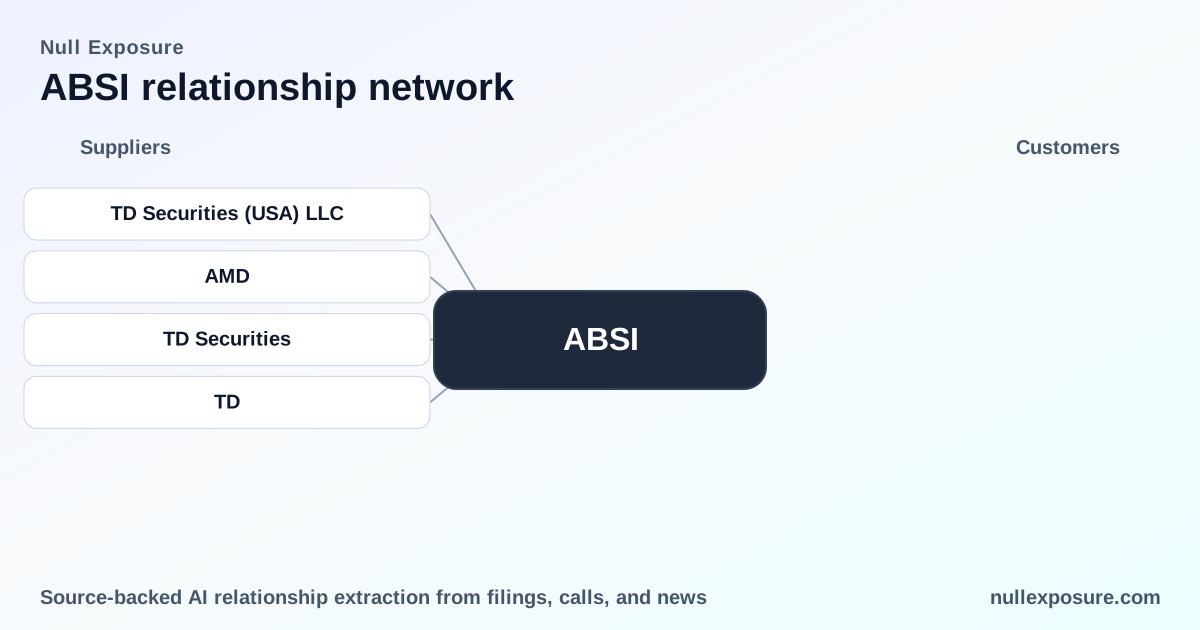
Absci Corp (ABSI) — Customer relationships read-through and investor implications
Absci Corp operates an AI-driven protein design and biologics discovery platform that licenses discovery services and collaborates with biopharma partners to generate therapeutic leads; the company monetizes through milestone payments, research fees and downstream commercial participation in programs that progress toward development. For investors, the core thesis is simple: Absci is a platform play whose valuation depends on the pace and quality of external collaborations converting into material, recurring revenue rather than on near-term product sales. Learn more about how we surface partner intelligence at https://nullexposure.com/.
Executive snapshot: business model drivers and operating posture
Absci’s value proposition rests on a proprietary computational and wet-lab stack that accelerates protein generation and candidate optimization, which the company commercializes primarily through collaborative agreements with pharmaceutical and biotech firms. Financial signals show early-stage commercialization: trailing twelve-month revenue is modest (about $2.8M) with persistent negative margins (Operating Margin TTM -54.5%, Gross Profit negative), reflecting a mix of R&D investment and milestone-driven revenue recognition. Institutional ownership at roughly 75% implies professional investor interest, while insiders retain a material stake (~13%), creating alignment but also potential concentration of directional control.
From an operational perspective:
- Contracting posture is partnership-driven — Absci sells capabilities and program-level collaborations rather than commoditized product licenses, which creates bespoke negotiation dynamics and uneven revenue timing.
- Commercial concentration is a structural feature — monetization depends on limited, high-value partner wins and milestone realization rather than broad-based recurring revenue.
- Criticality and maturity are asymmetric — Absci’s platform is strategically valuable to partners, but Absci is still early in commercial maturity, so partnerships are critical for near-term revenue but not yet broadly diversified.
These characteristics position Absci as a high-conviction, binary-outcome investment: successful program conversions and sustained partner wins will compress downside, while delays or program terminations will keep headline financials negative.
What the relationship hits in the results actually show
The provided relationship matches list three commercial counterparties: OSG (Overseas Shipholding Group), CPLP (Capital Product Partners), and GOGL (Golden Ocean Group). Each recorded excerpt in the results references the American Bureau of Shipping (ABS) — the maritime classification society — not Absci Corp. Below I cover every relationship returned in the raw results and the underlying source for clarity.
OSG — two news hits about an LCO2 barge AIP
The two items referencing OSG describe ABS (American Bureau of Shipping) awarding an Approval in Principle to Overseas Shipholding Group for a liquefied carbon dioxide barge design, and are unrelated to Absci’s business lines. One source is gCaptain (March 10, 2026): https://gcaptain.com/abs-grants-approval-for-first-u-s-liquefied-co2-barge-design/, and the other is The Maritime Executive (March 10, 2026): https://maritime-executive.com/corporate/abs-approves-first-of-its-kind-lco2-barge-for-u-s-operation-1.
CPLP — class notation mention for an LNG carrier
A single Offshore Energy report (first seen March 9, 2026) notes that a newly delivered LNG carrier is classed by ABS, referring to classification activity rather than a commercial collaboration with Absci. Source: Offshore-Energy.biz (March 9, 2026): https://www.offshore-energy.biz/capital-product-partners-welcomes-7th-lng-carrier-into-the-fleet/.
GOGL — classing of a bulk carrier
An Offshore Energy article (March 9, 2026) reports the bulk carrier “Golden John” is classed by the American classification society ABS and will sail under the Marshall flag, again a maritime classing note unconnected to Absci’s therapeutic platform. Source: Offshore-Energy.biz (March 9, 2026): https://www.offshore-energy.biz/new-eco-friendly-bulk-carrier-delivered-to-gogl/.
Bottom line on the listed relationships: the three entries reflect news about the classification society ABS and maritime vessels, not Absci Corp customers; these are false positive hits for ABSI when evaluating customer exposures.
Why these false positives matter to investors
Data noise of this type has three practical implications for research and risk modelling:
- Signal quality risk: Automated relationship matches that conflate “ABS” (American Bureau of Shipping) with “ABSI” (Absci Corp) will produce misleading counterparty maps unless filtered, increasing the chance of erroneous conclusions about client concentration or industry exposure.
- Due diligence burden: Investors and operating partners must reconcile automated relationship outputs with business reality; Absci’s customer universe sits in pharma and biotech, not shipping, so on-the-ground verification is necessary before relying on relationship-derived valuations.
- Misstated concentration metrics: If false positives are counted as customers, models will understate commercial concentration risk in Absci’s actual partner set (biopharma collaborations), giving a false sense of diversification.
These are research-process constraints rather than company-specific operational constraints; no explicit contractual or counterparty constraints for Absci were returned in the relationship data provided.
Financial and commercial risk context for underwriting
Integrating Absci’s financials with the relationship noise above yields a pragmatic investor checklist:
- Revenue scale and cadence are low and lumpy. Absci’s TTM revenue (~$2.8M) and negative gross profit indicate commercialization is nascent and highly milestone-dependent.
- Cash burn and margin dynamics are central. Negative EBITDA and operating losses keep execution and financing risk elevated until collaborations produce predictable, recurring revenue.
- Institutional ownership is high, but product maturity is low. A 75% institutional ownership rate signals professional interest, yet valuation depends on successful partner conversions and potential future licensing or royalty streams.
- Research hygiene is mandatory. Given the mismatch in the relationship outputs, investors must validate counterparties against disclosed collaboration announcements, filings and press releases rather than rely solely on automated relationship mappings.
If you want a structured partner reconciliation for Absci’s disclosed collaborations and a cleaned customer exposure map, see our methodology at https://nullexposure.com/.
Conclusion — clear research actions and key takeaways
- Treat Absci as a platform-led biotech with high optionality and binary commercialization outcomes.
- Discard the maritime “ABS”-related hits for customer-analysis of Absci; they are noise.
- Prioritize verification of biopharma collaborations and milestone schedules when modeling revenue realization.
- Monitor cash runway and milestone achievement cadence as the primary drivers of re-rating.
For investors building exposure or conducting counterparty diligence on ABSI, the most immediate action is to reconcile automated relationship outputs with Absci’s public collaboration disclosures and financial filings to avoid the exact false-positive signals surfaced here.