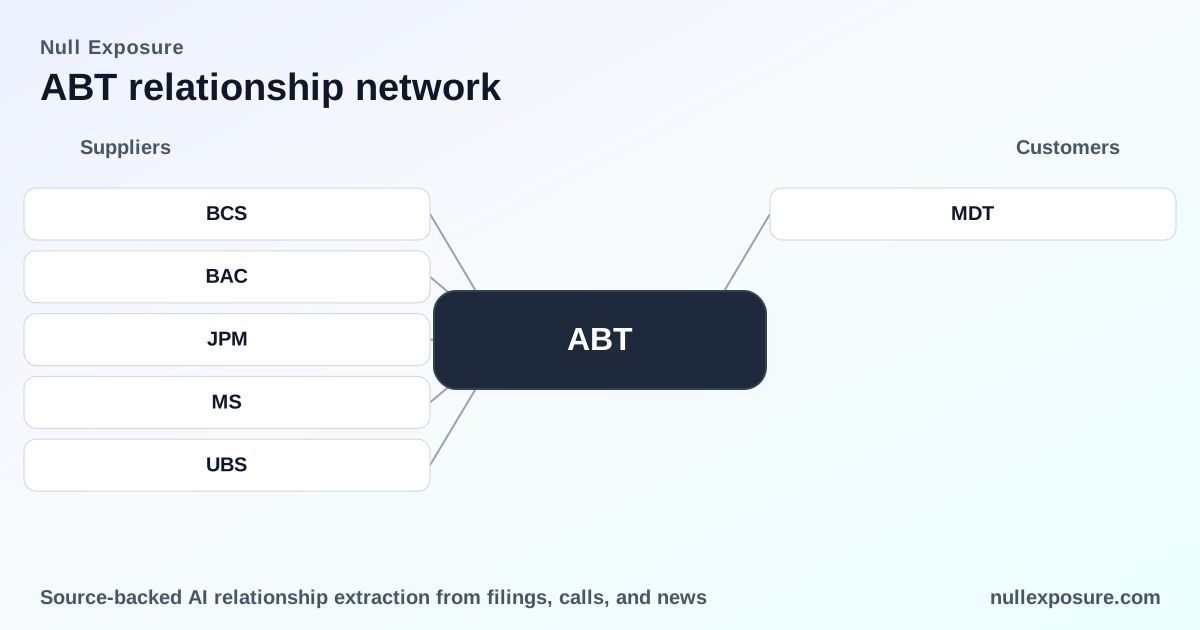
Abbott Laboratories (ABT): customer relationships that deliver recurring revenue and product reach
Abbott monetizes through a diversified portfolio of medical devices, diagnostics, nutrition and branded generics, selling products directly to health systems, distributors and consumers while capturing recurring revenue from consumables, service contracts and multi-period diagnostic agreements. The company’s commercial model mixes high-volume, short-term receivable sales with strategically important long-term service and supply arrangements in diagnostics and devices, creating both stable cash flow and embedded franchise value. For a deeper view of customer-level exposure and partner integration, visit https://nullexposure.com/.
Quick investment thesis in one paragraph
Abbott’s competitive moat is distribution breadth and product stickiness: consumable-heavy diagnostics and continuous glucose monitoring (CGM) sensors generate repeat revenue, while device integrations with insulin pump and mapping-system vendors expand addressable markets. Revenue is concentrated in many small, recurring customer relationships rather than a few material counterparties, reducing single-counterparty risk while tying Abbott’s growth to partner adoption of its sensor and diagnostic platforms.
The relationships you should know — plain-English summaries and sources
Below I cover every customer/partner mention found in the source set. Each entry is a concise summary with the public source.
FLGT (Fulgent Genetics)
Fulgent disclosed reliance on Abbott for certain laboratory equipment, supplies and services used in its FISH tests and testing services, indicating Abbott supplies instruments and reagents to external clinical labs. Source: Fulgent 2024 10‑K (flgt-2024-12-31).
PLSE (Pulse Biosciences)
Pulse announced its nPulse cardiac catheter will be presented integrated with Abbott’s EnSiteX™ 3D Mapping System at the AF Symposium, signaling device-level interoperability between Pulse’s ablation catheter and Abbott mapping platforms. Source: InvestingNews and BioSpace press releases covering the AF Symposium (Feb–Mar 2026).
MDT / Medtronic
Multiple press reports in early 2026 note that Medtronic’s insulin delivery systems are being launched or validated to work with Abbott sensors — the Instinct/Instinct Go sensor compatibility is repeatedly highlighted — reflecting Abbott’s role as a sensor supplier to other major pump vendors. Sources: DrugDeliveryBusiness and SimplyWallSt coverage of Medtronic product launches (Mar–May 2026).
PODD (Insulet / Omnipod)
Insulet’s product development commentary references integrating Omnipod 5 with Abbott’s FreeStyle Libre 3 Plus sensor as part of future device-roadmap work, indicating an OEM/integration relationship in the automated insulin delivery ecosystem. Source: TradingView summary of Insulet disclosures (Mar 2026).
TNDM (Tandem Diabetes Care)
Tandem has announced that its t:slim X2 pump is available integrated with Abbott’s FreeStyle Libre 2 and FreeStyle Libre 3 Plus sensors in the United States, demonstrating broad third‑party adoption of Abbott CGM sensors across pump manufacturers. Sources: Zacks/TradingView and SimplyWallSt reporting of Tandem announcements (2026).
BioReference® Health LLC
BioReference Direct publicly states it offers the simpli‑COLLECT™ STI at‑home self‑collection test through a collaboration with Abbott, which positions Abbott as a supplier or clinical partner for at‑home specimen collection/testing workflows. Source: GlobeNewswire press release announcing BioReference Direct product expansion (Apr 30, 2026).
OPK (Opko Health or related partner reference)
An item in the same GlobeNewswire release connects Abbott collaboration to BioReference Direct offerings; OPK appears in the results set with the same description, indicating either a cross‑referenced distribution/partner mention or overlapping press coverage. Source: GlobeNewswire (Apr 30, 2026).
OMDA (Omada Health)
Abbott and Omada announced a partnership to integrate FreeStyle Libre CGM into Omada’s digital care program for people with type 2 diabetes, reflecting Abbott’s strategy of embedding sensors into digital therapeutics and coaching ecosystems. Source: Abbott press release on the Abbott–Omada partnership (Oct 2019; referenced in later summaries).
What the relationship map reveals about Abbott’s operating model
-
Contracting posture — mix of short-term sales and multi‑period service contracts. Abbott sells many products under short-term receivables, but diagnostics and device segments include multi‑period instrument/service arrangements that create contract liabilities and future revenue recognition. This split supports predictable consumables revenue while allowing capital recovery for installed instruments. (Company filing disclosures.)
-
Customer concentration — broadly dispersed and immaterial at the single‑counterparty level. Abbott’s filings state it has no single customer whose loss would be materially adverse; revenue is distributed across retailers, wholesalers, hospitals, labs, government agencies and consumers.
-
Geographic reach — global selling footprint. Abbott operates worldwide, supplying instruments, consumables and sensors across geographies and channels, which reduces exposure to localized downturns but increases regulatory and payer complexity.
-
Role variety — Abbott is simultaneously seller, distributor partner and platform supplier. The company functions as manufacturer and direct seller, but also supports distributor channels and third‑party integrations (e.g., CGM sensors integrated into competitors’ pumps and into digital health partners).
-
Maturity and spend profile — sizable committed backlog in diagnostics. Abbott reports approximately $5.5 billion of unsatisfied performance obligations in Diagnostics and $440 million in Medical Devices, indicating substantial multi‑period contractual revenue that supports medium‑term cash flow and confirms a spend band consistent with large institutional customers.
Investment implications: drivers and risks
-
Key driver: repeatable consumables and service revenue from CGM sensors, diagnostics reagents and lab supplies underpin margins and valuation multiple expansion potential.
-
Strategic advantage: platform integrations — presence inside insulin pumps (Tandem, Insulet, Medtronic) and electrophysiology mapping systems (Pulse) accelerates clinical adoption and widens the installed base for consumables.
-
Risk considerations: regulatory approvals and interoperability decisions by partners influence adoption timing; while Abbott’s customer base is broad, product success depends on continued integration wins with device OEMs and digital-health platforms.
-
Additional operational signals:
- Abbott sells primarily under short‑term receivables, but multi‑period service arrangements create deferred revenue and recurring recognition.
- Government agencies and individual consumers are material buyer categories, reflecting mixed B2B and B2C distribution dynamics.
- The company’s declared lack of single‑customer concentration reduces counterparty concentration risk.
For a consolidated, interactive view of these customer relationships and how they affect counterparty exposure, see https://nullexposure.com/.
Bottom line
Abbott’s commercial model is built for repeatability: durable consumables demand plus strategic integrations provide both recurring revenue and optionality into adjacent device and digital markets. Investors should watch near‑term partner integrations and the pace of adoption by insulin pump and electrophysiology OEMs as primary drivers of incremental growth and margin leverage.
Explore more relationship analytics and commercial counterparty signals at https://nullexposure.com/.