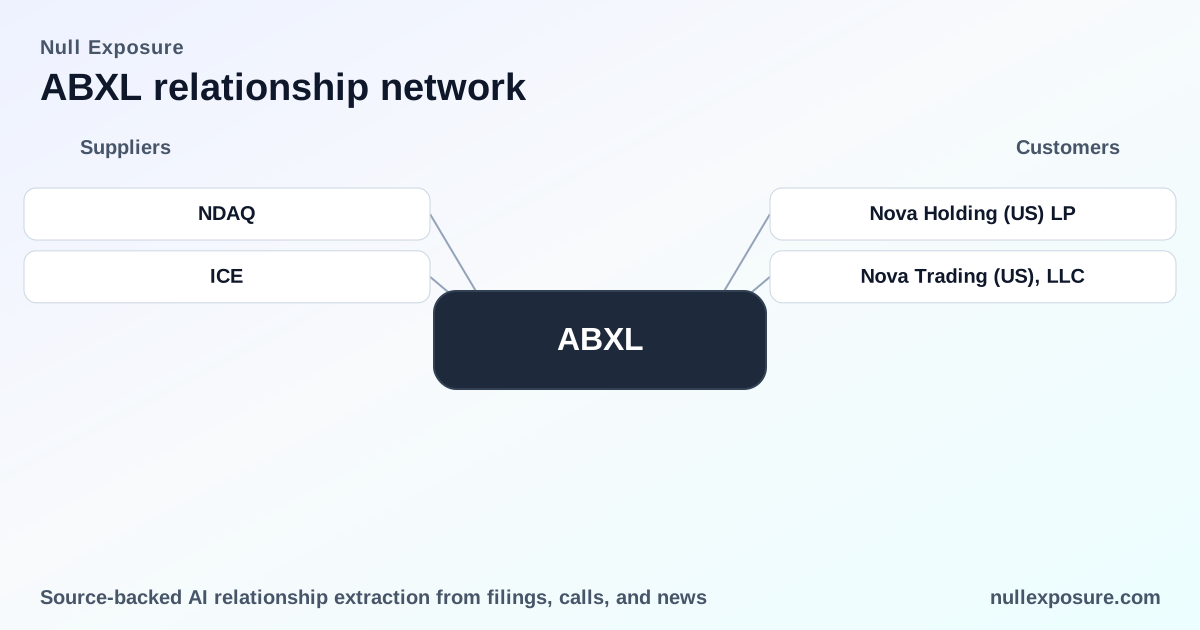
ABXL: Customer Relationships and Commercial Posture — what investors need to know
Thesis: ABXL operates as a life‑settlements and alternative asset manager that has recently layered technology services through its ABL Technologies unit; the company monetizes through fixed annual technology contracts, asset‑management fees tied to assets under management, origination spreads on policy trades, and fee‑based policy servicing. These revenue streams create a hybrid business model combining recurring contract revenues with transaction‑driven trading profit — a profile that rewards scale, regulatory breadth, and the uptake of newly introduced technology services.
For additional context on how we source and present counterparty relationships, visit https://nullexposure.com/.
Executive summary: ABXL’s FY2024 disclosures list two related‑party customer connections to Nova entities. Both relationships are disclosed as related parties in the company’s 2024 Form 10‑K; the filings provide no further commercial terms in the excerpts but do situate these counterparties within a broader, U.S.‑centric operating footprint that is developing a technology subscription offering alongside mature life‑settlements operations. Below I walk through the disclosed relationships, then synthesize company‑level constraints that drive contract risk, concentration, and runway for revenue growth.
H2: Quick read on the disclosed customer ties
- Nova Holding (US) LP — According to ABXL’s 2024 Form 10‑K, Abacus Settlements discloses a related‑party relationship with Nova Holding (US) LP in FY2024; the filing lists the connection but does not disclose commercial terms in the excerpted language. (Source: ABXL FY2024 Form 10‑K, abxl‑2024‑12‑31.)
- Nova Trading (US), LLC — ABXL’s FY2024 Form 10‑K also records a related‑party relationship between Abacus Settlements and Nova Trading (US), LLC; again, the filing notes the relationship without revealing detailed transaction pricing or volumes in the excerpt. (Source: ABXL FY2024 Form 10‑K, abxl‑2024‑12‑31.)
H3: What those relationship disclosures tell investors The two Nova entities are recorded as related parties rather than typical arm’s‑length customers, which is an important governance and commercial signal. Related‑party designation elevates counterparty risk and requires monitoring for preferential terms, though the Form 10‑K excerpts do not disclose economics or concentrations attributable to these specific Nova counterparties. Investors should treat these as governance‑adjacent relationships that can influence consolidated cash flows if material terms or guarantees exist beyond the disclosure line items. (Source: ABXL FY2024 Form 10‑K.)
H2: Company‑level constraints and what they imply about the operating model
ABXL’s filings yield multiple company‑level signals about contracting posture, customer concentration, criticality, and maturity of revenue streams. Presenting these as company characteristics:
- Contracting posture — subscription and fixed‑term orientation. Technology Services are sold on fixed annual contracts; the disclosure frames fees as subscription‑style, recurring revenue that began generating revenue in December 2024. This produces a baseline of recurring cash flow but also creates renewal risk as contracts roll annually. (Source: ABXL FY2024 Form 10‑K.)
- Revenue mix — recurring fees plus transaction economics. Asset Management fees are percentage‑of‑AUM, producing usage‑linked revenue, while originations and trading generate spreads and one‑off gains; servicing yields fee‑based revenue tied to policy value. The hybrid profile amplifies upside from asset growth but also produces volatility from trading activity. (Source: ABXL FY2024 Form 10‑K.)
- Customer composition — government, institutions, and individuals. The company explicitly targets pension funds, government agencies, insurance businesses, and individual channels (a ~30,000 advisor network and direct‑to‑consumer), indicating diversified counterparty types but a heavy U.S. orientation. This mix supports scale for technology services while anchoring asset management with institutional mandates. (Source: ABXL FY2024 Form 10‑K.)
- Geography — concentrated in North America with targeted EMEA presence. Operations are “mostly confined to the United States,” active in 49 states and DC, while a small Luxembourg office supports Asset Management in EMEA — signaling dominant U.S. regulatory exposure with limited international footprint. (Source: ABXL FY2024 Form 10‑K.)
- Maturity profile — established life settlements leadership; technology is nascent. ABXL reports a roughly 26% market share by capital invested in 2023, positioning the firm as a market leader in life settlements; by contrast, Technology Services only began revenue in December 2024 (contributing modest dollars in 2024), so growth runway exists but execution is early‑stage. (Source: ABXL FY2024 Form 10‑K and related 2024 report citations in the filing.)
- Segment orientation — services first, software second. The business is primarily services‑driven (asset management, portfolio servicing, originations), while ABL Tech introduces software‑enabled services (real‑time mortality verification, missing participant location). This means margins can improve with software scale, but near‑term economics will reflect heavy service labor and asset financing costs. (Source: ABXL FY2024 Form 10‑K.)
H3: Operational implications for investors and operators
- Renewal and concentration risk: Fixed annual contracts create predictable near‑term cash flows but concentrate renewal risk around contract anniversaries. Institutions and government agencies as counterparty classes reduce churn compared with DTC channels, but large institutional relationships can create single‑counterparty concentration if one contract is material.
- Capital intensity and timing: Originations and holding policies on the balance sheet require premium payments and working capital; trading strategies generate spreads but require liquidity. The mix of AUM fees and trading spread should be evaluated against balance‑sheet funding costs.
- Technology leverage: ABL Tech’s product set is strategically valuable — real‑time mortality verification is a differentiator — and software scale could shift margins over time, but current revenue is nascent and ramping. (Source: ABXL FY2024 Form 10‑K.)
For further company screening and relational insights, see https://nullexposure.com/.
H2: Investment takeaways — positioning and risks
- Bull case: ABXL combines a leading incumbent position in life settlements with a nascent technology offering that can convert service revenue into higher‑margin recurring contracts; diversified counterparty types (government, institutional, retail channels) reduce single‑channel dependency. (Source: ABXL FY2024 Form 10‑K.)
- Key risks: Related‑party relationships such as those with Nova entities warrant governance scrutiny; technology revenue is early and small, so growth assumptions must be grounded in contract wins and retention metrics; balance‑sheet funding of policies creates interest‑rate and liquidity exposure. (Source: ABXL FY2024 Form 10‑K.)
- Catalysts to watch: sustained growth in Technology Services contract signings, material increases in AUM, or disclosures that define the Nova relationships economically.
Conclusion: ABXL presents a blended commercial model where recurring, subscription‑style technology contracts coexist with asset‑heavy life‑settlements operations. The FY2024 references to Nova Holding (US) LP and Nova Trading (US), LLC are recorded as related parties and should be tracked in future filings for transactional detail. Investors should weigh the company’s established market share and U.S. regulatory breadth against governance questions tied to related parties and the early‑stage economics of its technology segment.
If you want a concise dashboard of ABXL’s counterparty exposures and signal‑driven constraints, NullExposure offers an investor‑grade view at https://nullexposure.com/.