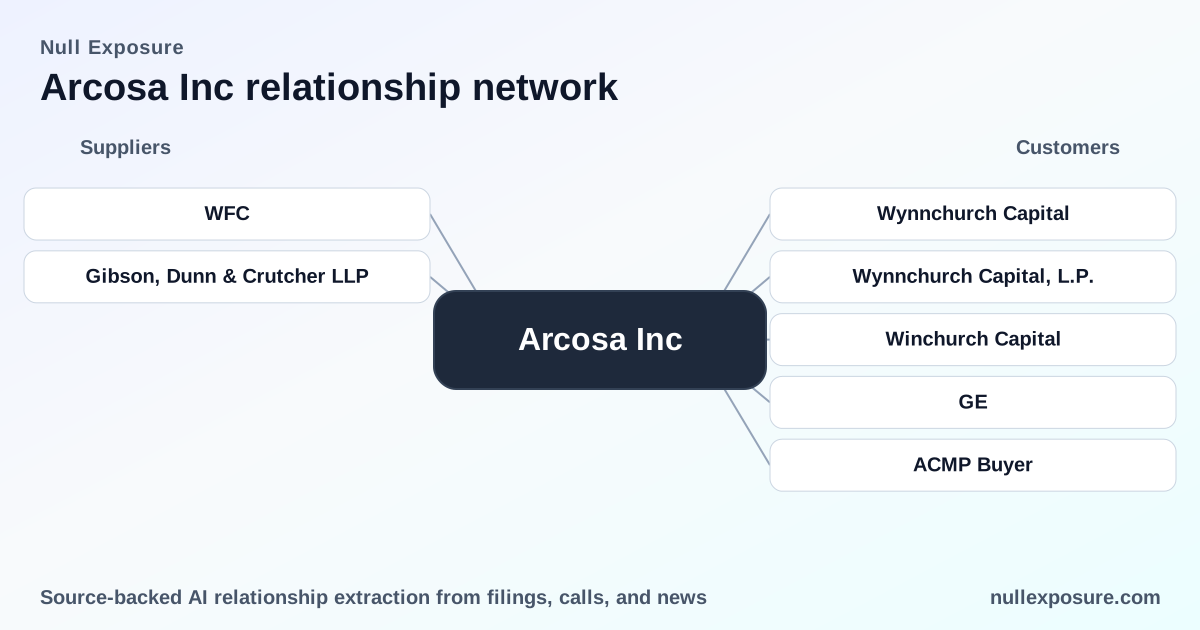
Arcosa (ACA) — Customer relationships and what they say about revenue visibility and concentration
Arcosa monetizes by selling infrastructure-related products and services across three core lines: Engineered Structures (custom utility and wind towers recognized over time), Construction Products (aggregates, asphalt sold at point of title transfer), and Transportation Products (inland barges and related equipment). The company sells directly and through distributors, builds multi-year alliance contracts with utilities for engineered structures, and carries a multi-hundred‑million dollar backlog that underpins near‑term revenue visibility. For investors, the key drivers are backlog-driven revenue recognition in engineered structures, material customer concentration in large industrial buyers, and recent portfolio pruning that released $450 million in cash. (Explore primary customer intelligence at https://nullexposure.com/.)
How Arcosa actually sells — a short commercial profile
Arcosa operates as a North American infrastructure platform selling both highly customized, long‑duration engineered products and commodity construction materials. Engineered Structures generate long-term, input‑cost revenue recognition for bespoke orders, giving multi-year visibility; Construction and Transportation Products are largely spot/turnover sales recognized at delivery, which preserves margin when volumes are strong but amplifies cyclicality. The company’s backlog and reported unsatisfied performance obligations (utility/wind structures and barges) describe a business that is simultaneously stable in contracted pipeline and exposed to short‑cycle demand swings. Arcosa’s revenue mix and GE Vernova concentration (above 10% historically) are material for credit and equity analysis.
What the coverage feed shows — every relationship called out
Below I cover every relationship listed in the collected results and cite the source tied to that mention.
Wynnchurch Capital / ACMP Buyer (multiple mentions)
Arcosa agreed to sell its inland barge business (Arcosa Marine Products, Inc.) for approximately $450 million in cash to an affiliate of Wynnchurch Capital — referenced in press coverage and trading platforms; the transaction was announced in March 2026 and reported complete in May 2026 in some outlets. (Waterways Journal, Dallas Innovates, TradingView, GlobeNewswire and other March–May 2026 press coverage: https://www.waterwaysjournal.net/2026/02/27/arcosa-to-sell-barge-business-for-450-million/; https://dallasinnovates.com/dallas-based-arcosa-to-sell-its-barge-business-to-wynnchurch-capital-for-450m/; https://www.tradingview.com/news/tradingview:aa49e8cbb0915:0-arcosa-to-sell-arcosa-marine-products-to-wynnchurch-affiliate-for-approximately-450-million/).
Note: the buyer is also referenced as “ACMP Buyer,” an affiliate vehicle used to acquire Arcosa Marine Products, and press coverage confirms the same economics and party. (TradingView, Mar 2026: https://www.tradingview.com/news/tradingview:aa49e8cbb0915:0-arcosa-to-sell-arcosa-marine-products-to-wynnchurch-affiliate-for-approximately-450-million/).
Winchurch / Win(n)church Capital (transcript reference)
A Q4 2025 earnings call transcript quoted management expressing confidence that the buyer (misspelled there as “Winchurch”) will perform well with the asset — this is the same Wynnchurch Capital buyer repeatedly reported in contemporaneous press. (InsiderMonkey earnings call transcript excerpt, Mar 2026: https://www.insidermonkey.com/blog/arcosa-inc-nyseaca-q4-2025-earnings-call-transcript-1706228/).
GE / GE Vernova, Inc.
GE Vernova is a material customer in Arcosa’s Engineered Structures segment, accounting for roughly 12.2% of consolidated revenues in 2025 (10.8% in 2024, 8.1% in 2023) — a concentration that requires investor attention for both revenue and working capital sensitivity. (Arcosa Form 10‑K, FY2025; company filing language on customer concentration, reported in the 2025 10‑K).
NHPBP and NHPAP (National Healthcare Properties tickers referenced in press)
Press items referencing NHPBP and NHPAP describe public offerings where Crédit Agricole CIB and Synovus act as co‑managers; these items were captured by the feed but do not describe Arcosa as a counterparty. They appear as third‑party capital markets activity in the same news scrape. (GlobeNewswire/Manila Times/press releases, Apr–May 2026: examples at https://www.globenewswire.com/news-release/2026/04/13/3272369/0/en/National-Healthcare-Properties-Announces-Launch-of-Public-Offering.html).
WELL (Welltower)
A PR Newswire release cited Crédit Agricole CIB as sustainability structuring agent in a Welltower credit facility announcement; this appears in the feed as part of broader market news and is not described as a direct Arcosa customer relationship. (Welltower PR Newswire, Mar 2026: https://www.prnewswire.com/news-releases/welltower-announces-upsizing-and-maturity-extension-of-6-25-billion-senior-unsecured-line-of-credit-302709133.html).
EE (Excelerate Energy / EE ticker reference)
A press note referenced book‑running managers on an Excelerate Energy offering (Credit Agricole CIB, DNB Markets, Jefferies, Wells Fargo). This clipping is included in the relationship feed but does not represent an Arcosa customer; it is market coverage adjacent to Arcosa items. (PR/BizWire coverage, Apr 2025 as referenced in the feed).
Interpreting constraints: what the relationship patterns tell investors
The underlying constraint signals in Arcosa’s customer relationships produce a clear commercial profile for credit and equity analysis:
- Mixed contracting posture: Arcosa runs a hybrid model — long‑term, high‑customization contracts in Engineered Structures (revenue recognized over time using an input approach) coexisting with spot and short‑term sales in Construction and Transportation Products (revenue when title transfers). This combination gives predictability for large bespoke projects and volatility for commodity lines.
- Material concentration: The 2025 Form 10‑K identifies GE Vernova as >10% of consolidated revenue, a material concentration that amplifies counterparty risk in the engineered‑structures book.
- Backlog maturity and delivery timing: Reported backlog shows major delivery cycles into 2025 and through 2028 for engineered structures and concentrated delivery for barges into 2025–2026; this supports near‑term revenue visibility but also front‑loads execution risk.
- Geographic concentration: Arcosa operates principally in North America, so demand and regulatory cycles in the U.S./Mexico dominate cash flow outcomes.
- Spend scale: The company‑level signal indicates customer spend bands above $100m for material relationships, consistent with large utility and industrial buyers.
- Relationship roles: Arcosa is predominantly a seller of manufactured infrastructure products, with selective service provision (asphalt paving) and distributor channels; for engineered segments it operates as a long‑term contract manufacturer.
Strategic implications for investors
- The completed sale of the barge unit to Wynnchurch (ACMP Buyer) for $450 million in cash materially de‑risks cyclicality in the Transportation Products portfolio and strengthens the balance sheet for core expansion (per multiple March–May 2026 reports). (Dallas Innovates; Waterways Journal; GlobeNewswire).
- Concentration with GE Vernova is an explicit earnings leverage point; loss or deferral of large orders would quickly affect consolidated margins given the >10% revenue share reported in FY2025. (Arcosa 2025 10‑K).
- The long‑term alliance contracts with utilities give durable revenue streams in engineered structures, but execution cadence and raw‑material/steel cost pass‑throughs will determine margin realization.
- Market commentary and filings suggest active management of portfolio composition (asset sale, focus on core engineered and construction products) — a positive for long‑term free‑cash flow if the company redeploys proceeds into higher‑margin or higher‑return segments.
If you want a structured investor summary (credit checklist and exposure map) or a one‑page slide for board/stakeholder review, I can prepare that next. For more detailed customer analytics and signal tracking, visit https://nullexposure.com/.
Bold takeaway: Arcosa combines backlog‑backed engineered revenues with spot commodity sales; the Wynnchurch barge divestiture crystallizes value and reduces transportation cyclicality, while GE Vernova concentration remains the principal counterparty risk to monitor.