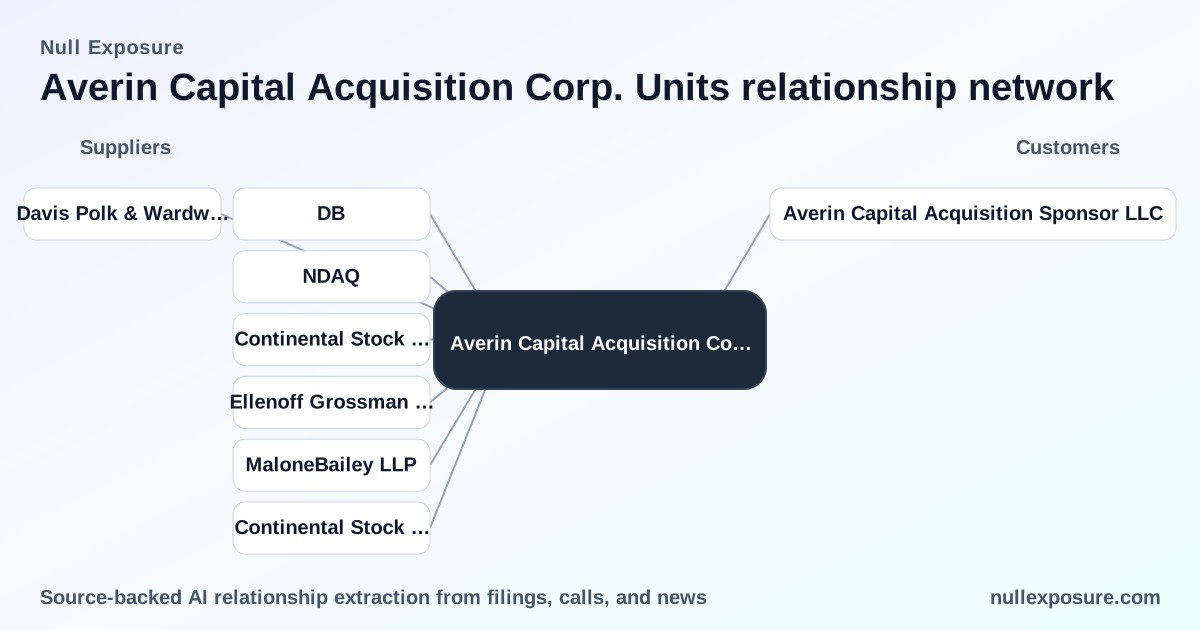
Averin Capital Acquisition Corp. (ACAAU) — Sponsor placement and what it signals to investors
Averin Capital Acquisition Corp. is a classic SPAC vehicle: it monetizes by raising cash through a public unit offering and a concurrent sponsor private placement, then seeks a business combination in technology, healthcare, or consumer sectors to convert that pooled capital into operating value. Investors buy exposure to deal execution and sponsor alignment rather than operating cash flow today; the sponsor’s private purchase is a direct alignment signal that contributes upfront working capital and preserves underwriting economics for the sponsor group.
For deeper diligence on SPAC capitalization and sponsor behavior, see the research hub at NullExposure.
Why the sponsor purchase matters for investors
A sponsor private placement is not a revenue event — it is a governance and alignment vector. Averin’s sponsor purchased 200,000 units at $10 each, generating $2.0 million of gross proceeds concurrent with the IPO. That capital increases the SPAC’s resources for a business combination and gives the sponsor an equity stake that aligns incentives around deal completion and post-merger upside. The sponsor purchase is small relative to the reported $250 million IPO but strategically important as a formal show of commitment and a typical mechanism for SPAC economics.
A second look at capitalization and related filings can be accessed at NullExposure for consolidated document traces and timeline context.
The evidence, line by line
Averin Capital Acquisition Sponsor LLC — each of the following entries documents the same economic event through multiple filings and reporting channels. Each item below is a plain-English summary of a distinct record in the public reporting trail.
-
Averin Capital Acquisition Sponsor LLC purchased 200,000 units at $10.00 per unit in a concurrent private placement, bringing $2 million in gross proceeds to the SPAC; reported alongside coverage of a $250 million IPO. See Investing.com’s SEC-filings summary (May 2, 2026): https://m.in.investing.com/news/sec-filings/averin-capital-acquisition-completes-250-million-ipo-on-nasdaq-93CH-5262027?ampMode=1.
-
A separate SEC filing snapshot recorded the sponsor acquisition of 200,000 Class A ordinary shares at $10.00 per share on February 20, 2025, reflecting the private placement mechanics of the sponsor purchase. See StockTitan’s SEC filing capture (accessed May 2, 2026): https://www.stocktitan.net/sec-filings/ACAAU/.
-
The company’s 8-K referenced the private sale explicitly: 200,000 Private Placement Units were sold to Averin Capital Acquisition Sponsor LLC at $10.00 per unit, with gross proceeds to the company of $2,000,000, simultaneous with IPO closing. See the 8-K summary on StockTitan (accessed May 2, 2026): https://www.stocktitan.net/sec-filings/ACAAU/8-k-averin-capital-acquisition-corp-reports-material-event-c6d06bbf05e8.html.
-
A Form 4 filing captured the insider/affiliate transaction that shows the sponsor’s reported acquisition of 200,000 Class A ordinary shares at $10.00 per share, consistent with the private placement mechanics. See StockTitan’s Form 4 aggregation (accessed May 2, 2026): https://www.stocktitan.net/sec-filings/ACAAU/form-4-averin-capital-acquisition-corp-insider-trading-activity-636f15593d9c.html.
-
An additional StockTitan Form 4 note reiterated the sponsor’s buy of 200,000 Class A ordinary shares on February 20, 2025, bringing its reported Class A holdings to 200,000 shares; this record corroborates sponsor ownership immediately after IPO closing. See the Form 4 entry (March 9, 2026): https://www.stocktitan.net/sec-filings/ACAAU/form-4-averin-capital-acquisition-corp-insider-trading-activity-731940451f44.html.
-
A South African Investing.com mirror also reported the concurrent private placement: Averin Capital Acquisition Sponsor LLC bought 200,000 units at $10 each, generating $2 million in gross proceeds to the company, aligning with global SEC-filing summaries. See the investing.com regional feed (May 2, 2026): https://za.investing.com/news/sec-filings/averin-capital-acquisition-completes-250-million-ipo-on-nasdaq-93CH-4136248.
What these relationships imply for operating posture and risk
-
Contracting posture: Averin is operating under a standard SPAC contracting posture — a public IPO combined with a sponsor private placement. The sponsor purchase is an affiliate deal that secures initial cash and sponsor equity while preserving the public capital raised for the trust account and future combination activities.
-
Concentration: The evidence set shows a single, concentrated sponsor counterparty as the immediate non-public investor. The sponsor’s $2.0 million private placement is modest relative to the reported $250 million public raise, implying that public capital supplies the bulk of deal firepower while the sponsor contribution provides alignment and economics.
-
Criticality: Sponsor capital is strategically important for governance and incentive alignment even when quantitatively small; the sponsor’s ownership and control rights following the placement are more critical than the dollar amount in terms of deal execution and sponsor promote mechanics.
-
Maturity: The company’s public financial profile is characteristic of shell/SPAC entities: operating and revenue metrics are zero, book value near zero, and normal SPAC-era disclosures rather than operating KPI trends. This is an early-stage capitalization profile dependent entirely on deal execution, not operating cash generation.
No company-level constraints (third-party operational limits, vendor restrictions, or contract constraints) were identified in the customer-scope review; the record is limited to capital-raising and sponsor ownership disclosures.
Investment takeaways and risk checklist
-
Sponsor alignment exists but is limited in scale. The sponsor’s $2 million is a clear alignment signal but represents a small percentage of the IPO proceeds; investors should weigh alignment against dilution, promote mechanics, and redemption risk at the business combination stage.
-
Corporate economics drive outcomes, not operating cash today. Averin’s value to shareholders depends on target selection, deal terms, and post-merger execution; current public financials do not provide operating runway indicators.
-
Concentration of reporting channels is narrow. All relationship records trace to the same sponsor transaction across multiple filing feeds and news mirrors, which strengthens the provenance of the event but also indicates limited relationship diversity at this stage.
-
Governance and insider holdings matter. With insiders and sponsors holding a meaningful stake by design, sponsor behavior will materially influence transaction timing and terms; review Form 4s and the definitive proxy for deal-level economics.
Final view
Averin’s sponsor private placement is a conventional SPAC construct — a symbolic but economically small endorsement of the IPO and a necessary piece of standard SPAC capital structure. For investors and operators evaluating ACAAU customer/affiliate relationships, the immediate focus is on sponsor ownership, governance implications, and the broader IPO trust capital that funds the business-combination strategy.
For consolidated tracking of filings, sponsor transactions, and timeline analytics, visit NullExposure research center for primary-link aggregation and continuous updates.