Aurora Cannabis (ACB) — What the Leafio Distribution Tie Reveals About Customer Strategy
Aurora Cannabis operates as a vertically integrated medical cannabis producer and distributor, monetizing through branded product sales, wholesale distribution channels, and international market expansion. The company leverages a multi-brand portfolio—MedReleaf, CraftPlant, Aurora, Whistler Cannabis Co., and IndiMed—to reach pharmacies and clinics, and it captures margin through wholesale arrangements and branded penetration in regulated markets. Investors should evaluate recent distribution partnerships for signs of channel execution, revenue durability, and geographic concentration.
For a concise view of Aurora’s customer relationships and contract signals, visit the Null Exposure portal: https://nullexposure.com/
Why the Leafio partnership matters for revenue access in Australia
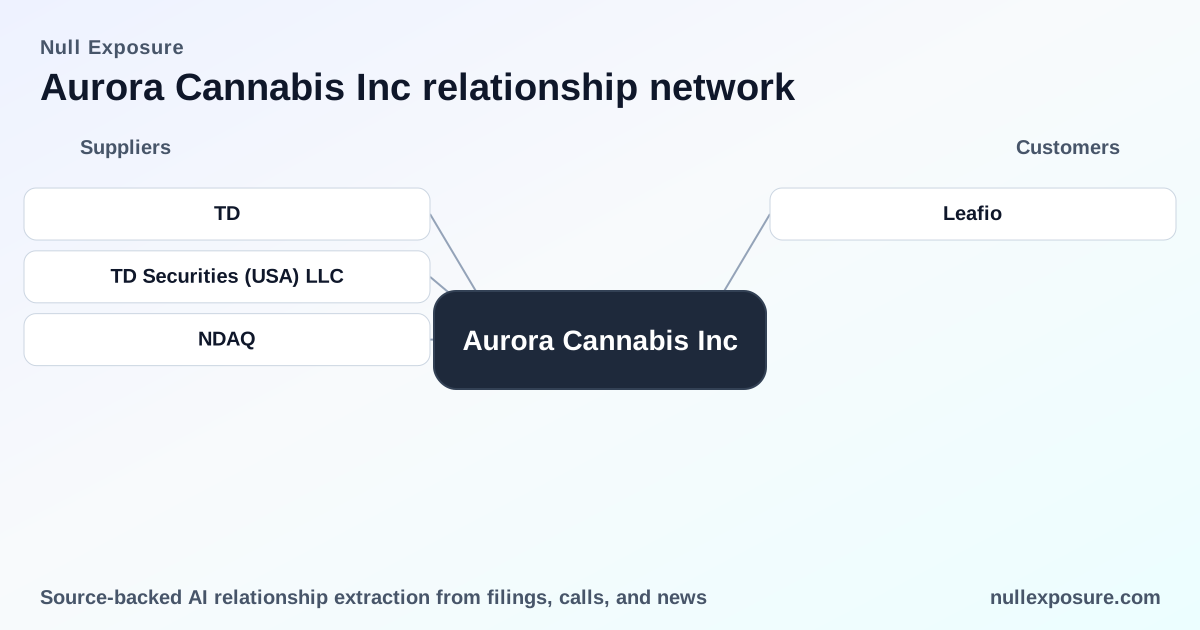
Aurora announced a commercial distribution arrangement for Australia that places its medical brands into local wholesale and pharmacy channels under the Leafio/Montu distribution platform. This is a classic go-to-market move: use a local wholesaler to scale brand presence without building a full on-the-ground logistics network. According to a PR Newswire release dated March 9, 2026, Leafio will act as the wholesaler for Aurora’s MedReleaf, CraftPlant, Aurora, Whistler Cannabis Co. and IndiMed brands in Australia. Source: PR Newswire (Mar 9, 2026).
A contemporaneous industry report noted that Aurora’s subsidiary, MedReleaf Australia, formally engaged Leafio (the wholesale arm of Montu Australia) with the stated objective of improving medical cannabis access across Australian pharmacies and patients; that announcement traces to a December 2, 2025 update described in market summaries. Source: TS2.Tech (Dec 2025). A third market outlet reinforced the same point by noting the signing of the Leafio partnership to distribute medical brands across Australian pharmacies. Source: StockTitan (Dec 2025–Mar 2026).
Customer relationship: Leafio — what the facts show
Leafio will wholesale Aurora’s medical brands into Australian pharmacies and clinics, providing distribution reach for Aurora’s portfolio without Aurora assuming direct last-mile logistics in that market. Source: PR Newswire (Mar 2026).
Industry reporting places this agreement in late 2025 and early 2026 coverage as part of Aurora’s strategy to scale MedReleaf Australia’s footprint and improve patient access through an established local wholesaler. Source: TS2.Tech (Dec 2025) and StockTitan (Dec 2025).
How this relationship fits Aurora’s operating model and business constraints
The relationship with Leafio illustrates several company-level operating model characteristics:
- Contracting posture: Aurora favors partnerships with local wholesalers to commercialize brands internationally rather than building proprietary local distribution infrastructure. That posture lowers upfront capital and operating complexity while placing execution risk on the distributor partner.
- Concentration and criticality: Single-market wholesale arrangements increase dependency on partner execution for revenue realization in that geography; the Leafio tie is critical for Australian channel access but represents one element of a dispersed international go-to-market approach.
- Maturity and scalability: Using a local wholesale partner reflects a scalable, low-capex market entry model—suitable for markets where regulatory complexity favors local expertise.
- Data/contract transparency: The available relationship feed contains no explicit contractual constraints or detailed commercial terms for customer deals, which is a company-level signal indicating limited public contract metadata for investor diligence. Absence of constraints in the captured data does not remove commercial risk; it simply limits visibility into tenor, exclusivity, or minimum purchase commitments.
These operating signals matter for forecasting revenue persistence and assessing downside: if wholesale partners face distribution disruption or exclusivity limitations, near-term sales could be volatile. Conversely, this model preserves capital flexibility and speeds market penetration when partner execution is reliable.
Commercial implications and revenue dynamics
Distribution partnerships like Leafio typically deliver volume uplifts through established pharmacy networks while compressing gross margins relative to direct-to-retail models because the wholesaler captures part of the distribution spread. For Aurora:
- Upside: Faster patient access and broader shelf presence in Australia without the capex of local logistics hubs; potential to scale existing brands rapidly if demand is strong.
- Downside: Margin dilution through wholesale economics and revenue concentration risk if the partner is the principal route into the market.
Investors should watch operational KPIs such as product listing counts, pharmacy penetration metrics (where disclosed), and any announcements around exclusivity or minimum purchase volumes to quantify both growth and risk.
Risk factors in the customer portfolio to monitor
- Execution dependency: The commercial outcome in Australia depends on Leafio’s ability to distribute effectively and maintain pharmacy relationships; any operational lapse translates to slower revenue recognition for Aurora in that region.
- Regulatory shifts: Medical cannabis markets remain sensitive to regulatory change; distribution partnerships reduce regulatory burden but do not eliminate compliance exposure tied to product approvals and prescribing regimes.
- Transparency gaps: The public disclosures tied to this relationship are high-level press coverage; investors lack line-item contractual details (term length, revenue guarantees, termination rights), which increases model uncertainty.
Principal takeaways for investors
- Leafio is a targeted channel play: It secures access to Australian pharmacies for Aurora’s established medical brands while preserving capital flexibility. (Source: PR Newswire, TS2.Tech, StockTitan)
- This model trades margin for speed: Wholesale distribution accelerates market reach but compresses per-unit economics and elevates dependency on partner execution.
- Limited contract visibility is a company-level signal: The dataset captures the relationship announcement but includes no detailed contractual constraints, increasing the importance of operational KPIs for monitoring performance.
For decision-making, focus on shipment and listing disclosures, subsequent financials showing Australian revenue contribution, and any follow-on press releases about expanded product listings or exclusivity clauses.
If you want ongoing tracking and structured summaries of Aurora’s customer relationships, visit the Null Exposure exploration hub: https://nullexposure.com/
Actionable next steps for analysts
- Monitor Aurora’s quarterlies for line items or MD&A commentary that quantify Australian revenue and distribution costs tied to the Leafio arrangement.
- Track pharmacy listing announcements and local market coverage in Australia to assess on-the-ground execution.
- Treat this relationship as material to regional revenue forecasts but assess margin assumptions conservatively given wholesale economics and the current lack of contract detail.
Bold, clear commercial partnerships like the Leafio distribution agreement move the needle on market access. Investors should weigh faster reach against margin and transparency trade-offs when modeling Aurora’s path to sustainable revenue growth.