ACCO Brands: Customer Relationships, Distribution Reach, and What Investors Should Know
ACCO Brands designs, manufactures and sells consumer, school, technology and office products and monetizes primarily through product sales across broad retail and distribution channels, supplemented by a small but steady stream of service and extended maintenance agreements (EMAs). Revenue is concentrated among a handful of large customers while distribution partners and resellers extend reach into global markets — a mix that creates both scale advantages and client-concentration risk for investors. For deeper customer-level insight, visit https://nullexposure.com/.
How ACCO actually gets paid — a concise operating thesis
ACCO’s business is transactional at scale: product sales through mass retailers, e‑tailers, wholesalers, office superstores and specialty dealers account for the lion’s share of revenue, with online direct sales and a direct sales organization as complementary channels. EMAs provide modest recurring revenue, recognized over contract terms that are predominantly short (mostly one year or less), while a limited number of large customers collectively represent a material portion of net sales even though no single customer exceeds 10% of total sales.
The company-wide customer signals that define risk and runway
ACCO is structured to be a global branded supplier, and the filings and disclosures provide clear operating signals investors should internalize:
- Global distribution, regionally organized. Effective January 1, 2024 ACCO reports through two operating segments — Americas (U.S., Canada, Brazil, Mexico, Chile) and International (EMEA, Australia/New Zealand, Asia). The company states products are sold primarily in the U.S., Europe, Australia, Canada, Brazil and Mexico, which supports a geographically diversified sales footprint while keeping meaningful exposure to developed markets (company filing, FY2024).
- Channel-driven go-to-market with multiple counterparty types. The firm lists mass retailers, e‑tailers, warehouse clubs, hardware and specialty stores, wholesalers, independent dealers and direct e‑commerce as core distribution routes; this implies high reliance on distributors/resellers and channel economics rather than single-source direct enterprise contracts (company filing).
- Concentration at the top but no single customer dominance. Net sales to the five largest customers were $532.9 million in FY2024 (and higher in prior years), indicating material concentration even though no single customer exceeded 10% of net sales (company filing). This is a double-edged signal: scale relationships support volume leverage, but loss or disruption among the largest buyers would be meaningful to margins and cash flow.
- Contracting posture is largely short-term. EMAs range from three to sixty months but most are one year or less, and payment is generally received upfront and recognized straight-line over the agreement term — indicating predictable short-duration recurring revenue (company filing).
- Services are small but visible. Unearned EMA revenue was $2.9 million as of December 31, 2024, of which $2.4 million is expected to be recognized in the next 12 months and $0.5 million beyond — signaling that services are an adjunct, not a core recurring engine (company filing).
- Relationship roles are diverse and active. The company acts as seller to distributors and resellers, and as vendor to both individual/retail customers and large enterprise buyers — a hybrid buyer/distributor/reseller marketplace (company filing).
- Scale and spend band. The five largest customers’ combined spend places ACCO in the $100M+ class of top-account exposure, which is material to revenue and needs active account management (company filing).
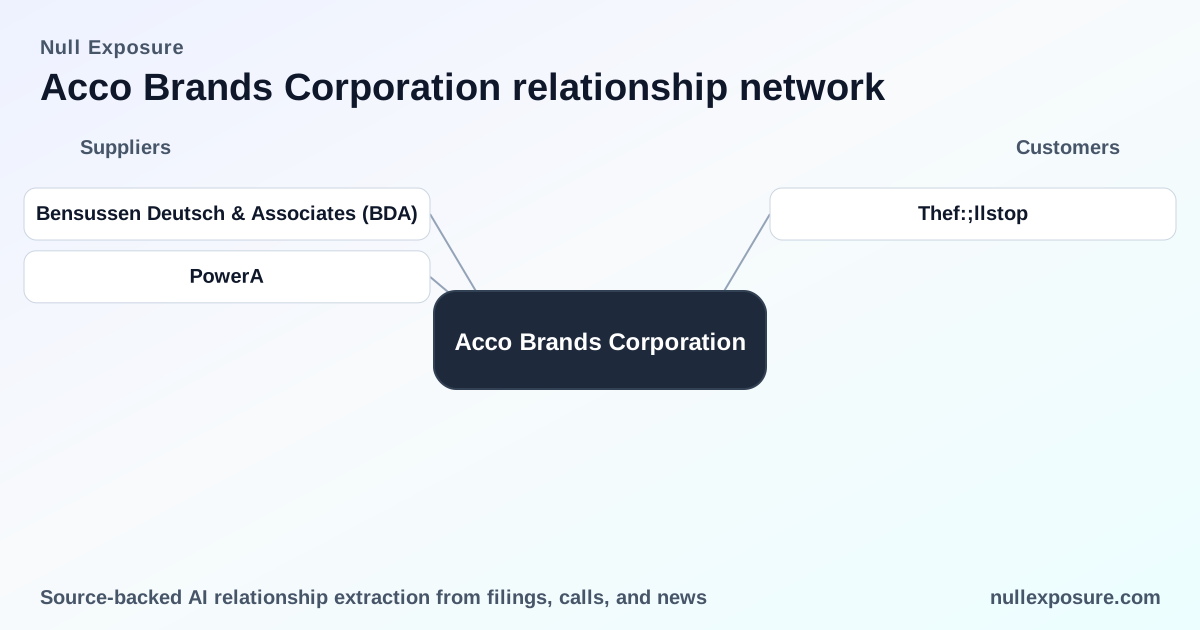
Distributor appointment in Sri Lanka — Thef:;llstop
A March 2026 report in FT.lk notes that Derwent, a British fine‑art brand owned by ACCO Brands, appointed Thef:;llstop as its new distributor in Sri Lanka, expanding local distribution for artist-focused products and adding a regional reseller channel for the brand (FT.lk, March 9, 2026). This is a tangible example of ACCO’s strategy to extend branded product distribution via local partners in APAC and EMEA markets.
What that single relationship reveals about ACCO’s model
The Derwent/Thef:;llstop appointment underscores several company-level dynamics rather than being an isolated anomaly:
- Brand-level distribution strategy: ACCO uses local distributors to access niche categories (fine art supplies) and geographies where local channel knowledge matters.
- Low contractual complexity and short sales cycle: Distributor appointments are consistent with the company’s broader short-term contracting posture and channel-centric sales approach.
- Geographic expansion with limited recurring revenue impact: These distribution deals drive product sales rather than significant long-term service contracts; therefore they increase top-line exposure in a low-capex, low-recurring way.
Investment implications — risks and opportunities
- Opportunity — Global scale with diversified channels. ACCO’s multi-channel approach and presence across Americas, EMEA, LATAM and APAC provide broad market access and resilience to region-specific shocks.
- Risk — Customer concentration. The top five customers account for a material share of sales ($532.9M in FY2024), which elevates counterparty concentration risk even if no single customer breaches the 10% threshold.
- Risk — Limited recurring revenue runway. EMAs are short-term and small relative to total revenue ($2.9M unearned), so margin stability relies on product volumes and channel economics rather than durable subscription cash flows.
- Opportunity — Brand extension through local distributors. Appointments like Thef:;llstop for Derwent illustrate a low-risk way to expand margins and reach within niche segments without heavy balance-sheet investment.
- Operational implication — active account management required. Given the materiality of the largest accounts and the dependence on third-party channels, execution risk sits with distribution partnerships, inventory flow and retailer relationships.
Actions for investors and operators
- Monitor quarterly disclosure of net sales to top customers and any material changes in the composition of the five largest buyers; these figures directly affect concentration risk.
- Watch EMAs and unearned revenue line items for any movement toward more multi-year or higher-margin service contracts; a shift would change revenue durability.
- Track regional distributor deals (like Derwent in Sri Lanka) as indicators of incremental revenue expansion in niche categories.
For a concise package of customer‑relationship signals and to compare ACCO’s partner posture against peers, visit https://nullexposure.com/.
Bottom line
ACCO is a channel-first physical‑goods OEM with meaningful top‑customer concentration, modest services income, and an active program of local distributor appointments to extend branded reach globally. That mix creates steady cash generation in favorable retail cycles, but leaves the company sensitive to concentration and channel disruption — the exact dynamics investors should weigh when assessing valuation and downside risk.