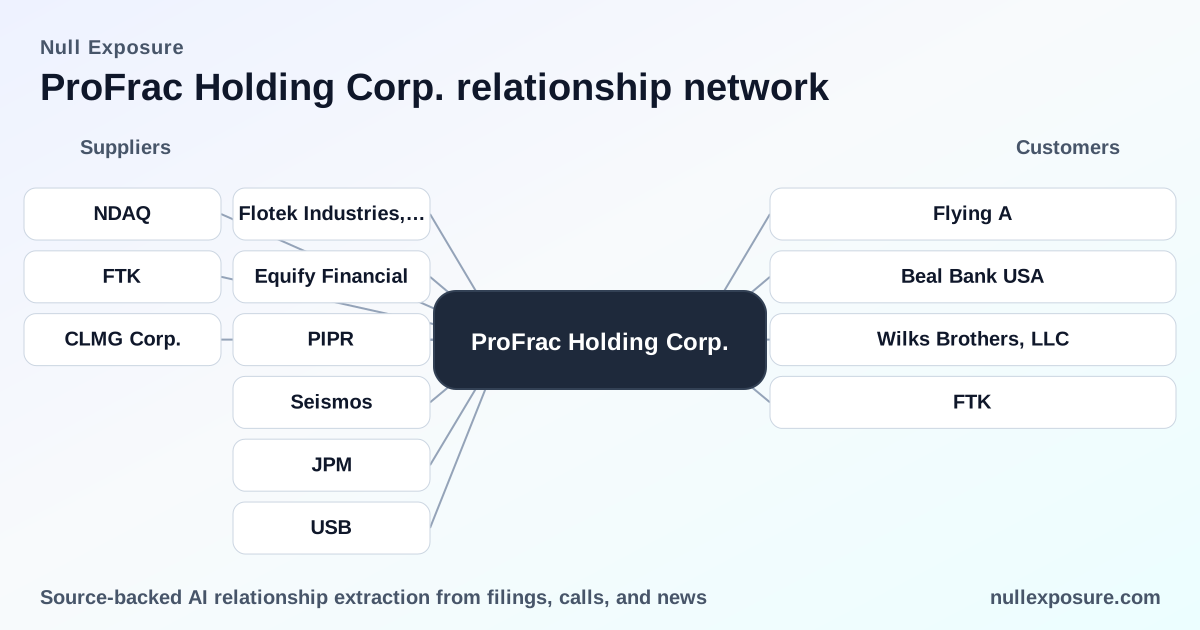
ProFrac (ACDC) — customer relationships that shape revenue and risk
ProFrac Holding Corp. (ACDC) operates as a vertically integrated hydraulic fracturing and completion services platform, monetizing through three revenue engines: Stimulation Services (frac operations), Proppant Production (sand sales), and Manufacturing (high‑spec equipment sales and rentals). The business captures value from on‑site services and proximate proppant supply, while financing and supply partnerships periodically reshape liquidity and margin dynamics.
For deeper company signals and relationship-level sourcing visit https://nullexposure.com/.
What investors need to know in one line
ProFrac runs a largely short‑term, project‑driven commercial model with selective medium‑term commitments and active financing relationships — low customer concentration but high cyclicality, and a vertically integrated cost position that supports margin capture when activity is rising.
The customer and financing relationships, one by one
Flying A
ProFrac sold surplus equipment, inventory components and assigned certain equipment pre‑orders to Flying A for a total consideration of $36.3 million, demonstrating a transactional equipment sale and disposition dynamic rather than a long‑term strategic equity tie. This is recorded in ProFrac’s FY2024 Form 10‑K.
Source: FY2024 Form 10‑K (ProFrac), disclosure of June 2023 equipment sale and assignment.
Beal Bank USA
Beal Bank participated as a purchaser across tranches in the private placement of Senior Secured Floating Rate Notes due 2029, joining Wilks Brothers in the financing package that underpinned a $60.0 million issuance at closing on June 30, 2025. Market reports and the company’s 8‑K detail Beal Bank’s role in the note purchase.
Source: 8‑K (Private placement, June 30, 2025) and accompanying news reporting (StockTitan, reporting FY2025/FY2022 references).
Wilks Brothers, LLC
Wilks Brothers purchased $20.0 million of the New Notes on June 30, 2025, acting as a direct private investor in ProFrac’s secured financing round and providing an equity‑adjacent liquidity source for the business. This transaction is disclosed in the company’s June 30, 2025 8‑K.
Source: 8‑K (ProFrac Holding Corp., June 30, 2025).
Flotek / FTK
ProFrac’s second‑quarter 2025 earnings commentary documents an operational partnership and a supply agreement with Flotek, with the company recognizing approximately $8 million in shortfall expenses tied to that agreement during the quarter; the company excludes Flotek contribution in certain adjusted measures. The relationship is presented as a supplier/partner arrangement with measurable P&L impact.
Source: Q2 2025 earnings call (company comments on Flotek supply agreement and shortfall expenses).
Operating constraints and what they signal for customers and investors
-
Contracting posture — predominantly short‑term with pockets of multi‑period commitments. ProFrac states that most customer contracts are short‑term and performance is recognized over time, but it also discloses $41.5 million in transaction price allocated to unsatisfied performance obligations with revenue scheduled into 2025–2027. This mix yields limited long‑range revenue visibility but some medium‑term backlog.
Source: Revenue recognition discussion in FY2024 Form 10‑K. -
Spot sales coexist with service contracts. The company recognizes proppant sales at point‑in‑time (generally at shipment), indicating a material portion of revenue driven by spot logistics and immediate demand. Spot proppant economics amplify exposure to near‑term commodity and logistics cycles.
Source: FY2024 Form 10‑K revenue recognition for proppant. -
Customer size and concentration — large enterprise counterparty profile but low single‑customer concentration. ProFrac targets leading E&P companies in North America (large enterprise counterparties), yet discloses that no individual customer represented more than 10% of consolidated revenues for 2022–2024, which reduces single‑counterparty risk while leaving the company exposed to sectoral capital‑spend cycles.
Source: FY2024 Form 10‑K (customer mix and concentration statements). -
Geographic footprint — concentrated in North America (U.S.). All segments operate within the continental United States and the company frames its strategy around active unconventional U.S. basins, imparting regional demand exposure and regulatory/environmental risk tied to U.S. shale economics.
Source: FY2024 Form 10‑K (geography disclosures). -
Role breadth — service provider, manufacturer, and proppant supplier. ProFrac functions across Stimulation Services, Proppant Production and Manufacturing: it is both a seller of manufactured equipment and a provider of field services, as well as a supplier of proppant to third parties; vertical integration is a structural advantage for cost and availability when basins ramp.
Source: FY2024 Form 10‑K (segment descriptions). -
Relationship maturity — established regional partnerships. The company reports longstanding customer relationships in the most active U.S. unconventional regions, signaling operational integration with major basin operators and potential preference in base‑load activity allocation.
Source: FY2024 Form 10‑K (operations and customer relationship maturity).
Key investment implications and risk signals
- Revenue visibility is limited but not zero. The company’s business is primarily short‑term and spot oriented, yet the disclosed $41.5 million of unsatisfied performance obligations gives modest multi‑year revenue visibility. Investors should monitor changes to that backlog as an early indicator of contracting momentum.
- Low single‑customer concentration reduces counterparty credit risk, but the business remains cyclically sensitive to E&P capital spending; downturns can materially compress volumes and margins, as the company acknowledges.
- Financing and supplier relationships are active levers. The June 2025 private placement with Beal Bank and Wilks Brothers (totaling $60 million issuance) is an explicit example of relying on private debt placements to manage liquidity; supplier agreements (Flotek) have direct margin consequences as evidenced by the $8 million shortfall expense. Both sets of relationships require active monitoring.
- Vertical integration is a competitive advantage that also concentrates operational risk. Owning proppant supply and manufacturing capability supports margins in tight markets but links operational disruptions to multiple revenue streams.
For a consolidated view of ProFrac’s customer relationships and constraints, visit https://nullexposure.com/.
Bottom line
ProFrac’s relationship map shows a company that monetizes through short‑term, transactional customer engagements supplemented by selective medium‑term obligations and strategic financing partners. The combination of vertical integration, low single‑customer concentration, financing activity through private notes, and supplier arrangements that can affect margins defines the near‑term risk/reward profile for investors: attractive upside in a recovering rig market, with measurable exposure to cyclical downturns and supplier/financing execution.