Arch Capital (ACGL): Customer Map and What It Means for Revenue Durability
Arch Capital Group underwrites insurance, reinsurance and mortgage products worldwide and monetizes through underwriting margins and premium flow—writing gross premiums via brokers and direct mortgage channels, investing float, and retaining portions of risk through quota-share and syndicate structures. For investors, the customer picture is twofold: distribution concentration through a small number of large brokers, and institutional counterparty relationships with government-sponsored entities in mortgage insurance, both of which drive earnings volatility and regulatory sensitivity. Explore partner-level signals and filings for transaction-level context at https://nullexposure.com/.
How Arch’s commercial relationships shape its economics
Arch is primarily a seller of insurance and reinsurance products and a material participant in mortgage insurance, operating globally across North America, EMEA and APAC. The company routes premiums through large brokers and direct channels, earns premiums up front and recognizes them over policy terms, and uses quota-share and reinsurance treaties to calibrate retained risk. These structural choices produce three investment-relevant characteristics:
- Concentration in distribution. Large brokers account for meaningful shares of gross written premiums, which amplifies distribution risk if placement dynamics change.
- Counterparty criticality in mortgages. Arch’s mortgage insurance business writes predominantly on loans sold to the U.S. GSEs—Fannie Mae and Freddie Mac—making regulatory and GSE policy shifts directly material to the business.
- Geographic diversification with regulatory complexity. Operations in North America, Europe and Australia reduce single-market exposure but increase regulatory and model risk across jurisdictions.
- Contracting posture is mixed. Arch acts as seller to primary insureds, buyer of reinsurance protection at times, and relies on brokers as distributors; it also operates as a service provider within acquired mortgage insurance platforms (notably in Australia).
These characteristics inform capital allocation, reinsurance purchasing, and sensitivity to rates, claims frequency and broker market share.
Constraints and company-level signals that affect customers
The company’s public filings and disclosures provide firm-level constraints that investors should treat as operating limits or risk drivers:
- Government counterparty exposure: Arch’s mortgage business is written predominantly on loans sold to Fannie Mae and Freddie Mac, classifying these GSEs as critical counterparties for the mortgage segment and increasing regulatory concentration risk. This is stated directly in Arch’s mortgage segment disclosures.
- Global footprint but regional focus: Arch operates in North America, EMEA and APAC; Australian mortgage insurance entities (Arch Indemnity / Arch LMI) are explicit regulatory fixtures in APAC and signal a mature presence there.
- Broker-driven distribution: The company identifies its largest brokers and reports material placement shares—Marsh & McLennan Companies accounted for a high-single-digit to mid-teens percentage of gross premiums written in 2024, underscoring broker concentration as a business constraint.
- Role mix: Arch predominantly functions as a seller of insurance and reinsurance, while simultaneously acting as a buyer of retrocession/reinsurance and a service provider via acquired local mortgage insurers.
- Relationship stage: Customer exposures are presented as active and ongoing across core markets, implying persistent revenue streams tied to the prevailing treaty and broker landscape.
These constraints are company-level signals that shape negotiating leverage, capital needs, and the sensitivity of earnings to regulatory and distribution shifts.
Who the customers and partners are (explicit relationships)
Below are the customer and distribution relationships identified in Arch’s public materials and press coverage. Each relationship is summarized in plain English with a source reference.
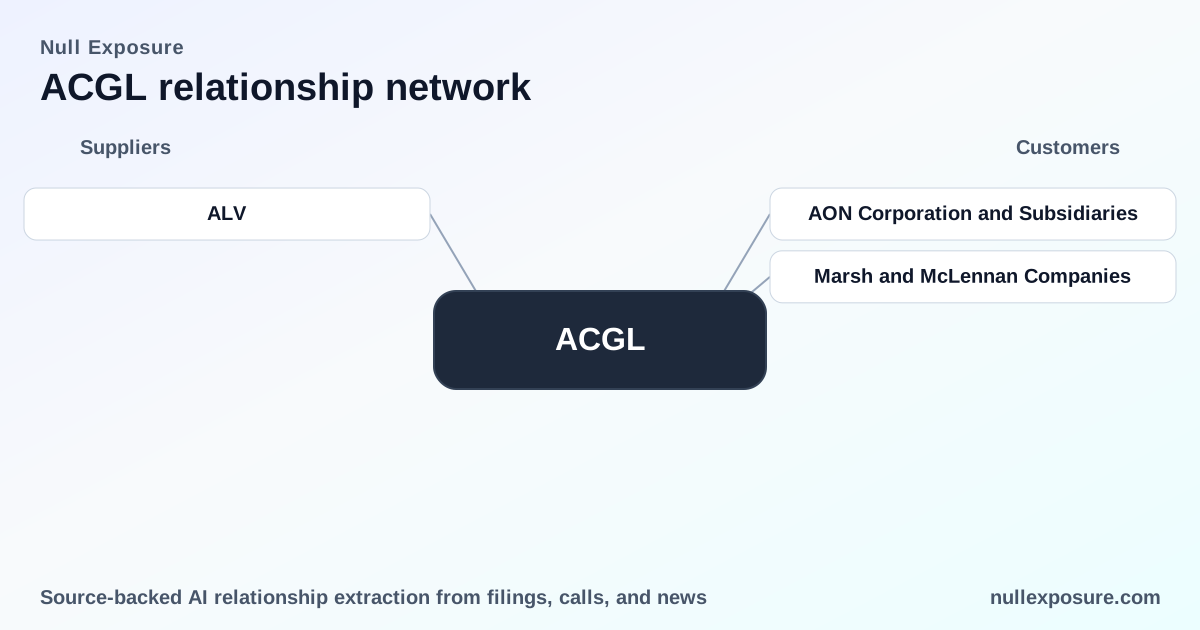
AON Corporation and Subsidiaries
Arch lists AON among entities referenced in its FY2024 10‑K customer concentration disclosure, indicating that AON is a material placement or broker counterparty in the company’s distribution network. According to Arch’s FY2024 Form 10‑K, AON is included in the customer concentration section for gross written premiums (FY2024 filing).
Marsh and McLennan Companies
Marsh & McLennan is a primary broker for Arch, representing a material share of gross written premiums—Arch’s disclosure shows Marsh & McLennan generated 18.6% of gross premiums written in 2024, making the firm a strategically important distributor for Arch’s product flow (Arch FY2024 10‑K). This level of broker concentration is a commercial risk factor for placement leverage and pricing dynamics.
ACIC (AmCoastal / Arch quota-share mention)
Press reporting around mid‑2025 renewals notes that AmCoastal’s tower included a 15% quota share that Arch provided, showing Arch’s active role as a quota‑share reinsurer in coastal catastrophe programmes. A March 2026 article on Artemis covering the mid‑2025 renewal documents the placement and describes the Arch quota‑share participation.
Federal Home Loan Mortgage Corporation (Freddie Mac)
Arch’s mortgage insurance business writes predominantly on loans sold to Freddie Mac, making Freddie Mac a primary channel/counterparty for the mortgage segment and tying performance to GSE policies and credit overlays. This relationship is described in an 8‑K reproduced via StockTitan that summarizes the mortgage segment and its GSE concentration (8‑K filing, reported May 2, 2026).
Federal National Mortgage Association (Fannie Mae)
Similarly, Fannie Mae is a predominant buyer of loans covered by Arch’s mortgage insurance, placing Fannie among Arch’s most critical mortgage distribution counterparties and exposing Arch to any GSE programme changes. Arch’s mortgage segment disclosure in the same 8‑K (StockTitan relay, May 2, 2026) explicitly identifies Fannie Mae alongside Freddie Mac as the primary conduits for U.S. primary mortgage insurance.
Investment implications and risk checklist
- Distribution concentration is a double-edged sword. Large brokers like Marsh & McLennan produce reliable premium flow but concentrate placement risk—contract pricing or market-share shifts at these brokers will be disproportionately material. Marsh’s 18.6% share is a headline risk item.
- GSE exposure raises policy sensitivity. Mortgage results are directly tied to Fannie Mae and Freddie Mac program design and eligibility rules; regulatory or credit policy changes at the GSEs will transmit quickly to Arch’s mortgage book.
- Geographic diversification increases operational complexity. Presence in APAC and EMEA reduces single-market loss exposure but requires maintaining multiple regulatory approvals and capital regimes (e.g., APRA, UK regulators).
- Reinsurance and quota-share are active levers. Arch uses quota-share and syndicate placements (as in the AmCoastal example) to manage peak catastrophe exposure and retain targeted risk layers.
For practitioners and institutional analysts wanting partner-level depth, our coverage consolidates filings, regulatory signals and press coverage into a single stream—visit https://nullexposure.com/ for the full partner-level view and to subscribe to deal- and counterparty-level alerts.
Bold takeaways: broker concentration (Marsh) and GSE mortgage reliance (Fannie/Freddie) are the two primary customer risks that drive Arch’s near‑term earnings sensitivity; quota‑share and reinsurance placements are predictable levers Arch uses to stabilize retained risk.