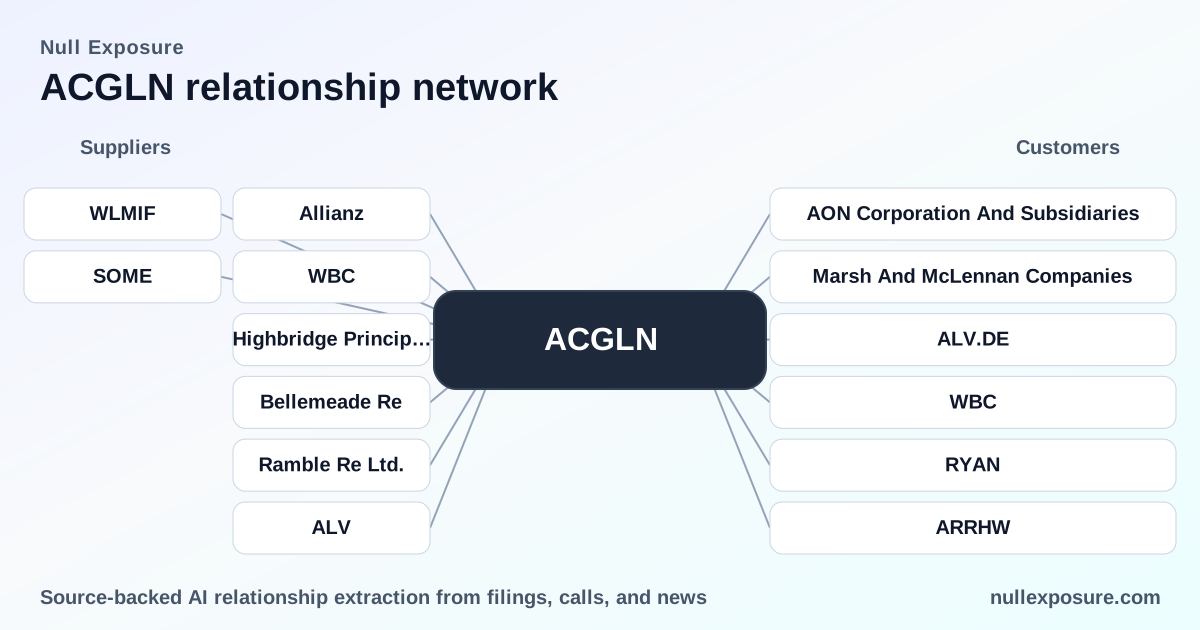
Arch Capital (ACGLN) customer relationships — who pays for its capacity and why it matters
Arch Capital Group Ltd. operates as a global insurer, reinsurer and mortgage insurer that monetizes through underwriting premiums, reinsurance capacity sales and mortgage guaranty contracts, supported by investment income. The company writes largely short-duration insurance policies (typically 12 months) while maintaining targeted multi‑year reinsurance arrangements; its commercial model depends on diversified geographies, distribution partners and selective long-term capacity deals. For investors, the critical variables are distribution concentration, the mix of short‑term versus multi‑year contracts, and geographic footprints across North America, EMEA and APAC. Learn more at https://nullexposure.com/.
Quick investor take: structural characteristics that drive value and risk
- Contracting posture: Revenue is predominantly earned on short‑term, pro‑rata policies (usually 12 months), providing regular repricing opportunities but also exposure to renewal cycles. The company also executes multi‑year quota share and service agreements in reinsurance where strategic.
- Distribution and concentration: Arch discloses broker and customer concentration factors; large global brokers and institutional counterparties play a central role in origination and placement, producing both scale benefits and counterparty concentration risk.
- Geographic and segment diversification: Arch writes insurance, reinsurance and mortgage insurance across the U.S., U.K./EMEA, Canada and Australia, which reduces single‑market exposure but raises regulatory complexity.
- Role dynamics: Arch functions primarily as a seller of insurance and reinsurance capacity, a services provider for mortgage insurance programs, and an occasional buyer of reinsurance protection and retrocession.
- Operational maturity: The firm’s underwriting discipline, capital base and global platform indicate a mature operator capable of balancing short‑term premium cycles with selective longer‑dated treaties.
Customer and partner map: relationship‑by‑relationship
AON Corporation And Subsidiaries
Arch specifically flags broker relationships in its disclosures, and Aon is listed within customer concentration risk related to gross written premiums, indicating Aon is a material distribution channel for Arch’s underwriting. This is cited in Arch’s FY2024 Form 10‑K.
Marsh And McLennan Companies
Marsh is likewise named in Arch’s customer concentration discussion, identifying it as a significant broker through which Arch places and services business; the mention appears in Arch’s FY2024 Form 10‑K.
Coalition
Arch provides long‑term capacity to Coalition’s U.S. and Canada cyber and technology E&O programs via a multi‑year partnership, delivering underwriting capacity for Coalition’s cyber products. This arrangement was reported by Insurance Journal in 2021.
ALV.DE (Allianz / affiliate reference)
Arch’s filings note business written by Fireman’s Fund Insurance Company, an affiliate of Allianz, which signals underwriting relationships or risk placed via affiliate carriers; this appears in Arch’s FY2025 Form 10‑K.
WBC (Westpac)
Arch’s Australian mortgage insurance activity includes an acquisition that established Arch as an exclusive lenders’ mortgage insurance provider to Westpac under the deal announced in 2021, strengthening Arch’s mortgage insurance footprint in Australia. Coverage of the Westpac arrangement appeared in Bermuda Re/Insurance Magazine in 2021.
Westpac
Same counterparty described as Westpac: Arch’s acquisition and exclusive LMI provider status for Westpac reflect a strategic customer relationship in Australia’s mortgage market, as reported in the 2021 news coverage.
Fireman's Fund Insurance Company
Arch’s FY2025 filing references business written by Fireman’s Fund Insurance Company (an Allianz affiliate), indicating Arch places or administers business in collaboration with this carrier affiliate; see Arch’s FY2025 Form 10‑K.
Ryan Specialty (RYAN)
Ryan Specialty completed the acquisition of Castel Underwriting Agencies from Arch Financial Holdings (UK) Ltd., a divestiture that reduces Arch’s direct ownership in that underwriting agency and transfers distribution/agency relationships to Ryan Specialty, as reported by Insurance Journal in 2024.
RYAN (duplicate entry for Ryan Specialty)
A second entry reiterates that Ryan Specialty acquired Castel Underwriting Agencies from an Arch affiliate; the same Insurance Journal 2024 article documents the transaction.
Arch Re (ARRHW)
Arch Re placed $100 million of retrocession capacity via the inaugural Ramble Re catastrophe bond, using industry‑loss and per‑occurrence triggers to transfer peak catastrophe risk across a three‑year term; this transaction was reported by Artemis in 2024.
ARRHW (duplicate Arch Re entry)
A second listing documents the same Ramble Re catastrophe bond retrocession, as reported by Artemis in 2024.
(Those entries are drawn directly from Arch’s 2024 and 2025 filings and press coverage; see Arch’s FY2024 and FY2025 Form 10‑K disclosures and the cited Insurance Journal, Bermuda Re/Insurance Magazine and Artemis articles.)
Explore structured relationship intelligence and sourcing at https://nullexposure.com/ for deeper diligence.
What the relationship map implies for operators and investors
- Revenue predictability vs. renewal risk: The predominance of 12‑month policy terms gives Arch steady, frequent repricing opportunities but creates sensitivity to short‑cycle market shocks. Short‑term contracting supports margin management but increases vulnerability to cyclical premium compression or rapid loss events.
- Distribution concentration is a double‑edged sword: Named brokers like Aon and Marsh accelerate scale and placement efficiency, but their prominence is a concentration risk that investors should monitor through filing disclosures on customer concentration.
- Strategic long‑dated arrangements and retrocession reduce peak loss volatility: Multi‑year quota shares and catastrophe bonds (e.g., Ramble Re) demonstrate active balance‑sheet management to transfer extreme loss exposure, which protects capital but adds counterparty and market access dependency.
- Geographic diversification with regulatory complexity: Arch’s operations span North America, EMEA and APAC, providing balance across markets and product cycles while increasing regulatory and operational oversight—particularly in mortgage insurance markets tied to GSEs in the U.S. and APRA rules in Australia.
- Active portfolio management: The sale of agency assets to Ryan Specialty and the use of affiliate carriers illustrate continuous portfolio optimization—managing channel ownership, capital consumption and focus on core underwriting capabilities.
Bottom line and investor actions
Arch’s customer and partner profile shows a diversified, broker‑mediated distribution model supported by both short‑duration underwriting and selective longer‑term treaties and retrocession structures. For investors, monitor renewal pricing, broker concentration disclosures, catastrophe protection (retrocession/cat bonds) and mortgage insurance regulatory metrics for the clearest signals of underwriting momentum and capital adequacy. For operators and analysts seeking transaction‑level sourcing and relationship context, visit https://nullexposure.com/ for access to the underlying filings and news provenance used in this analysis.
Key takeaway: Arch balances short‑term premium economics with targeted multi‑year protections and strategic distribution partnerships—this mix supports strong returns in benign cycles and requires active capital and counterparty management when losses accelerate.