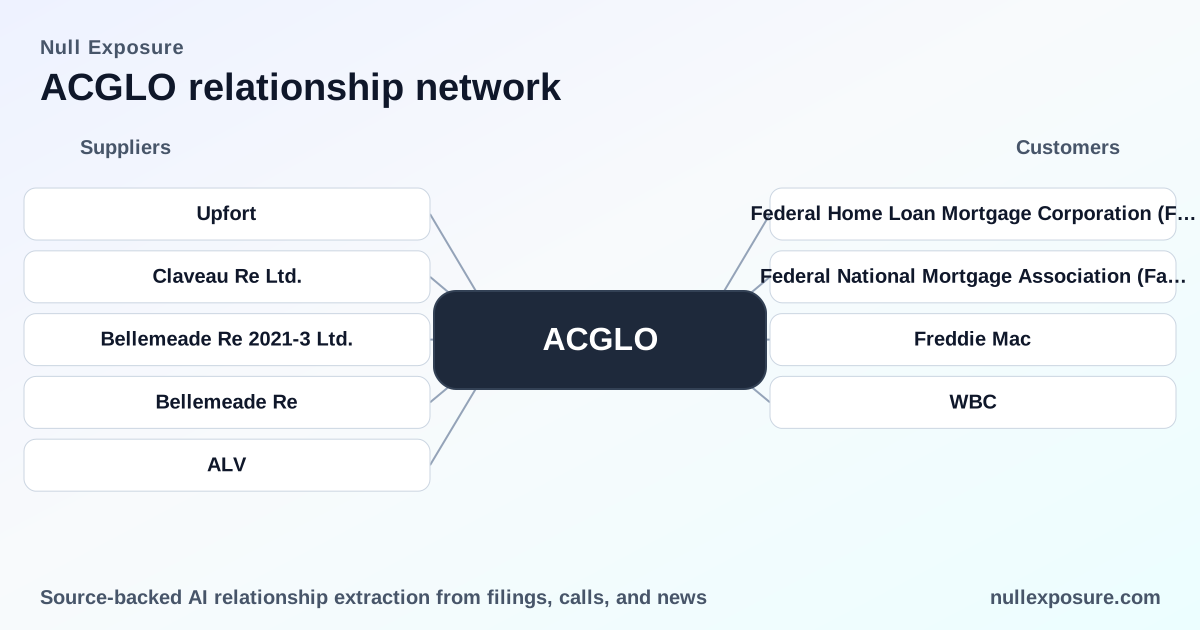
ACGLO Customer Map: Who buys Arch Capital’s mortgage and reinsurance risk
Arch Capital Group Ltd (ACGLO) underwrites and monetizes through three principal channels: primary mortgage insurance, reinsurance and specialty P&C lines, and distribution partners that place business across geographies. The company collects premiums on both short-duration (annual) and long-duration mortgage exposures, earns underwriting margin on specialty and reinsurance lines, and uses multi-channel brokers and exclusive distribution arrangements to scale origination — a revenue mix that drives recurring cash flow and capital deployment decisions. For deeper coverage and raw relationship extraction, visit https://nullexposure.com/.
Investment thesis in one paragraph
Arch leverages a globally diversified footprint and captive mortgage platforms to convert underwriting relationships into predictable premium streams and capital-efficient reinsurance capacity. Mortgage insurer relationships with large government-sponsored enterprises and major bank/finance partners are material to origination flow, while reinsurance deals with institutional counterparties and catastrophe placements underpin earnings volatility and capital management. These customer ties make Arch a hybrid operator: part lender-insurer franchise, part wholesale capacity provider — one that earns through premiums, investment income and tailored reinsurance solutions.
What the customer list reveals about Arch’s commercial posture
Arch’s disclosed customer relationships show a dual strategy: participating directly in the U.S. primary mortgage ecosystem and acting as a provider of reinsurance/capacity to large institutional counterparties and bancassurance partners internationally. The relationships indicate both regulated, long-term mortgage channels and shorter-duration, treaty-driven reinsurance exposures that together shape capital allocation and loss sensitivity.
- Contracting posture: Arch writes both short-duration (pro rata, usually 12-month) insurance and longer-duration single-premium mortgage policies; the company therefore operates with a mix of renewal-driven income and multi-year liabilities.
- Concentration and distribution: Arch emphasizes multi-channel, broker-led distribution while holding exclusive long-term arrangements in select markets (an example is the Westpac LMI tie), implying both broad diversification and pockets of concentrated account risk.
- Criticality and maturity: Relationships with government-sponsored entities and major banks are commercially critical for mortgage origination flow; reinsurance ties and catastrophe placements can be episodically material to earnings.
- Global footprint: Operations span North America, EMEA and APAC, exposing Arch to multiple regulatory regimes and cross-border capital constraints that influence dividend capacity and underwriting strategy.
Complete list of customer relationships (each item documented)
-
Federal National Mortgage Association (Fannie Mae)
Arch discloses that some of its mortgage operations include providers approved as eligible mortgage insurers for Fannie Mae, signaling participation in the GSE-supported U.S. primary mortgage market. According to Arch’s FY2024 Form 10‑K, Arch’s U.S. primary mortgage insurance operations write business that interfaces directly with Fannie Mae underwriting standards. -
Federal Home Loan Mortgage Corporation (Freddie Mac) — regulatory disclosure
The FY2024 Form 10‑K also lists Freddie Mac alongside Fannie Mae as a GSE for which Arch’s mortgage insurers are eligible providers, confirming Arch’s access to GSE-driven mortgage flows in the U.S. (Arch 2024 10‑K). -
Freddie Mac — specific reinsurance/cover placement
A Bermuda Reinsurance Magazine article (March 2026) reported that Arch Re provided a $77.4 million cover for Freddie Mac, demonstrating Arch’s active role supplying private reinsurance capacity to public mortgage counterparties and highlighting opportunity in U.S. public risk transfer. This placement underscores Arch’s willingness to underwrite institutional mortgage credit risk outside of traditional primary MI products. -
Westpac Group (WBC) — Lenders’ Mortgage Insurance exclusivity
As part of Arch’s acquisition of Westpac-linked mortgage insurance assets, WLMI retained its existing risk and Arch became Westpac’s exclusive provider of lenders’ mortgage insurance on new mortgage originations for 10 years, per a Bernews report from 2021. This exclusive distribution arrangement creates an institutional origination channel in Australia that is contractually significant for Arch’s APAC mortgage footprint. -
WBC referenced in corporate press (profit reporting)
Bermuda Reinsurance Magazine’s profit coverage (March 2026) reiterated Arch’s role as the exclusive LMI provider to Westpac following the acquisition, calling out the strategic distribution lock with Westpac as a revenue and flow-stability driver in Arch’s Australian mortgage operations. -
Westpac — trade press summary of the acquisition
Bernews’ 2021 coverage of the acquisition closed the loop on the commercial terms: the combined entity under Arch retained risk in force and gained a decade-long exclusive LMI slot with Westpac, an arrangement that materially strengthens Arch’s APAC mortgage channel and underwriting scale. -
Nationwide — casualty/cat exposure tied to underwriting losses
Artemis (May 2026) quoted Arch’s CEO referencing losses “between the California wildfire on the Nationwide account, and some of the storms that we’ve seen,” which identifies Nationwide as a named account where catastrophe losses affected Arch’s underwriting results. This link illustrates how large commercial accounts and property portfolios translate into episodic P&L sensitivity for Arch.
How these relationships translate into financial and operational signals
- Premium stickiness vs. volatility: The combination of multi-year mortgage ties (GSE eligibility, exclusive LMI relationships) and event-driven reinsurance/cat exposures produces a revenue base that is both recurring and episodically volatile. Mortgage corridors provide predictability; catastrophe-exposed reinsurance and large account placements create loss variability.
- Regulatory impact and capital flow constraints: Arch’s disclosures note U.S. mortgage subsidiaries’ dividend capacity limits and Solvency II requirements for EU entities, signaling the capital management constraints imposed by jurisdictional regulation rather than by customer relationships alone.
- Distribution strategy: Arch uses a mix of brokers, MGAs and a small set of exclusive bank partners; this hybrid distribution reduces single-buyer concentration while creating strategic dependency on a few long-term exclusives (company-level signal from disclosure excerpts).
Risk and opportunity checklist for investors
- Opportunity: Exclusive bank/LMI deals (e.g., Westpac) provide durable origination flow and pricing leverage in APAC.
- Risk: Large named accounts and catastrophe exposures (Nationwide wildfire losses) drive underwriting volatility and capital strain in stressed years.
- Operational consideration: Cross-border regulation (U.S. dividend caps, Solvency II) constrains capital mobility and accentuates the need for strong loss reserve discipline.
For a comprehensive extraction and monitoring of Arch’s customer relationships and contract signals, see our coverage at https://nullexposure.com/ — we track relationship edits, source provenance, and contract attributes relevant to underwriting and capital decisions.
Bottom line
Arch’s customer map blends GSE-facing mortgage channels and institutional reinsurance placements, anchored by targeted exclusive distribution deals and broad broker networks. That mix underpins predictable premium income while exposing results to episodic catastrophe and counterparty placements — a profile that demands active capital management and disciplined underwriting from an investor’s perspective.