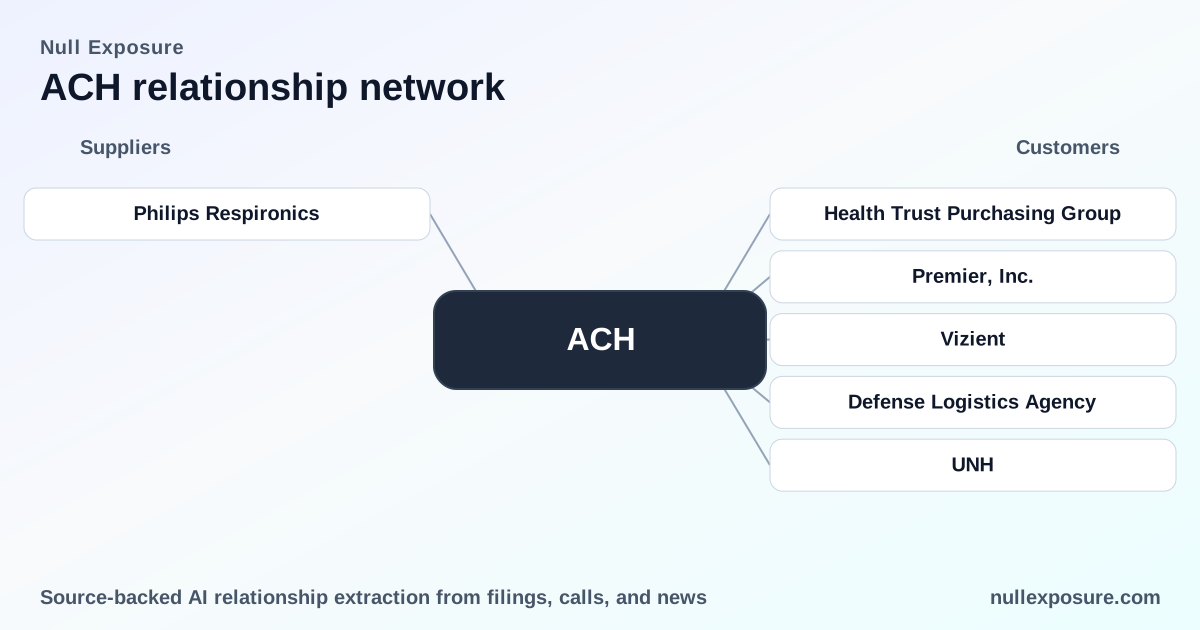
Accendra Health (ACH): Who pays the bills and why it matters to investors
Accendra Health operates as a hybrid medical-products manufacturer, distributor and home-health services provider and monetizes through two core streams: Products & Healthcare Services (distribution, manufacturing and outsourced logistics sold to hospitals and health systems) and Patient Direct (rental and sales of home medical equipment and supplies, billed to payors and patients). A large share of revenue flows through national group purchasing organizations (GPOs) and fee-for-service rental contracts, creating concentrated, recurring commercial exposure that defines both upside and risk for equity holders. Learn more about how these customer ties shape the business at https://nullexposure.com/.
What investors need to know about Accendra’s operating model and customer-driven constraints
Accendra’s disclosures and public reporting describe a business with short-term, high-frequency revenue on the Patient Direct side and contract-backed, large-volume sales through GPO channels on the Products side. Revenue from rented equipment is recognized over short, noncancelable rental periods—typically monthly—which produces steady cash flow per unit but ties growth to patient acquisition and reimbursement rates. According to the company’s FY2024 Form 10‑K, approximately 65% of consolidated net revenue in 2024 came from sales to member hospitals under contract with the company’s largest GPOs: Vizient, Premier and HealthTrust Purchasing Group, making these relationships material and operationally critical.
Geography is a balancing factor: Accendra is predominantly U.S.-focused—its Patient Direct network reaches over 90% of the U.S. population via 300+ locations—while the company also serves customers in roughly 80 countries, indicating a mix of domestic scale with targeted international distribution. Contracting posture is predominantly active and short-term for rentals, with large GPO agreements operating under standing contracts that remained active as of December 31, 2024. The company performs multiple roles across the value chain—manufacturer, distributor and service provider—which increases internal control over margins but also concentrates operational execution risk in logistics and production.
Key investor implications: concentration in a handful of GPO channels, reliance on short-term rental economics in Patient Direct, and a diversified but U.S.-heavy footprint. For more context on customer exposures and counterparties, visit https://nullexposure.com/.
The customer map: counterparties cited in Accendra’s disclosures and related public reporting
Below are every counterparty referenced in the collected results with a concise, plain-English summary and the source for each claim.
Vizient
Vizient is cited in the company’s FY2024 10‑K as one of the GPOs representing a significant portion of business, indicating that a material share of hospital sales is routed through Vizient-contracted purchasing channels (FY2024 10‑K filing).
Premier, Inc.
Premier, Inc. is likewise named in Accendra’s FY2024 10‑K as a major GPO customer channel; Premier contracts account for part of the roughly 65% of revenue sold to member hospitals under the largest GPOs (FY2024 10‑K filing).
Health Trust Purchasing Group (HPG)
HealthTrust Purchasing Group rounds out the trio of largest GPOs referenced in the FY2024 10‑K; the company reports contracts to provide distribution services to members of national GPOs including HealthTrust, and these contracts remained active at year-end 2024 (FY2024 10‑K filing).
Defense Logistics Agency (DLA)
A GovConWire article (reported March 2026) describes DLA contract modifications awarded to large medical distributors; the article highlights how federal contracting for medical-surgical products can shift volume among suppliers and underscores government procurement dynamics that affect the sector (GovConWire, March 2026).
Dominion Healthcare Acquisition Corporation
A 2026 filing summary reported by StockTitan documents that Owens & Minor agreed to sell its Products & Healthcare Services business to Dominion Healthcare Acquisition Corporation for $375 million in cash, a transaction that reshapes competitor footprints and market consolidation in the medical-distribution landscape (SEC filing summary, 2026).
Optum (UnitedHealth Group / UNH)
An earnings-call transcript published in March 2026 noted the signing of a preferred agreement with Optum, highlighting strategic ties between major payors/health services platforms and distribution partners; this is a relevant commercial signal given payor-driven referral and purchasing dynamics (InsiderMonkey transcript, Q4 2025 / March 2026).
UNH (UnitedHealth Group)
UNH appears in coverage tied to the Optum reference—public statements credit a preferred arrangement with Optum/UNH that illustrates how Accendra and peers interact with large integrated payor-provider platforms (InsiderMonkey transcript, March 2026).
Kaiser
Financial coverage in May 2026 (Intellectia/UBS summary) flagged Kaiser-related contract losses and their drag on competitor EBITDA, a market-level datapoint that investors should treat as indicative of pricing and volume pressure when large integrated health systems shift vendor relationships (Intellectia.ai, May 2026).
How these relationships translate into investment risk and opportunity
- Concentration and criticality: With ~65% of consolidated net revenue routed via Vizient, Premier and HPG (FY2024), Accendra’s revenue profile is concentrated in a small number of institutional channels; that concentration yields bargaining leverage but also single-event exposure if contract terms change.
- Contracting posture and cash flow profile: The company’s Patient Direct rental model produces short-term, recurring revenue recognized monthly, creating predictable per-patient cash flows but coupling growth to reimbursement trends and patient acquisition economics.
- Operational complexity: The firm acts as manufacturer, distributor and service provider, which helps protect margins through vertical integration but increases execution risk across production, logistics and billing.
- Geographic footprint: Predominantly U.S.-centric with selective global reach, meaning regulation, reimbursement and hospital contracting in the United States are dominant value drivers.
Bottom line for investors
Accendra’s commercial leverage is concentrated and contract-driven; its performance tracks decisions made by a small set of GPOs and large payors. For investors, the company’s exposure to Vizient, Premier and HealthTrust is both a source of scale and the primary counterparty risk to monitor. Track contract renewals, reimbursement trends in Patient Direct, and any competitive shifts among large systems (e.g., Kaiser or Optum/UNH) as the most actionable near-term signals. For a focused drill-down on customer exposures and to access related analytics, visit https://nullexposure.com/.