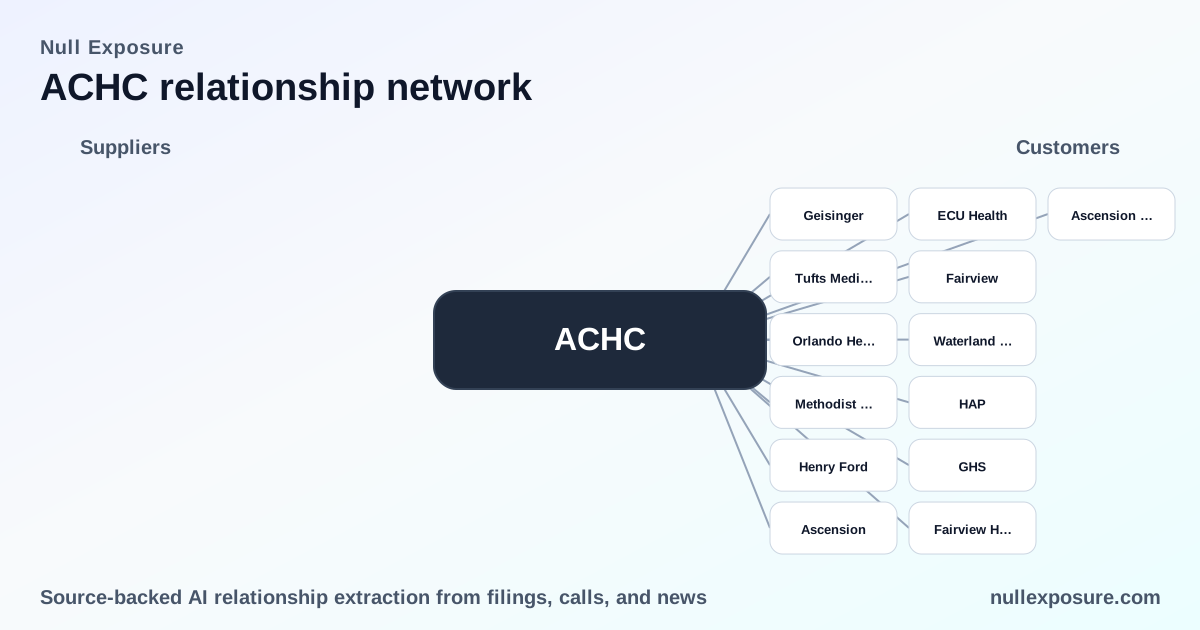
Acadia Healthcare (ACHC): Joint ventures and customer relationships that shape revenue and risk
Acadia Healthcare operates and monetizes a national network of behavioral-health facilities — inpatient, outpatient, residential and substance‑use treatment — by contracting with public and private payors and partnering with local health systems through joint ventures to open and operate hospitals. Revenue flows largely from government payors (Medicaid/Medicare), commercial insurers and individual patients, while strategic joint‑venture relationships with health systems accelerate capacity expansion and market access. For deeper company coverage and the underlying signals behind these relationships, visit https://nullexposure.com/.
Why the partner list matters to investors
Acadia’s recent disclosures and calls make clear the company pursues growth through two channels: organic operations as a service provider and capital-light expansion via joint ventures with established health systems. That hybrid model increases scale while transferring some development and referral risk to partners. From a finance perspective, key operating-model characteristics follow from the disclosure set:
- Contracting posture: Acadia recognizes many contracts as short‑term (one year or less) under ASC 606, reflecting service-level billing and episodic patient stays rather than long-term fixed fees.
- Concentration and criticality: The company derives a material majority of revenue from government payors — Medicaid and Medicare together account for roughly 71% of revenue — creating revenue sensitivity to public reimbursement policy.
- Geographic reach and maturity: Operations span 39 states and Puerto Rico with ~262 facilities and ~11,850 beds as of year‑end 2024, indicating broad national scale and established regional footprints.
- Role and segment: Acadia functions primarily as a service provider in a single reportable segment (behavioral healthcare services), not as a diversified medical-contractor business.
These characteristics inform valuation: joint ventures accelerate bed growth and referral channels but do not eliminate reimbursement concentration or policy sensitivity.
Relationship roll‑call: every cited partner and source
Below are the relationships cited in Acadia’s recent filings, calls, and media coverage. Each entry is a plain‑English summary tied to the original disclosure.
Fairview (earnings call)
Acadia disclosed opening a new joint‑venture facility with Fairview in Minnesota in 2025, reflecting the company’s continued JV strategy with health systems. According to Acadia’s 2025 Q4 earnings call (mentioned March 2026), the Fairview JV expands local inpatient capacity.
Geisinger (earnings call)
Acadia reported a 2025 joint venture with Geisinger in Pennsylvania to open behavioral health facilities, illustrating targeted partnerships in integrated delivery systems. This was stated on the 2025 Q4 earnings call (March 2026).
Tufts Medicine (earnings call)
Management noted three facilities operate with joint‑venture partners, including new hospitals with Tufts Medicine, underscoring partnerships in key New England markets. This detail was disclosed on the 2025 Q4 earnings call (March 2026).
Orlando Health (earnings call)
Orlando Health was cited as a joint‑venture partner among the three partner facilities noted, indicating Acadia’s engagement with regional health systems in Florida. The disclosure came during the 2025 Q4 earnings call (March 2026).
Methodist Health (earnings call)
Methodist Health was referenced among the joint‑venture cohort of three partner facilities, reflecting continued collaboration with system operators; the detail is from the 2025 Q4 earnings call (March 2026).
Henry Ford (earnings call)
Acadia opened a new joint‑venture facility with Henry Ford in Michigan in 2025, a transaction announced on the 2025 Q4 earnings call (March 2026) and indicative of expansion in Midwest markets.
Ascension (earnings call)
Management confirmed a 2025 Ascension partnership in Texas to open a behavioral health facility, reported on the 2025 Q4 earnings call (March 2026), supporting entry into large regional health networks.
ECU Health (earnings call)
Acadia cited a new joint venture with ECU Health in North Carolina in 2025, as noted on the 2025 Q4 earnings call (March 2026), demonstrating targeted growth in the Southeast.
Waterland Private Equity (news, UK divestiture)
Acadia closed the sale of approximately 360 UK properties to Waterland Private Equity on January 19 (reported historically), a move that reduced international exposure and refocused the company on U.S. operations. A business‑health sector report documented the UK divestiture (BH Business, Feb 26, 2021).
Henry Ford Health (news sentiment)
A market note referencing Acadia’s 2025 activity stated that five joint‑venture facilities opened in 2025 with partners including Henry Ford Health, highlighting multiple partner launches in that year. This aggregated summary appeared on TradingView citing a Zacks piece (May 2026).
Ascension Seton (news sentiment)
TradingView’s May 2026 coverage listed Ascension Seton among the five JV openings in 2025, reinforcing public reporting of the Ascension Seton partnership.
ECU Health (news sentiment)
TradingView’s May 2026 summary also named ECU Health as one of the five 2025 joint‑venture partners, consistent with Acadia’s public statements.
Fairview Health Services (news sentiment)
TradingView reported Fairview Health Services as a 2025 JV partner in its May 2026 piece, matching the company’s earnings‑call disclosure.
Geisinger Health (news sentiment)
TradingView’s May 2026 coverage included Geisinger Health among the five JV openings, echoing Acadia’s earnings‑call remarks.
Henry Ford Health (Form 10‑K, FY2025)
Acadia’s FY2025 Form 10‑K explicitly lists Henry Ford Health as one of the five joint‑venture partners that opened facilities in the year ended December 31, 2025, confirming the transaction in the annual filing (FY2025 10‑K).
HAP (Form 10‑K, FY2025)
The FY2025 10‑K includes an entry labeled “HAP” alongside the other partners in the five JV openings for 2025, showing the same point in the company’s annual disclosure (FY2025 10‑K).
Geisinger Health (Form 10‑K, FY2025)
Geisinger Health is named in the FY2025 10‑K as a partner in one of the five joint‑venture facilities opened during the year, reinforcing the partner list in the annual report.
ECU Health (Form 10‑K, FY2025)
Acadia’s FY2025 10‑K records ECU Health among the five JV partners, substantiating the company’s public disclosure of the partnership.
Fairview Health Services (Form 10‑K, FY2025)
Fairview Health Services appears in the FY2025 10‑K as one of the five partners responsible for JV openings during 2025, aligning annual and call disclosures.
Ascension Seton (Form 10‑K, FY2025)
The FY2025 10‑K names Ascension Seton as a partner for one of the five joint‑venture openings, completing the company’s enumerated partner list for the year.
What investors should take away
- Growth through health‑system joint ventures is a clear strategic lever: the 2025 activity shows Acadia uses JVs to scale beds and market presence without assuming full greenfield development risk.
- Payor concentration is the principal macro risk: with government reimbursements dominating revenue, policy changes to Medicaid/Medicare reimbursement regimes are material to cash flow.
- Geographic scale softens single-market risk but increases regulatory complexity: operating in 39 states plus Puerto Rico increases exposure to state‑level Medicaid variability.
For a concise view of those relationship signals and how they map to portfolio exposure, see more analysis at https://nullexposure.com/.
Bold decisions about valuation should weigh the revenue uplift from new JVs against reimbursement concentration and execution risk in facility integrations.