ACHV: Investor-backed financing and the customer map that will define commercialization
Achieve Life Sciences develops and intends to commercialize cytisinicline, a single therapeutic aimed at nicotine dependence; the company currently monetizes through capital raises and grant funding while it advances late-stage clinical work toward market approval and payer reimbursement. Investors are supplying the balance sheet runway; government payors and managed-care contracts will determine ultimate revenue realization once the product launches. For primary diligence and market access intelligence, review the syndicate commitments and grant relationships below for how capital and payor signals line up against a single-product commercialization path.
Explore more research at https://nullexposure.com/.
Why the May 2026 financing matters to buyers, payors and operators
Achieve closed a substantial private placement that rebuilds its capitalization ahead of pivotal regulatory and commercial work. A $354 million financing led by a mix of life-science-focused investors and institutional managers materially de-risks near-term funding needs and positions the company to execute on late-stage development and market-preparation activities. According to a Quiver Quant news release dated May 2, 2026, the placement included both new and existing investors, a mix that signals both fresh validation and continued institutional support.
Syndicate composition — who the company brings to market
The financing syndicate and related legal advisory actions establish the primary customer/partner relationships investors should track. Below are plain-English, source-cited summaries for every relationship reported in the coverage set.
-
Marshall Wace — Marshall Wace acted as a lead participant in the $354 million private placement and was also the party for which Goodwin provided legal advice on the securities purchase agreement, linking Marshall Wace directly to the transaction structure and execution. A Quiver Quant release (May 2, 2026) lists Marshall Wace among lead investors, and a separate Mondaq press release (May 2, 2026) notes Goodwin’s role advising Marshall Wace on the securities purchase agreement.
-
Frazier Life Sciences — Frazier Life Sciences is named as a new lead investor in the $354 million private placement that funds cytisinicline development and commercial preparation. (Quiver Quant, May 2, 2026)
-
TPG Life Sciences Innovations — TPG Life Sciences Innovations is listed among the lead new investors in the placement, reflecting strategic life-science allocation into Achieve’s late-stage program. (Quiver Quant, May 2, 2026)
-
venBio Partners — venBio Partners participated as a lead investor in the financing, providing sector-specific capital to support development and near-term commercialization activities. (Quiver Quant, May 2, 2026)
-
Paradigm BioCapital Advisors — Paradigm BioCapital Advisors is reported as a lead investor in the private placement, joining the consortium funding the company’s path to market. (Quiver Quant, May 2, 2026)
-
Janus Henderson Investors — Janus Henderson Investors is among participating investors, signaling mainstream institutional allocation into the financing syndicate. (Quiver Quant, May 2, 2026)
-
Coastlands Capital — Coastlands Capital joined the placement as a participating investor, adding to the financing depth. (Quiver Quant, May 2, 2026)
-
Dialectic Capital — Dialectic Capital is included among participants in the transaction, reinforcing sector-specific investor interest. (Quiver Quant, May 2, 2026)
-
LifeSci Venture Partners — LifeSci Venture Partners participated in the financing, aligning venture-capital expertise with the company’s commercialization timetable. (Quiver Quant, May 2, 2026)
-
Logos Capital — Logos Capital is listed as a participating investor in the private placement that finances the cytisinicline program. (Quiver Quant, May 2, 2026)
-
Propel Bio Partners — Propel Bio Partners participated in the syndicate, contributing to the capital raise that supports next-stage clinical and go-to-market work. (Quiver Quant, May 2, 2026)
-
Spruce Street Capital — Spruce Street Capital is reported as a participant, signaling additional institutional interest. (Quiver Quant, May 2, 2026)
-
Coastlands Capital — (See above entry.) The coverage names Coastlands among both new and existing investors participating in the placement. (Quiver Quant, May 2, 2026)
-
Vivo Capital — Vivo Capital participated as an investor in the private placement, adding long‑term healthcare specialist capital to the register. (Quiver Quant, May 2, 2026)
-
Venrock Healthcare Capital Partners — Venrock Healthcare Capital Partners is named among participants in the financing, bringing established healthcare venture capital pedigree to the cap table. (Quiver Quant, May 2, 2026)
-
Wellington Management — Wellington Management participated in the placement as an institutional backer, providing additional scale to the financing. (Quiver Quant, May 2, 2026)
-
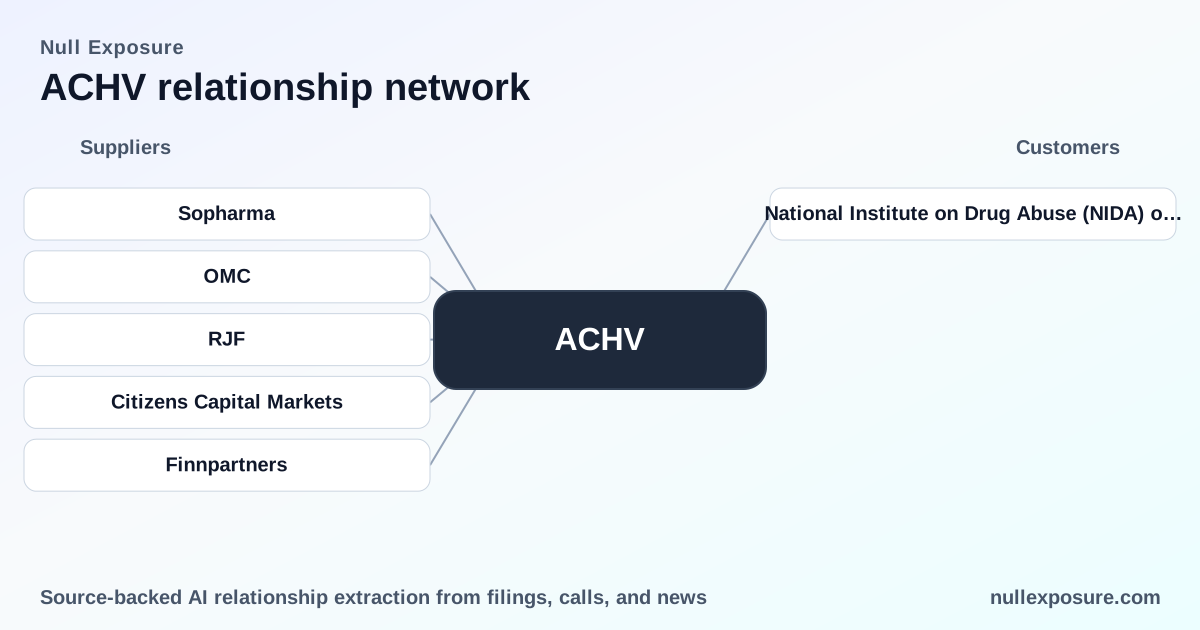
National Institute on Drug Abuse (NIDA) — NIH — Achieve received grant support for its ORCA‑V1 program totaling $2.8 million awarded in two phases, establishing an active government research funding relationship that underwrites a portion of clinical development. (GlobeNewswire reporting on NIDA grant support, 2022)
Operating model signals that flow from these relationships
The relationship map and public disclosures produce clear operating-model signals that investors and operators must integrate into valuation and go‑to‑market planning:
-
Single-product concentration. Achieve is a late‑stage specialty pharmaceutical company with a sole mission to commercialize cytisinicline; this creates high revenue concentration risk until a portfolio or partnerships are developed. The company itself frames the program as its core product.
-
Capital-driven runway until revenue. The $354 million placement demonstrates that equity and strategic investors are the company’s current customers in the sense of providing the capital that keeps R&D and commercialization planning on track.
-
Government and payer criticality. Sales will depend substantially on reimbursement by government payors, pharmacy benefits and managed-care organizations; the NIDA grant shows active government engagement in the clinical program but not commercialization funding.
-
Maturity and commercialization posture. The firm is late‑stage clinical; operational maturity remains pre-revenue (RevenueTTM = 0), so contract posture is focused on financing and regulatory strategy rather than distribution or sales-force agreements.
These points imply a contracting environment dominated by investor agreements and future payor negotiations, rather than established commercial distribution contracts.
Explore institutional investor activity and cap‑table signals at https://nullexposure.com/.
Risks, implications and what to watch next
- Execution vs. market access: The financing reduces financing risk but does not eliminate reimbursement risk; successful market access negotiations with government and private payors will determine revenue trajectory.
- Concentration exposures: Single-product focus increases the impact of any regulatory setback or unfavorable payer decision.
- Institutional backing is supportive: High institutional participation in the financing and reported institutional ownership (about 60.8% reported) provides capital stability and governance scrutiny that favor disciplined commercialization planning.
- Data milestones trigger commercial decisions: Investors have funded a pathway; watch clinical readouts, regulatory filings, and early payer signaling as the moments when investor support converts into commercial value.
Bottom line for investors and operators
Achieve has secured a diversified, life‑science‑savvy syndicate and retained government research support that together provide the funding runway needed to pursue commercialization of cytisinicline. The company’s business model remains single‑product and pre‑revenue, so the next key value inflection points are clinical/regulatory outcomes and payer contracting. Monitoring the syndicate’s follow-on behavior and NIDA/government engagement will provide the clearest signals about commercialization timing and reimbursement prospects.