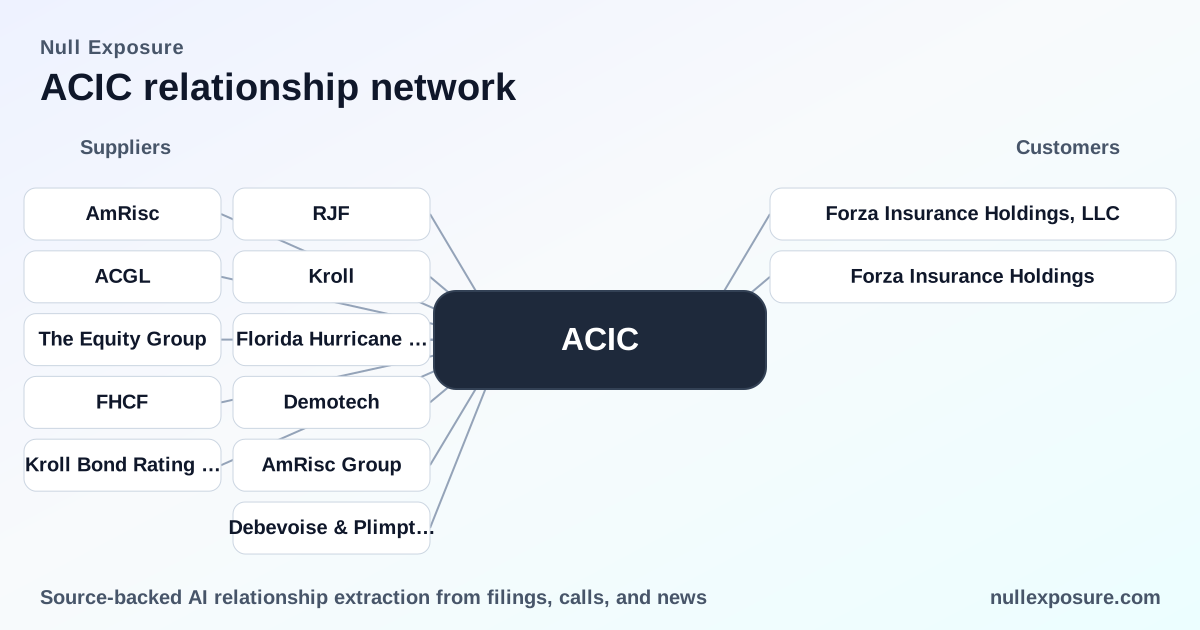
American Coastal Insurance Corp (ACIC): Strategic Partner Map and Operating Signals for Investors
American Coastal Insurance Corporation underwrites and distributes property & casualty insurance with a clear tilt toward commercial specialty property; the company monetizes through underwriting margin on commercial lines and agency-distributed personal and residential products, supplemented by investment income. ACIC’s economics are driven by a concentrated commercial book, high underwriting margins, and a distribution model that mixes wholesale MGAs and a large independent-agent network, making the company sensitive to geographic concentration and partner execution. For investors evaluating customer and partner relationships, the recent divestiture activity and distribution tie-ups materially change the shape of the book and the company’s go‑to‑market posture. Learn more at https://nullexposure.com/.
The investment thesis in one line
ACIC is a commercially focused P&C underwriter that is actively reshaping its footprint by exiting certain personal lines and leaning on specialty distribution partners to scale commercial E&S property — a repositioning that increases concentration on higher-margin business while concentrating underwriting and channel risk.
Documented partner mentions and what each relationship means now
Below are every relationship mention captured in public reporting; each entry is a concise, plain-English summary linked to the original reporting.
Forza Insurance Holdings, LLC — definitive agreement enables focus on commercial portfolio
ReinsuranceNews reported on March 9, 2026 that a definitive agreement with Forza transfers Interboro to Forza and allows American Coastal to focus on its expanding commercial specialty property portfolio. This frames the transaction as strategic refocusing rather than a purely financial disposal (Reinsurance News, March 9, 2026).
Forza Insurance Holdings — finalized sale of Interboro for ~$26.4 million cash
Insurance Business Magazine reported that American Coastal finalized the sale of its New York-based personal lines subsidiary, Interboro Insurance, to Forza Insurance Holdings for approximately $26.4 million in cash, underscoring an active retreat from certain personal lines territories (Insurance Business Magazine, March 2026).
Forza Insurance Holdings, LLC — completion of the Interboro sale
ReinsuranceNews also carried a March 2026 notice confirming that ACIC completed the sale of Interboro to Forza, reiterating that Interboro was a personal-lines subsidiary and that the deal is closed (Reinsurance News, March 9, 2026).
Forza — referenced in ACIC corporate disclosures (Sale Agreement dated May 9, 2024)
A company filing summarized by StockTitan references the original Sale Agreement entered May 9, 2024 in which ACIC agreed to sell Interboro to Forza, providing a record of the legal transaction timeline behind the public notices (StockTitan / company filing summary, referenced March 2026).
AmRisc — exclusive Florida condominium association distribution partnership
A May 2026 press release cited in The Globe and Mail states that ACIC has an exclusive partnership with AmRisc Group for distribution of Condominium Association properties in Florida, positioning ACIC to capture a niche but hurricane‑exposed segment through a large managing general agent (The Globe and Mail, May 2, 2026).
AmRisc — quota share participation in nationwide E&S commercial property
The same May 2026 announcement notes ACIC’s assumption of a 6% net quota share of AmRisc’s nationwide excess & surplus commercial property portfolio, signaling a targeted route to scale E&S commercial property exposure without building full underwriting infrastructure (The Globe and Mail, May 2, 2026).
What the relationships collectively reveal about ACIC’s operating model
- Contracting posture: ACIC is moving to partner-heavy distribution, using MGAs (AmRisc) and selective divestitures to reshape the underwriting footprint rather than relying solely on organic agent hiring. The sale of Interboro to Forza and a quota share with AmRisc confirm a mix of asset-light scaling and targeted acquisitions/divestitures.
- Concentration and geography: Company filings and the partnership language point to heavy exposure to Florida and select regional personal lines (e.g., New York historically). This geographic concentration increases hurricane and regulatory sensitivity but also concentrates underwriting expertise.
- Criticality of partners: The exclusive Florida condominium program with AmRisc and the quota share for nationwide E&S make these partners strategic distribution and underwriting conduits — failures or misexecution by these partners would directly affect ACIC’s ability to grow E&S and condominium lines.
- Maturity and stage: The constraints signal an active commercial operating posture, with ACIC transitioning toward scaled commercial lines as its primary operating segment and trimming non-core personal-lines subsidiaries.
- Customer and counterparty profile: ACIC distributes through a large independent-agent network (roughly 400 agencies historically) and partners with MGAs; this indicates a mixed counterparty base of small-to-medium agencies and larger MGAs, and a seller/distributor role in its go‑to‑market.
Key takeaways for investors
- Strategic refocus: The Interboro sale to Forza is a deliberate rejig of the portfolio; ACIC is consolidating around higher-margin commercial E&S property lines and leveraging quota-share arrangements to accelerate scale.
- Partner risk is concentrated but purposeful: AmRisc is now a critical partner for Florida condominium distributions and national E&S access; the 6% quota share is modest but symbolically important as a scalable distribution lever.
- Financial profile supports execution: ACIC’s TTM revenue (~$335m) and strong profitability (profit margin ~31.9%, ROE ~38.6%) create capacity to execute on reallocation strategies, but operational execution through partners will determine whether margin expansion sustains.
For further insight into ACIC’s partner exposures and how they affect underwriting sensitivity, visit Null Exposure’s research hub: https://nullexposure.com/.
Bottom line: what to watch next
Investors should monitor three signals: 1) integration metrics and retention from the AmRisc condo distribution program, 2) the performance and claims experience on the newly expanded commercial E&S property book that ACIC is targeting, and 3) any follow‑on transactions that further consolidate personal lines or expand quota-share capacity. The company’s ability to convert partner-sourced underwriting into stable combined ratios will be the critical determinant of long-term valuation expansion.
If you want a tailored review of ACIC’s partner risk and channel concentration for portfolio decision-making, Null Exposure publishes ongoing relationship mappings and risk flags at https://nullexposure.com/.