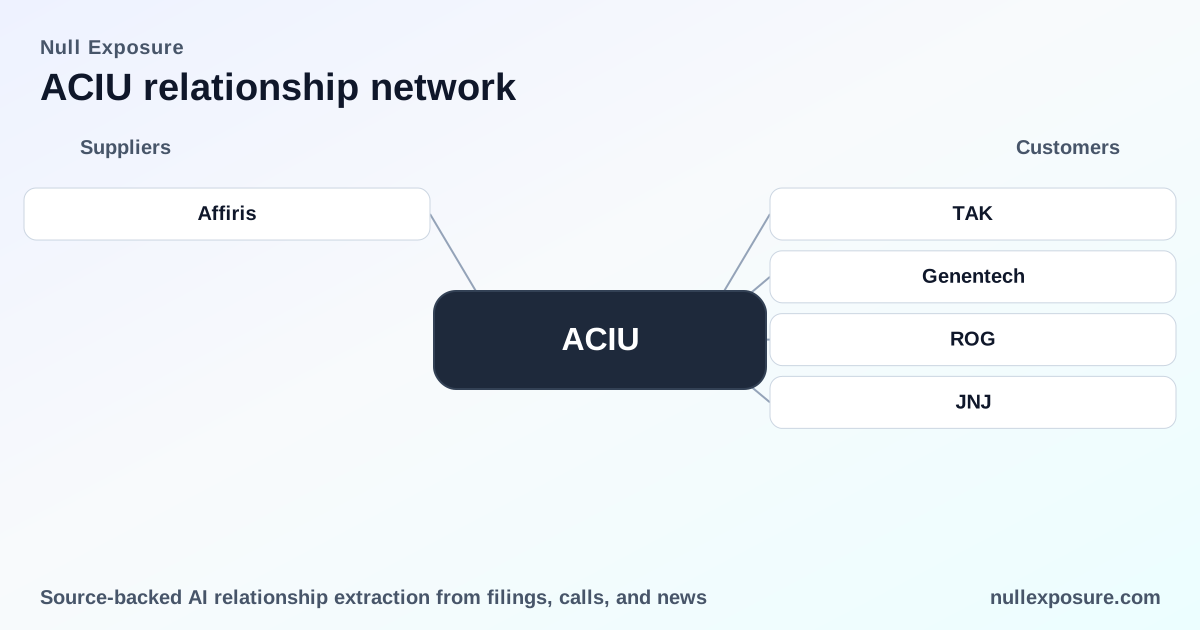
AC Immune: A milestone-driven partner business underpinned by Big Pharma collaborations
AC Immune (ACIU) is a clinical-stage biotech that monetizes primarily through licensing and collaboration agreements with large pharmaceutical partners, receiving upfront payments, development milestones and future royalties while its own R&D advances clinical candidates. For investors, the company’s cash flow profile is lumpy and partnership-dependent, with a small recurring product revenue base and meaningful upside tied to successful Phase transitions paid by partners.
If you want a quick view of AC Immune’s partner map and how it drives near-term cash, visit https://nullexposure.com/.
Why AC Immune’s partner list matters for valuation
AC Immune operates as a research and early-clinical engine that transfers program risk—and funding responsibility—to major pharma through exclusive licenses and collaboration amendments. Upfront payments and milestone triggers (Phase 1 dosing, cohort initiations, regulatory events) drive reported contract revenue; royalty streams are prospective and contingent. That contracting posture produces short-term revenue when trials advance, but also concentrated counterparty risk because a small number of partners account for most contractual value. The company remains clinical-stage and development-dependent, so investors should treat partner milestones as both liquidity events and binary value drivers.
Key partner relationships — what investors need to know
Eli Lilly (LLY) — renewed focus on Morphomer Tau, CHF10M upfront
AC Immune amended its 2018 license and collaboration with Eli Lilly to continue research on Tau aggregation inhibitor small molecules, including new Morphomer Tau candidates; the amendment included a CHF 10 million upfront payment, a Phase‑1 dosing milestone and eligibility for over CHF 1.7 billion in further milestones plus low double‑digit royalties. This amendment was announced in a company release in April 2026 and was widely reported in industry press. (GlobeNewswire press release, April 7, 2026; Yahoo Finance coverage, May 2026)
Takeda (TAK) — ACI‑24 immunotherapy option with milestone receipts
Takeda holds an exclusive worldwide option and license for AC Immune’s ACI‑24 active immunotherapy family, a deal structuring potential payments up to approximately $2.2 billion; operationally, AC Immune recognized contract revenues tied to Takeda efforts (CHF 1.3 million in Q2 2025 and CHF 3.6 million for full‑year 2025) and received a $12 million milestone tied to cohort initiation in AD4. The Takeda relationship is a recurring source of milestone receipts and contract revenue recognition. (Pharmaceutical‑Technology, March 2026; AC Immune press releases / GlobeNewswire, August 2025 and April 2026)
Janssen Pharmaceuticals / Johnson & Johnson (JNJ) — funded ReTain trial and milestone recognition, then enrollment headwinds
Janssen (a J&J company) is developing JNJ‑2056 under a global license agreement and has fully funded the Phase 2b ReTain trial, previously delivering a significant milestone (CHF 24.6 million recognized in 2024). More recently, Johnson & Johnson paused enrollment in an AC Immune‑partnered anti‑Tau immunotherapy trial, introducing execution timing risk around that program’s next milestones. These developments together create both prior cash inflows and present timing uncertainty. (AC Immune FY2025/2026 financial reports via GlobeNewswire, March 2026; Citeline reporting on enrollment pause, May 2026)
Roche / Genentech (ROG) — partnership wound down after program read‑outs
Roche and its U.S. affiliate Genentech have stopped further R&D on semorinemab and crenezumab, effectively ending a long-standing collaboration with AC Immune after disappointing study results, which reduces near-term external validation and potential milestone streams from that program. The decision represents a contraction in AC Immune’s historical partner base and removes a previously important collaborator. (European Biotechnology / Endpoint News summary, March 9, 2026)
What the relationship map implies about AC Immune’s operating model
- Contracting posture: AC Immune functions primarily as a licensor and discovery partner; cash realization is milestone‑and‑event driven rather than from recurring product sales. That structure shifts clinical and commercial risk to partners but concentrates revenue timing around discrete events.
- Concentration: A small number of large pharma partners (Takeda, Lilly, Janssen/J&J, Roche/Genentech historically) account for the bulk of contractual value and cash, creating counterparty concentration risk for cash forecasts.
- Criticality: For AC Immune, partner decisions and trial readouts are material to liquidity and valuation; the company’s ability to secure upfronts and milestone payments directly affects runway.
- Maturity: The business remains clinical-stage, with limited current revenues (contract revenue spikes when milestones hit) and most commercial economics contingent on successful late‑stage development.
Note: the source pool for the partner events presented above contains no explicit constraint documents beyond public announcements; the operating model characteristics above are therefore presented as company‑level signals derived from the partnership activity.
Investment implications and risk checklist
- Positive: Large pharma commitments (Lilly, Takeda, Janssen) provide near‑term cash via upfronts and milestones and validate AC Immune’s platform strategy. The April 2026 Eli Lilly amendment and Takeda milestone payments are concrete cash events that improve short‑term liquidity.
- Negative: Program cancellations and trial pauses (Roche/Genentech program terminations; J&J enrollment pause) create binary downside to pipeline value and delay milestone realization. Revenue remains lumpy and unpredictable, driven by partner decisions and clinical readouts.
- Operational: Management’s ability to convert preclinical and early clinical work into partnerable assets is central; continued success depends on both scientific progress and partner execution.
Practical takeaway for modelers: treat AC Immune’s revenue forecast as a series of conditional cash flows keyed to partner milestones and trial events, and stress‑test scenarios for partner terminations and enrollment delays.
For a deeper, transaction‑level read of AC Immune’s partner amendments and press coverage, see the AC Immune customer relationship overview at https://nullexposure.com/.
Final read: partners are the asset and the risk
AC Immune’s valuation is intrinsically tied to a small number of commercial collaborations that supply cash and validation. The April 2026 amendment with Eli Lilly and recent Takeda milestones are positive, concrete signs of near‑term monetization, but Roche/Genentech program terminations and the J&J enrollment pause underscore that clinical outcomes control value. Investors should value AC Immune as a milestone‑timed biopharma investment—one where partner milestones create upside while partner decisions and trial results create downside.