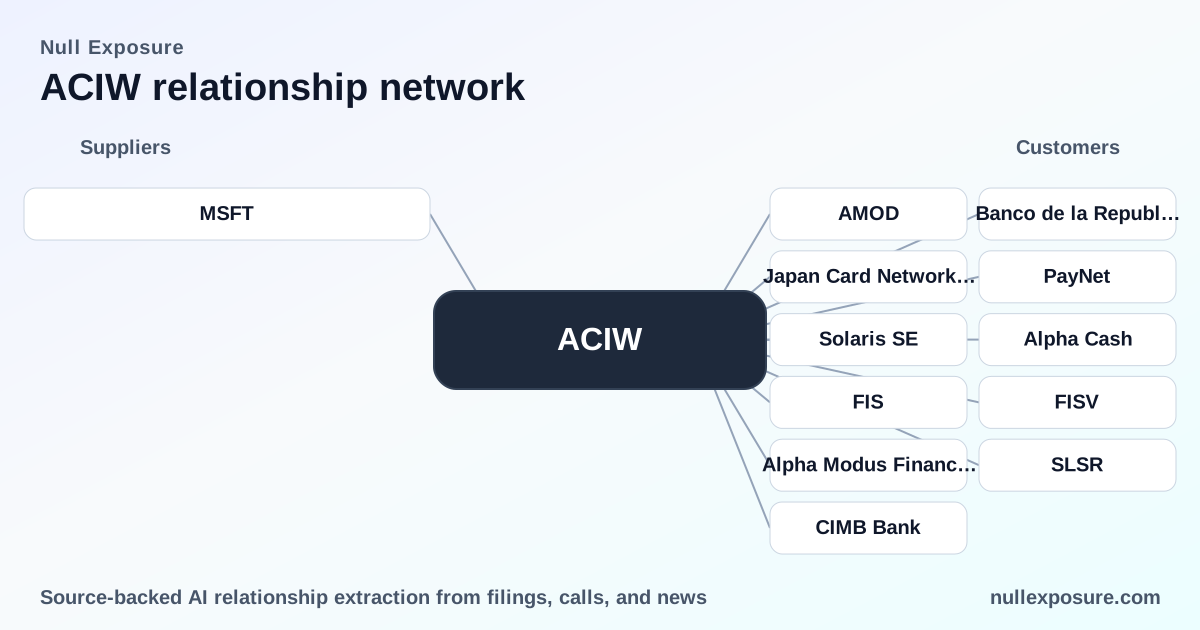
ACI Worldwide (ACIW): customer relationships that power a payments utility
ACI Worldwide sells mission‑critical payments software and hosted processing to banks, merchants and billers, monetizing through a mix of long-term licenses, SaaS/PaaS subscriptions, and usage‑based transaction fees. The company converts scale and multi‑product penetration into durable recurring revenue: large clients commit to multi‑year arrangements while ACI captures variable upside as payment volumes rise. For investors, the relevant frame is a software‑centric services business that behaves like a regulated utility — sticky, global, and transaction‑sensitive. Learn more at https://nullexposure.com/.
How ACI contracts customers and why that matters to earnings
ACI operates with a deliberate contracting posture: multi‑year commitments are standard, and the firm sells software both as licensed on‑premises installs and as cloud‑hosted SaaS/PaaS. Contracts commonly include fixed recurring fees plus variable, usage‑based revenue tied to transaction volumes, which aligns ACI’s revenue with client payment activity. The customer base is global and concentrated in very large financial institutions and large enterprises, yet no single client represented more than 10% of consolidated revenues through 2024 — a structural credit and revenue diversification feature.
Key operating model signals:
- Long-term, stickier cash flows driven by five‑year standard terms (three years for some SaaS/PaaS) and renewal economics.
- Mixed monetization: up‑front licensing and professional services plus recurring subscription and transaction fees.
- Low single‑customer concentration at the company level, but high dependence on the health of global banking and merchant customers.
- Criticality and switching costs: ACI products are embedded in national and enterprise payment rails, making migrations expensive and slow. These characteristics produce a business that is predictable on renewals while offering volume‑sensitive upside during periods of higher payments activity.
Who ACI is working with today — the customer roster that matters
The following captures every customer relationship called out in the collected results, with plain‑English takeaways and source citations.
Alpha Modus Financial Services / Alpha Cash (AMOD / Alpha Cash)
ACI signed a multi‑year services agreement to provide hosted remittance and bill‑pay processing for the Alpha Cash retail ecosystem, enabling electronic and paper‑based bill payments across convenience, grocery and community retail locations nationwide. According to a GlobeNewswire release and multiple market writeups, the deal emphasizes ACI’s hosted remittance and bill pay footprint (GlobeNewswire, Feb 3, 2026; SimplyWall, Feb 2026).
Japan Card Network (CARDNET)
ACI entered an agreement to modernize digital payments in Japan, providing CARDNET with next‑generation digital payments technology and solutions for CARDNET’s customers. Financial IT covered the partnership as part of ACI’s regional expansion in FY2026 (FinancialIT, Mar 2026).
Solaris SE (Solaris / SLSR)
Solaris selected ACI Connetic to run cloud‑native card and instant payments capabilities, praising the solution for simplifying operations, accelerating product change, and supporting growth. MarketScreener and ACI commentary highlight Solaris as an example of ACI winning cloud‑native, fintech‑grade accounts in Europe (MarketScreener, 2026; AlphaStreet, 2025).
RVYL (RyVyl)
A quarterly update on RVYL noted implementation setbacks in Europe, with delays attributed to partners including ACI and Visa, illustrating that integrations into partner ecosystems can slow go‑to‑market execution for some clients. The observation was reported in a Yahoo Finance recap of RVYL’s Q3 2024 discussion (Yahoo Finance, Q3 2024).
FIS
ACI lists FIS among its important customers and referenced the relationship on public earnings calls, indicating ACI provides products and services to large processors and that these partners are also commercial customers. This was discussed in ACI’s Q2 2025 earnings call transcript (AlphaStreet, Q2 2025).
Fiserv
Management referenced Fiserv alongside FIS as industry peers that are also customers, signalling that ACI operates both alongside and as a vendor to large payments processors. The reference appears in the same earnings call transcript coverage (AlphaStreet, Q2 2025).
PayNet (Malaysia)
ACI disclosed an expansion with PayNet, Malaysia’s real‑time account‑to‑account national infrastructure, indicating ACI’s role in national real‑time rails and central clearing capabilities. The win was highlighted in ACI’s Q4 commentary (InsiderMonkey, Q4 2025).
Banco de la República (Central Bank of Colombia)
ACI went live with Banco de la República, the Central Bank of Colombia, described by management as a strategic regional win and evidence of ACI’s central‑bank level capabilities for national payment systems. This was stated on ACI’s Q4 2025 earnings call transcript (InsiderMonkey, Q4 2025).
CIMB Bank
CIMB Bank decided to consolidate real‑time, ACH, RTGS and cross‑border flows onto ACI Connetic, a consolidation win that underscores ACI’s ability to centralize diverse clearing flows for major banks in the region. The reference was noted in industry writeups around the Alpha Modus deal and ACI wins (SimplyWall / AlphaStreet commentary, 2026).
What these relationships imply for investors
- Scale and stickiness: Large bank and central‑bank clients plus major processors as both partners and customers validate ACI’s role as a payments backbone and support predictable renewal economics.
- Volume leverage: Usage‑based pricing on hosted solutions gives ACI upside when payments volumes recover or clients grow, supporting margin expansion versus pure license revenue.
- Implementation risk: Reports of partner‑related delays (RVYL) and the complexity of central‑bank and national‑rail implementations highlight execution risk and potential timing variance in revenue recognition.
- Diversification vs. concentration: No single customer breach of 10% revenue reduces single‑counterparty dependency, but the client mix skews toward very large enterprises and banks, concentrating exposure to cyclical financial sector dynamics.
- Competitive posture: ACI sells both software licenses and cloud services, which positions it to defend footprint through integration depth and operational criticality, while also facing competition from incumbent processors and cloud‑native rivals.
For a focused analysis of ACI’s commercial traction and to track how these client wins convert into recurring revenue, see https://nullexposure.com/.
Bottom line
ACI’s customer relationships — spanning fintechs like Solaris, national rails like PayNet and Banco de la República, processors such as FIS and Fiserv, and retail payment ecosystems like Alpha Cash — reflect a business model built on long‑term contractual commitments, usage‑linked revenue, and critical infrastructure placement. That combination delivers predictable recurring cash flow with upside driven by payment volume growth, balanced by execution risk on complex implementations. Investors should value ACI as a payments platform with utility‑like characteristics but remain attentive to project timelines and macro‑driven transaction volumes.