Axcelis (ACLS): Customer map and what it means for investors
Axcelis designs, sells and services ion-implantation and related processing equipment used to fabricate semiconductor chips, monetizing through high‑margin hardware sales and recurring aftermarket services and spares. Revenue is dominated by ion implanters (98.3% of 2024 revenue) while lifecycle services and spare parts provide a durable service stream (~23% of revenue in 2024), creating a mix of lumpy capital equipment bookings and recurring aftermarket economics. For investors evaluating customer risk and opportunity, the key facts are high APAC exposure, concentrated top‑customer share without a single >10% revenue dependency, and direct commercial links to leading global foundries and power‑device manufacturers. For a structured view of customer relationships and constraints visit https://nullexposure.com/.
Business model in plain terms: capital equipment seller with recurring life‑cycle revenue
Axcelis sells complex capital equipment that is mission‑critical for semiconductor fabs and complements that core sale with aftermarket services (CS&I) — used tools, spare parts, upgrades, field service and training — that smooth revenue between equipment cycles. This dual revenue stream underpins higher gross margins on systems and stable gross profit from services. Sales cycles are long, purchase decisions are concentrated among large chip manufacturers, and system shipments are heavily weighted to Asia (81% of system revenue in 2024), producing operational exposure to APAC demand and geopolitical export controls.
Operating posture, concentration and other company‑level constraints
- Counterparty profile: Axcelis sells primarily to large enterprise semiconductor manufacturers; top 20 industry buyers account for the bulk of capital equipment spend and Axcelis targets those customers.
- Geographic concentration: Asia accounts for the majority of system shipments (81.0% of system revenue in 2024), concentrating revenue sensitivity to APAC capex cycles.
- Customer concentration vs. single‑customer risk: Net sales to the ten largest customers represented 45.9% of revenue in 2024 while no single customer exceeded 10% of consolidated revenues for the year — a mixed signal that implies material concentration across a handful of buyers but no single counterparty dependency.
- Revenue mix and maturity: The ion‑implantation hardware franchise is the clear core product (98.3% of revenue in 2024), while services are a meaningful and stable adjunct (CS&I ~$235.3m in 2024, ~23.1% of revenue). Axcelis is expanding its Purion platform footprint and currently operates evaluation/pilot systems at customer sites.
- Contracting and criticality: Sales involve large, creditworthy fabs with formal procurement cycles; implanters are critical production equipment, making product qualification and post‑sale service central to long‑term customer relationships.
These constraints should be read as company‑level signals shaping Axcelis’s go‑to‑market dynamics and risk profile rather than as attributes tied to any single customer.
Customer relationships: the names investors should know
Below are every relationship record from the available results and a concise investor‑oriented takeaway for each.
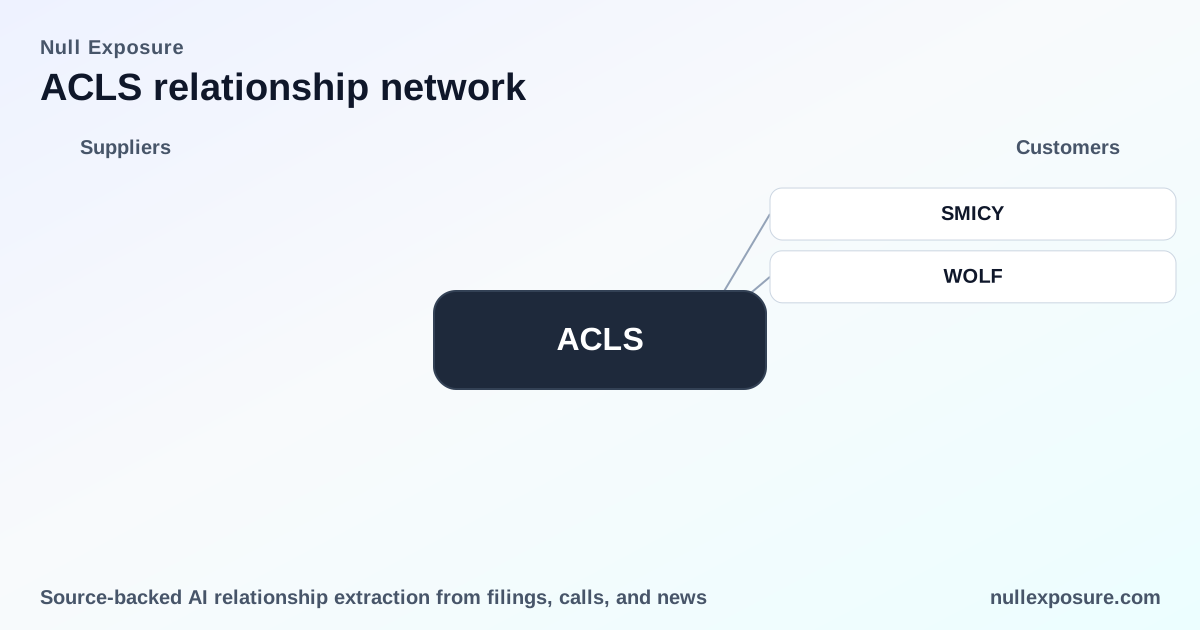
Semiconductor Manufacturing International Corporation (SMIC) — source: Axcelis 2025 Form 10‑K (FY2025)
Axcelis identifies SMIC as one of its major Chinese customers and discloses that SMIC is on the U.S. Entity List but subject to a 2020 licensing policy that permits shipments to certain mature‑process fabs; Axcelis states it has been able to obtain those licenses to date. According to the company’s 2025 Form 10‑K, export controls are an active commercial constraint for this customer relationship.
SMICY (alternate listing of SMIC) — source: Axcelis 2025 Form 10‑K (FY2025)
A second relationship entry duplicates the disclosure that SMIC/SMICY is a major Chinese customer on the U.S. Entity List and that Axcelis has relied on the 2020 licensing policy to ship to mature process fabs; this reinforces that export licensing is a documented operational consideration in Axcelis’s China sales. The company’s 2025 10‑K contains the disclosure.
WOLF (Wolfspeed) — source: semiconductor‑today news report (September 2025, FY2025)
Axcelis shipped a Purion H200 SiC Power Series ion implanter to Wolfspeed, signalling commercial traction in the SiC power device segment where demand is rising for EV and power‑electronics applications. The September 2025 industry report records the shipment of the Purion H200 to Wolfspeed.
Wolfspeed (duplicate entry) — source: semiconductor‑today news report (September 2025, FY2025)
A second record identifies the same shipment to Wolfspeed, confirming the vendor relationship and product deployment in Wolfspeed’s SiC production line as reported in industry media in September 2025.
Taiwan Semiconductor Manufacturing Company (TSMC) — source: FinancialContent fintech deep dive (March 2026, FY2026)
Independent coverage notes Axcelis’s customer base includes TSMC among a concentrated set of large foundries; this positions Axcelis as a validated supplier to the global leader in foundry capacity, which supports both equipment sales and longer‑term aftermarket revenue. The March 2026 market deep‑dive names TSMC explicitly.
Samsung — source: FinancialContent fintech deep dive (March 2026, FY2026)
Industry analysis lists Samsung as one of the major customers in Axcelis’s concentrated customer base, indicating exposure to another tier‑one foundry/IDM whose capex cadence will materially affect Axcelis’s orders. The March 2026 article identifies Samsung among leading customers.
What investors should focus on next
- Order book and backlog composition: Given that capex is lumpy and concentrated among large APAC fabs, monitor backlog geography and the split between new‑system orders and service contracts.
- Export control risk: The SMIC disclosure makes export licensing a recurring operational risk; investors should watch licensing outcomes and policy developments for China‑facing sales.
- SiC and power device traction: The Wolfspeed shipment signals growth beyond logic/DRAM/advanced foundries into power devices; continued wins in SiC could diversify end‑market exposure.
- Customer concentration evolution: Top‑ten share nearing half of revenue creates sensitivity to a small number of large buyers even if no single customer breaches the 10% threshold.
For a running, customer‑level feed and to benchmark these relationships against peer supplier networks visit https://nullexposure.com/ — the site centralizes the kinds of customer signals investors use to stress‑test semiconductor supply‑chain exposure.
Bottom line
Axcelis operates a high‑margin capital equipment business with valuable recurring aftermarket revenue, large APAC exposure, and concentrated relationships with top foundries and power‑device manufacturers. These facts create both upside — through product wins at TSMC, Samsung and Wolfspeed — and operational risk via geopolitical export controls and cyclical capex from a concentrated buyer set. Investors should weigh the company’s strong product positioning and service annuity against concentration and regulatory sensitivity when modeling revenue volatility and margin sustainability.