ACLX Customer Relationships: What the Gilead Deal and Partner Map Mean for Investors
Arcellx builds and commercializes engineered cell therapies for multiple myeloma and related oncology indications, monetizing through co-development and commercialization agreements with larger biopharma partners and, ultimately, product sales or an exit. The company’s operating model has been partner-first: clinical acceleration and go-to-market leverage are achieved through strategic relationships (notably with Gilead/Kite), and value is crystallized via M&A or commercial royalties and milestone payments. For active investors and operators, the critical lens is on counterparty concentration, regulatory-readiness of the lead program, and how partnership economics convert clinical success into realized cash flows.
If you want a consolidated view of counterparties and contract risk for ACLX, NullExposure maintains curated relationship profiles and timelines — see https://nullexposure.com/ for more detail.
The headline: Gilead acquires Arcellx — strategic consolidation, immediate de-risking
Gilead Sciences agreed to acquire Arcellx for up to $7.8 billion, taking full control of Arcellx’s lead program and integrating it into Gilead’s cell-therapy platform. Multiple news outlets reported the deal and the transaction terms, which transfer development, commercialization, and regulatory execution responsibilities to Gilead and its Kite subsidiary. According to CNBC (February 23, 2026), Gilead will pay as much as $7.8 billion to acquire Arcellx to expand its oncology pipeline.
Key takeaway: The acquisition converts Arcellx’s primary customer/partner relationships into an acquisition exit, shifting counterparty risk from a diversified set of commercial payors and partners to a single corporate acquirer (Gilead). This materially changes the revenue and contracting profile for ACLX stakeholders.
Relationship inventory: who Arcellx was working with and what the public record shows
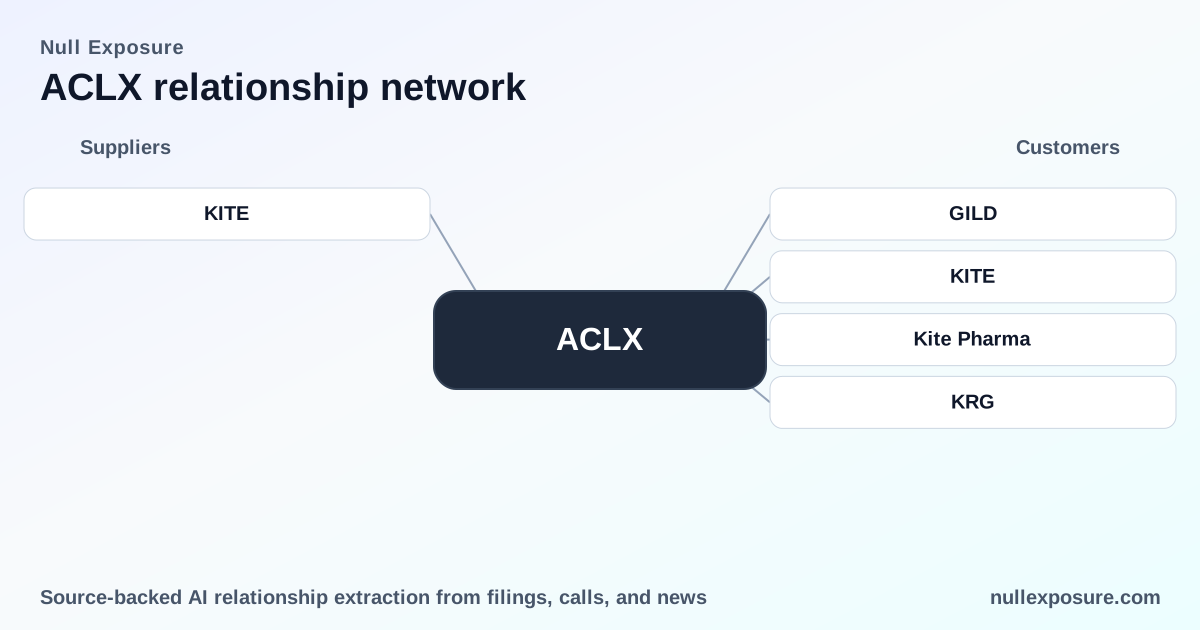
Gilead Sciences (GILD)
Arcellx’s principal strategic partner and now acquirer, Gilead agreed to purchase Arcellx for up to $7.8 billion as part of a push to broaden its oncology and cell-therapy portfolio; this transaction absorbs Arcellx’s programs and partnership economics into Gilead’s platform. CNBC reported the transaction on 2026-02-23 and multiple trade outlets confirmed regulatory approvals and closing activity through spring 2026.
Source: CNBC (2026-02-23) and follow-on coverage across trade press in March–May 2026.
Kite Pharma / Kite, a Gilead Company (KITE)
Kite was the co-development and commercialization partner for Arcellx’s lead ddCAR candidate anito-cel; the collaboration covered pivotal Phase 2 and planned global Phase 3 development and anticipated launch activities. Industry write-ups and investor notes emphasize the operational linkage between Arcellx’s clinical timeline and Kite’s manufacturing and commercial capabilities (Simply Wall St and Directorstalk Interviews, March 2026).
Source: Directorstalk Interviews and Simply Wall St coverage (March 2026).
KRG (KRG)
Independent commentary referenced KRG in the context of assessing the D‑domain CAR‑T approach and how safety-readout implications influence valuation rather than near-term revenue. Analysts cited KRG commentary in valuation pieces discussing how a cleaner safety profile for anito-cel would change investor outlooks on Arcellx’s programs.
Source: Simply Wall St analysis summarizing KRG-related commentary (March 2026).
Contracting posture and business-model constraints: company-level signals
Arcellx’s public language and filings frame its commercial path as partner-dependent and pre-revenue, which shapes contracting posture, concentration, criticality, and maturity:
- Contracting posture — partner-first and contingent. Arcellx historically relied on co-development and commercialization partnerships (e.g., Kite) to access manufacturing scale and commercial channels; contractual cash flows were tied to milestones and future product sales rather than legacy recurring revenue.
- Concentration — high at the program level. Value is concentrated in a single lead program (anito‑cel) and a small set of large partners; this created binary outcomes (successful pivotal data or acquisition) prior to the Gilead transaction.
- Criticality — strategically important to large enterprise partners. For a partner like Gilead/Kite, Arcellx’s D‑domain platform and anito‑cel represented a differentiated asset in multiple myeloma, increasing the strategic criticality of the relationship from a partner perspective.
- Maturity — early-stage clinical and commercial transition. Prior to acquisition, Arcellx had no approved products and no product revenue, placing it in the clinical-stage maturity bucket; the Gilead takeover accelerates transition to commercialization under an established enterprise.
These constraints are consistent with the company’s own disclosures about reliance on third‑party payors (including government programs) and the need to navigate regulatory frameworks across EMEA and APAC as programs advance.
Regulatory and market geography signals
Arcellx’s filings highlight exposure to regulatory regimes in Europe and Asia and dependence on coverage frameworks, including government health programs and commercial insurers. This implies that commercial economics will be shaped by multi-jurisdictional approval paths and payor negotiations — a dynamic that increases the importance of a large, global partner (the commercial advantage Gilead delivers).
What investors and operators should focus on next
- Post-acquisition integration and commercialization timelines. With Gilead now the contracting counterparty, the near-term value drivers move to how quickly Gilead/Kite converts clinical readouts into approved label and launches, and how milestone vs. royalty economics are settled in the acquisition terms.
- Payor and geographic rollout risk. Expect negotiation leverage to shift to a global enterprise (Gilead) with existing payer relationships, which reduces execution risk but concentrates revenue realization under one corporate umbrella.
- Safety signals and regulatory endpoints. Market commentary emphasized D‑domain safety signals and FDA guidance on accelerated approval endpoints (Simply Wall St); those clinical inputs remain the gating factors for commercial value even after acquisition.
For a deeper walkthrough of counterparty timelines and what the evolving partner map means for contract risk, visit https://nullexposure.com/ for the full relationship dossier.
Bottom line for investors and operators
The Gilead acquisition materially de-risks Arcellx for outside investors by moving development and commercialization into a large enterprise, but it also concentrates future upside within Gilead’s corporate P&L. Prior counterparty exposures—to Kite as a co‑developer and to payors across EMEA/APAC—now convert into integration and launch execution risk under Gilead. For operators, the move shifts the question from "can Arcellx commercialize this program?" to "how effectively will Gilead/Kite commercialize it and secure payer access globally?"
If you are modeling ACLX outcomes, treat the Gilead acquisition as a structural re‑scoping event: clinical success remains necessary, but the levers that capture commercialization value have shifted to a large strategic buyer with established payer relationships and global infrastructure.