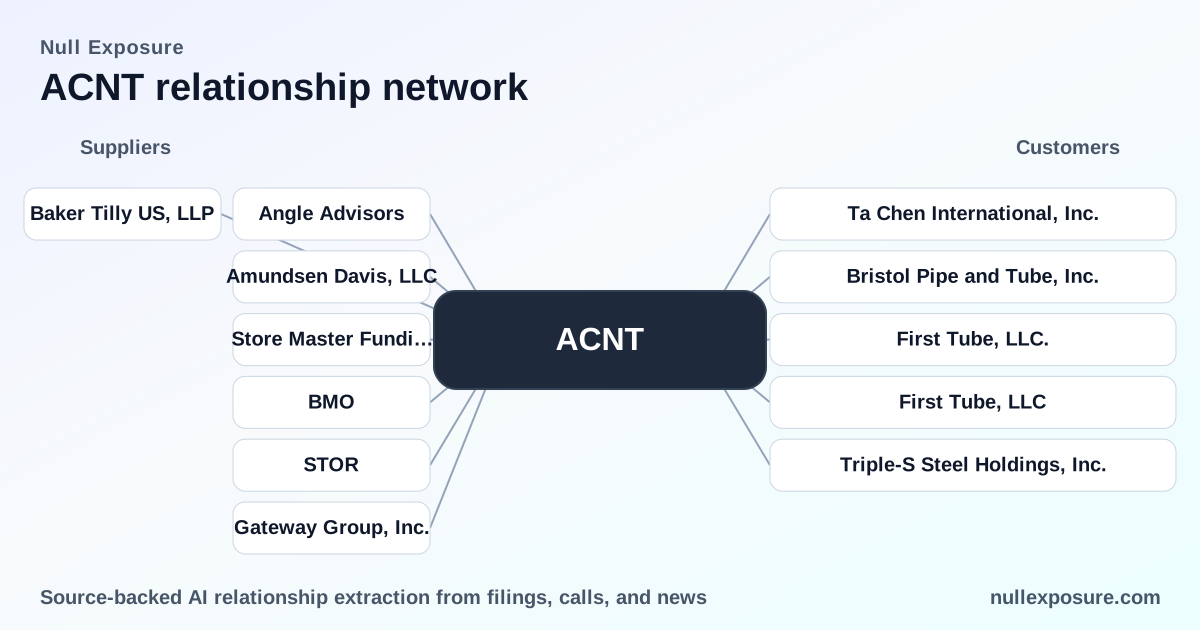
ACNT (Ascent Industries Co.): Customer relationships after a sweeping asset reshuffle
Ascent Industries Co. operates as a manufacturer and distributor of specialty chemicals and stainless steel tubular products, monetizing through product sales to distributors, OEMs and end users and by providing contract manufacturing services to chemical customers that outsource production to avoid CAPEX. The company has recently accelerated a strategic shift by selling entire tubular operations, converting balance-sheet and revenue mix dynamics while crystallizing counterparty exposures. For a concise portfolio view and matchup analysis, visit https://nullexposure.com/.
What the recent deals change for investors
Over the past year Ascent executed major asset sales of its tubular businesses that directly alter the company's customer and counterparty map. Those transactions monetize legacy industrial assets—$45 million for Bristol Metals and $16 million for American Stainless Tubing—and transfer ongoing commercial relationships to the acquirers. The transactions materially reduce Ascent’s tubular-product footprint and concentrate continuing revenue in the Specialty Chemicals segment, which historically exhibits high customer concentration and long-term contracting characteristics.
Key takeaway: Ascent has converted physical manufacturing exposure into cash and counterparty receivables while leaving a specialty-chemicals business that is geographically U.S.-heavy, materially concentrated among top customers, and structured around multi-year outsourcing relationships.
The corporate constraints that shape customer risk
Ascent’s operating model carries a small set of persistent traits that investors should treat as structural, not transient:
- Long-term contracting posture: The company reports long-term relationships with leading chemical customers that outsource production to Ascent to accelerate commercialization and avoid CAPEX. This makes Ascent’s specialty-chemicals revenue recurring and sensitive to contract renewal dynamics.
- Geographic concentration in North America: The company’s sales are predominantly U.S.-based (vast majority of reported geographic sales), meaning U.S. industrial demand and trade conditions drive near-term performance.
- Material customer concentration: The Specialty Chemicals segment’s top 15 customers accounted for roughly 53% of revenues in 2024, with the single largest customer contributing about 12%—a clear concentration risk to monitor.
- Mature, active relationships: The company classifies many of its customer engagements as long-standing and mature, consistent with being a contract manufacturer and seller in industrial end markets.
- Manufacturing-centric segments: Two reportable segments—Specialty Chemicals and Tubular Products—define the business model; the recent asset sales reduce tubular exposure and emphasize chemicals going forward.
These constraints signal that the firm’s earnings are sensitive to a small number of large chemical customers and U.S. industrial cycles, even as balance-sheet liquidity improved via asset dispositions.
Who acquired Ascent assets — and what that means for customer flow
Below are every counterparty noted in public reports connected to the asset sales; each relationship is summarized with the cited source.
-
Ta Chen International, Inc. — According to press reports in March 2026, Ta Chen bought substantially all the assets of Bristol Metals, LLC from Ascent for approximately $45 million in cash, taking on the tubular-product operations and the related customer flows formerly served by BRISMET. (Angle Advisors and CityBiz coverage, March 2026.)
-
Bristol Pipe and Tube, Inc. — The company's 10-K and related filing disclose that Bristol Pipe and Tube, a Delaware subsidiary of Ta Chen, was the purchaser of BRISMET assets under an asset purchase agreement executed March 12, 2025; the filing frames the transfer as a deconsolidation of the BRISMET business. (Ascent 10-K reproduced on StockTitan; March 2025 filing details reported in FY2026 filing materials.)
-
First Tube, LLC. — Ascent announced the sale of American Stainless Tubing, LLC (ASTI) to First Tube, LLC for $16 million in cash, with the transaction closing in FY2025; First Tube therefore inherits the tubing production and customer relationships built into ASTI. (Angle Advisors post, March 2026.)
-
Triple-S Steel Holdings, Inc. — First Tube is a wholly owned subsidiary of Triple-S Steel Holdings, and Triple-S becomes the corporate parent absorbing ASTI’s customers and operations via First Tube; public commentary links the $16 million ASTI sale to Triple-S’s acquisition vehicle. (Angle Advisors post, March 2026.)
Each of these entries reflects a transition of industrial tubular customers and production capacity out of Ascent’s control and into established stainless and steel distributors/manufacturers, altering where those buyer relationships now sit on the market map.
How investors should interpret the counterparty moves
The asset sales create three immediate investment implications:
- Liquidity and deleveraging: The cash proceeds (stated $45M and $16M in public notices) materially improve balance-sheet flexibility and reduce operational complexity by eliminating lower-margin or cyclic tubular assets.
- Revenue concentration risk increases in chemicals: With tubular products divested, the remaining revenue base concentrates further in Specialty Chemicals, where the top customers already account for a majority of segment revenue—heightening counterparty concentration and contract-renewal sensitivity.
- Counterparty transfer of operational risk: Buyers like Ta Chen and Triple-S are established industry operators; Ascent’s commercial risk tied to tubular customers transfers to those acquirers, reducing Ascent’s exposure to capital-intensive tubular markets while creating potential service and supply dependencies if legacy agreements persist.
What to watch next — catalysts and risk triggers
Investors should monitor three metrics and events over the coming quarters:
- Renewal and replacement of major chemical contracts: Given the long-term nature of the chemical outsourcing relationships, contract renewal cadence and pricing will drive revenue visibility.
- Revenue and margin composition post-divestiture: Watch reported segment results to confirm whether Specialty Chemicals can offset lost tubular margin contribution and to gauge the persistence of the reported material customer concentration.
- Use of proceeds and capital allocation: How Ascent deploys sale cash—paydown, reinvestment, dividends, or M&A—will determine whether the company emerges as a streamlined chemical-focused operator or as a holding vehicle awaiting redeployment.
Bottom line: cleaner balance sheet, concentrated earnings
Ascent has executed a decisive simplification: sold tubular assets for meaningful cash and now shoulders a concentrated, U.S.-centric specialty-chemicals book of business anchored by long-term customer relationships. That trade-off reduces capital intensity and transfers tubular counterparty risk to sector specialists, but it increases earnings sensitivity to a handful of large chemical customers and contract renewal dynamics.
For a structured view of counterparties and to benchmark these relationship changes against sector peers, see our research hub at https://nullexposure.com/.
Bold decision-making by management has made Ascent a purer-play specialty-chemicals firm; investors must now underwrite concentrated customer risk and watch contract timelines closely.