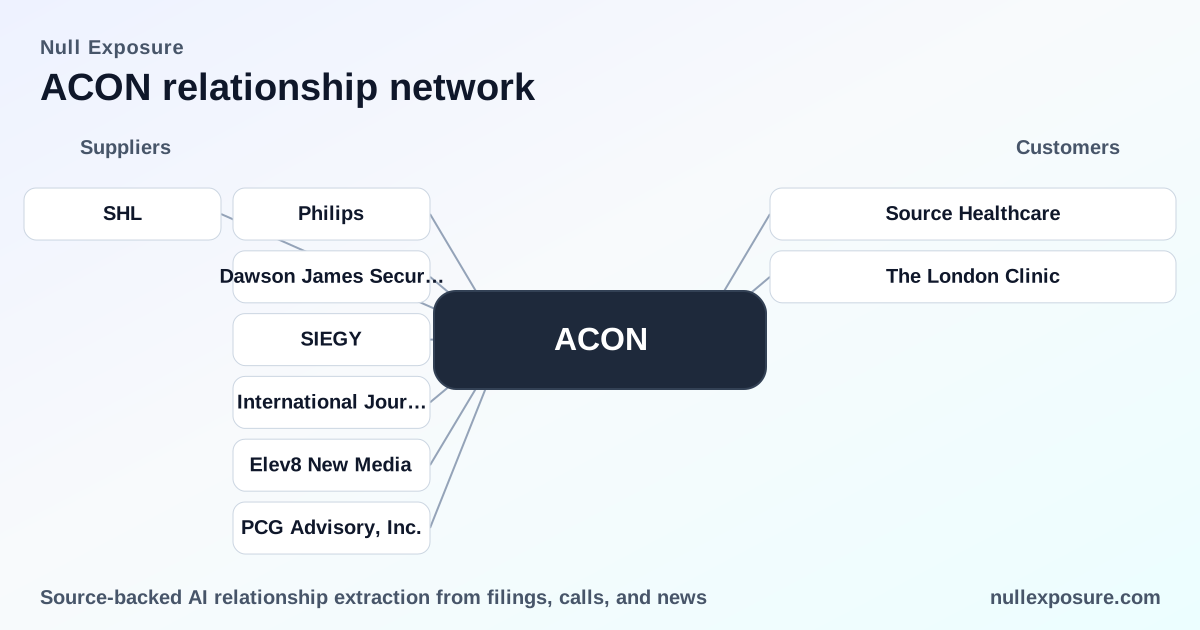
Aclarion (ACON) — Customer Relationships Signal Early Commercial Traction and Concentration Risk
Aclarion monetizes Nociscan as a clinician-facing SaaS service plus one-time site enablement charges and per-report revenue: the company sells post-processed MRI analytics to physicians, charges for delivered Nociscan reports at point of service, and recognizes revenue upon delivery with payment terms typically 30–90 days. Early commercial traction is driven by reimbursement wins in the U.K. and a handful of clinical partnerships that both generate scans and build real‑world evidence, while the revenue model retains high concentration and short-term contract characteristics that investors must weigh against adoption upside. For regular coverage and to track new partner announcements, visit https://nullexposure.com/.
Market validation in 2025–2026 centers on payer reimbursement and marquee clinical sites. Below I synthesize every customer relationship reported in available press coverage and earnings commentary, followed by the operational constraints that shape Aclarion’s runway and risk profile.
Why these partners matter for valuation and adoption
Aclarion’s growth vector is classic for early-stage digital health: convert clinical proof points into payer coverage, use high-volume clinical practices to scale scan volumes and real-world evidence, then leverage reimbursement to unlock routine referrals. Payer reimbursement (U.K. private insurers) and agreements with leading spine centers are the two most material commercial signals in recent public disclosures.
(If you want a succinct feed of partner disclosures and newsflow for modeling, Aclarion’s commercial updates are tracked on the company’s investor releases and summarized weekly at https://nullexposure.com/.)
Detailed partner relationships and sources
AXA
AXA is identified as one of three large U.K. private insurers that have reimbursed Nociscan for several months, supporting early commercial adoption and revenue recognition in that market. According to Aclarion’s Q1 2026 results as published via GlobeNewswire and reported by The Manila Times (April 30, 2026), AXA is listed among payers providing reimbursement. Source: The Manila Times / GlobeNewswire, Q1 2026.
Aviva
Aviva is likewise named as a reimbursing private insurer in the U.K., providing another payer credential that broadens coverage beyond a single carrier and strengthens the company’s U.K. reimbursement thesis. This reimbursement detail was cited in Aclarion commentary and reported by MEXC and other press (April–May 2026). Source: MEXC news summary, Q1 2026.
Vitality
Vitality joins AXA and Aviva as a U.K. private insurer reimbursing Nociscan, completing the set of three of the four largest private U.K. insurers referenced in Aclarion’s disclosures and supporting near-term scan volume growth in that market. Source: MEXC and StockTitan coverage of Aclarion’s Q1 2026 report.
Weill Cornell Medicine
Aclarion established a commercial agreement with Weill Cornell Medicine to use Nociscan in selected spine patients, expanding U.S. academic adoption and producing clinical data that supports payer discussions. The agreement was announced in Aclarion press releases and reported by outlets including The Manila Times and Bitget in April 2026. Source: GlobeNewswire / The Manila Times and Bitget press reports, April 2026.
Och Spine at NewYork‑Presbyterian / Weill Cornell Medical Center
Och Spine (the multidisciplinary spine team at NewYork‑Presbyterian/Weill Cornell) is specifically named as the clinical group bringing Nociscan into practice under the Weill Cornell agreement, led by a principal investigator with an established clinical reputation. Aclarion’s announcement and press coverage highlight this center-level deployment as part of the Weill Cornell partnership. Source: Bitget press coverage and GlobeNewswire summary, April 2026.
Och Spine (standalone mentions)
Separately, media summaries reference “Och Spine” deployments and center-level rollouts in connection with the Weill Cornell agreement; these items reiterate the same clinical adoption point at the spine center level and were cited in StockTitan and other press on the Q1 2026 release. Source: StockTitan coverage of Aclarion Q1 2026.
The London Clinic
The London Clinic is an early U.K. clinical partner where nearly 100 Nociscans have already been conducted, serving as a high‑visibility adoption site supporting both patient access and evidence generation. Aclarion discussed activity at The London Clinic in corporate updates and in the company’s personnel announcement, with media coverage in March–May 2026. Source: Yahoo Finance, StockTitan and Bitget press summaries, FY2025–FY2026.
Source Healthcare (Los Angeles)
Aclarion executed an agreement to introduce Nociscan at Source Healthcare, a high‑volume Los Angeles practice, to expand U.S. access and accelerate real‑world evidence generation in interventional pain pathways. This commercial expansion was described in company releases and covered by Yahoo Finance and Intellectia in March 2026. Source: Yahoo Finance and Intellectia reporting, March 2026.
Operating and model constraints that drive revenue dynamics
Across filings and press commentary, several company-level signals constrain how investors should model Aclarion’s revenue and risk:
- Contracting posture: spot / short-term — Revenue recognition occurs at the delivery of Nociscan reports with no ongoing obligations, and payment terms are typically 30–90 days; contracts are transaction-based rather than long-term recurring licenses. This creates predictable cash timing for delivered services but limits revenue visibility and customer stickiness.
- Counterparty mix: payers, government and individual patients — The company sells directly to medical professionals and currently generates most revenue from patients paying out‑of‑pocket, while growth relies on payer reimbursement (private insurers and potential government programs such as Medicare/Medicaid) to scale volumes.
- Geographic footprint: U.S. focus with targeted EMEA expansion — Substantially all current revenues are U.S.-centric, but CE-mark and U.K./EU launches plus U.K. insurer reimbursements indicate an active EMEA expansion path.
- Business role: seller and service provider — Aclarion functions as both a software seller (SaaS post‑processor) and a service provider producing diagnostic reports, positioning the company in a hybrid commercial role that requires clinical integration and operational support.
- Product segment and spend profile: software-led, sub‑$100k site enablement — The offering is software-first (Nociscan SaaS) with one-time site enablement costs for spectroscopy ranging $25k–$50k for sites lacking compatible software, suggesting a spend band beneath $100k for initial deployments.
- Maturity and concentration: early adoption with concentrated revenue sources — Adoption centers and UK insurer coverage are encouraging, but overall revenue remains limited and concentrated across small numbers of clinical sites and direct patient payments.
Investment implications: what to watch next
- Upside catalysts: expansion of payer coverage beyond the named U.K. insurers, additional high‑volume U.S. practice rollouts, and published outcomes from Weill Cornell / Och Spine that convert referral pipelines into recurring clinical use.
- Principal risks: limited revenue scale to date, high reliance on point‑in‑time report billing, and concentration in a small set of clinical partners and payer wins. These factors translate to heightened volatility in near-term financials despite promising adoption signals.
- Modeling stance: treat revenue as transactional with step-function growth tied to discrete reimbursement milestones and major clinical partner rollouts; cap long-term retention benefits until multi-year contracting language or subscription-style pricing is disclosed.
Conclusion: Aclarion shows credible early commercial validation through U.K. payer reimbursements and marquee clinical partners, but the company’s spot/short‑term revenue model and concentrated customer base require careful monitoring of payer expansion and evidence generation before extrapolating sustained revenue growth. For continuing updates on partner activity and to integrate these relationship signals into your models, see https://nullexposure.com/.