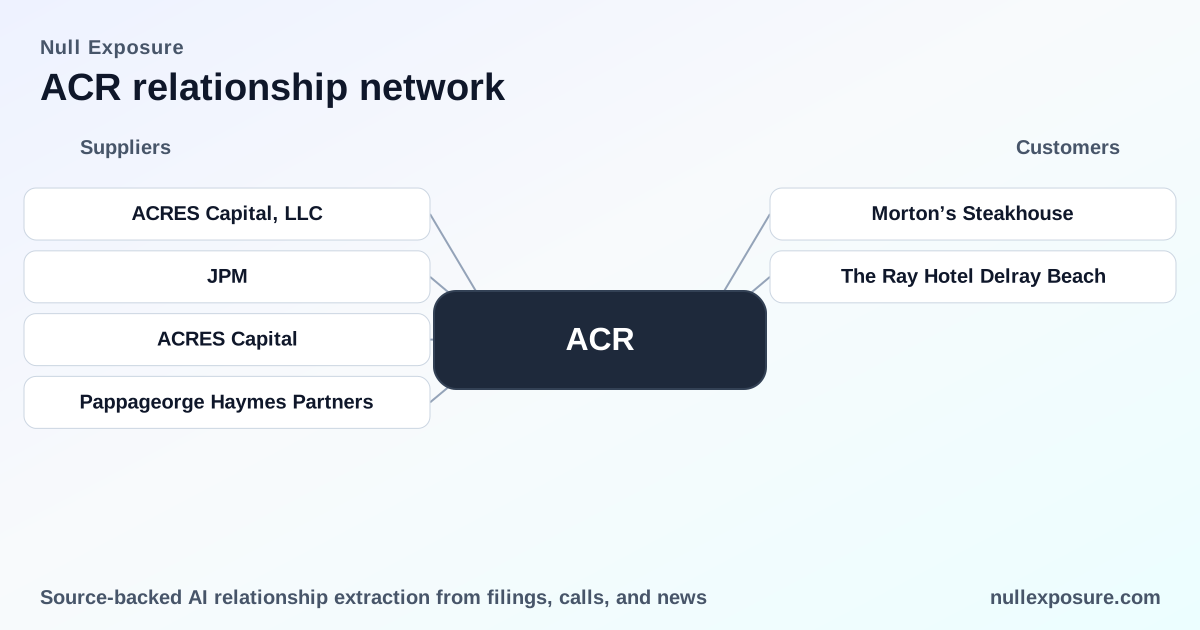
ACR: Lending the Built World — How Acres Commercial Realty Converts CRE relationships into predictable cash flow
Acres Commercial Realty Corp (ACR) operates as a mortgage REIT focused on commercial real estate lending: the company originates, holds and manages CRE mortgage loans and monetizes via interest income, fee income and asset management on an actively-managed loan portfolio. With roughly $87.8 million in trailing revenues and a market capitalization near $159 million, ACR’s economics are driven by loan underwriting, spread capture and portfolio rotation rather than property operations — a capital-light, credit-oriented model that scales through origination volume and balance-sheet leverage. For a deeper, investor-focused look at counterparties and customer links, visit https://nullexposure.com/.
Why customer relationships matter for a lending REIT
ACR’s counterparties are not retail customers — they are tenants, hotel owners and sponsors whose cashflow and real estate collateral define credit performance. Customer mentions captured in public reporting and local press illuminate the company’s active lending role: ACR underwrites refinancing and redevelopment projects that generate interest income and create re-deployment opportunities when loans pay down or are refinanced.
Morton’s The Steakhouse — a ground-floor commercial tenant at 65 E Wacker Place
ACR participated with Mavrek Development in financing the conversion of 65 E. Wacker Place in Chicago, where Morton’s The Steakhouse remains the ground-floor commercial tenant occupying the first two floors while the upper stories convert to residential use. Local coverage documents the financing close and the tenant’s continued presence in both the March and May 2026 reporting on the project (see Urbanize Chicago, March 9, 2026 and interior-demolition permit reporting May 2, 2026), and REJournals reported the financing close on May 2, 2026: https://rejournals.com/mavrek-acres-commercial-realty-close-financing-for-chicagos-65-e-wacker-place/ and https://chicago.urbanize.city/post/plan-commission-approves-residential-conversion-65-e-wacker.
The Ray Hotel Delray Beach — a debt relationship, not a property operation
ACR originated a nearly $86 million loan to refinance The Ray Hotel Delray Beach, a Hilton-branded hotel, demonstrating the firm’s role as credit provider to hospitality owners rather than an operator of hotels. This transaction was covered in REIT Magazine in November–December 2021 as an example of ACR’s middle-market CRE lending activity: https://www.reit.com/news/reit-magazine/november-december-2021/acres-targets-middle-market.
How these relationships map to ACR’s operating posture
The public evidence and corporate disclosures create a coherent picture of ACR’s operating constraints and strategic posture:
- Contracting posture — predominantly long-term. Excerpts indicate whole loans with multi-year terms (example range January 2025 to January 2030), signaling a portfolio weighted to multi-year mortgage contracts and predictable interest streams.
- Geographic footprint — national but regionally concentrated. ACR’s CRE lending revenues derive from U.S. origination and the loan portfolio is distributed across regions (Southwest 25.0%, Mountain 19.2%, Southeast 16.5%, Mid-Atlantic 12.6%, Northeast 10.7%, Pacific 10.1%, and smaller positions elsewhere), which produces national diversification with higher exposure in certain Sunbelt and Mountain markets (source: company portfolio summary).
- Concentration and criticality — idiosyncratic risk is controlled. The company states no single loan or investment represented more than 10% of total assets and no single group generated over 10% of revenue, a governance signal that limits single-borrower concentration risk.
- Role and service posture — lender and loan manager. ACR’s business is a service-oriented CRE lending operation: the firm originates, holds and services loans rather than operating real estate assets.
- Relationship maturity and performance — active and performing. Disclosures note loans were performing under modified contractual terms as of December 31, 2024, indicating current portfolio performance consistent with covenant compliance and active servicing.
- Single-segment focus. Management reports one consolidated operating segment — CRE lending operations — which concentrates management attention and reporting on loan performance and origination economics.
What investors should extract from these customer links
ACR’s publicly-visible customer relationships illustrate two durable product lines: financing sponsor-led value-add conversions (the 65 E Wacker Place deal) and refinancing established hospitality assets (The Ray Hotel loan). Those deal types generate interest income today and create future book-rotation opportunities when loans pay off or are restructured.
Key investment implications:
- Underwriting-driven returns: ACR’s earnings depend on loan-level spread capture and portfolio turnover rather than property NAV appreciation.
- Diversification vs. local execution risk: Geographic spread reduces single-market exposure, but higher concentration in several regions creates common-cycle sensitivity across portions of the book.
- Low single-borrower risk: With no loan >10% of assets, the portfolio avoids outsized single-name shocks.
- Active origination capability: Public reports show ACR actively originates into conversion and hospitality financings, demonstrating market access to mid‑market sponsors.
Risks and advantages — quick checklist:
- Advantage: Predictable interest revenues from multi-year whole loans.
- Advantage: No single-loan concentration over 10% limits catastrophic idiosyncratic exposure.
- Risk: Market-cycle sensitivity in concentrated regions (Southwest, Mountain, Southeast).
- Risk: Asset-type exposure to hospitality and conversion projects which are more sensitive to demand cycles.
Valuation context and portfolio signals
ACR shows modest trailing EPS and revenue dynamics (trailing revenue $87.8M; diluted EPS $0.03), with forward valuation metrics reflecting recovered investor expectations (Forward P/E ~10.6 versus an elevated trailing P/E anchored by low trailing EPS). The balance-sheet orientation — loans held for investment — drives valuation multiples differently than an equity REIT owning property; investors should value ACR on loan yield spread, credit performance and the reuse rate of capital rather than on cap-rate expansions alone. Insider ownership (~21%) and institutional ownership (~49%) indicate meaningful alignment with management and institutional oversight.
Bottom line: an originator-lender with diversified, credit-driven exposure
ACR’s customer mentions — a ground-floor tenancy at 65 E Wacker Place and an $86 million hotel refinance in Florida — are consistent with a portfolio of middle-market CRE loans originated to lenders and sponsors rather than property operation. The firm’s operating characteristics (long-term contracts, national footprint with regional concentrations, immaterial single-loan exposure, single-segment services focus and performing loans as of year-end 2024) form the core credit and operational signals investors should weigh.
For investors and operators evaluating counterparty risk and portfolio composition, ACR is a lender-first franchise whose returns will track underwriting quality and the macro real estate cycle. For more in‑depth relationship mapping and ongoing monitoring, visit https://nullexposure.com/.