ACR-P-C: Customer Footprint and Real-World Tenant Signals Investors Should Track
ACR-P-C represents a claim in an asset-management franchise that monetizes through advisory and investment products for institutional clients, while the preferred share class captures a prioritized claim on distributions. Revenue comes from recurring management fees and investment returns, with capital structure priorities determined by the preferred instrument — a holder-level exposure to cash flow stability rather than organic operating growth. For relationship intelligence and ongoing updates on tenant and leasing signals that affect asset performance, visit https://nullexposure.com/.
Why tenant-level news matters to holders of a preferred claim
Physical tenants and ground-floor occupancies are not merely retail details; they affect cash flow predictability, asset valuations, and refinancing options for properties that underpin an asset manager’s balance sheet or credit agreements. When ACR-P-C’s referenced assets maintain long-term, creditworthy tenants, the probability of stable distributable income increases and downside scenario severity decreases. Conversely, loss or downgrade of marquee tenants can compress net operating income and complicate capital transactions.
The customer relationships uncovered — what the reporting shows
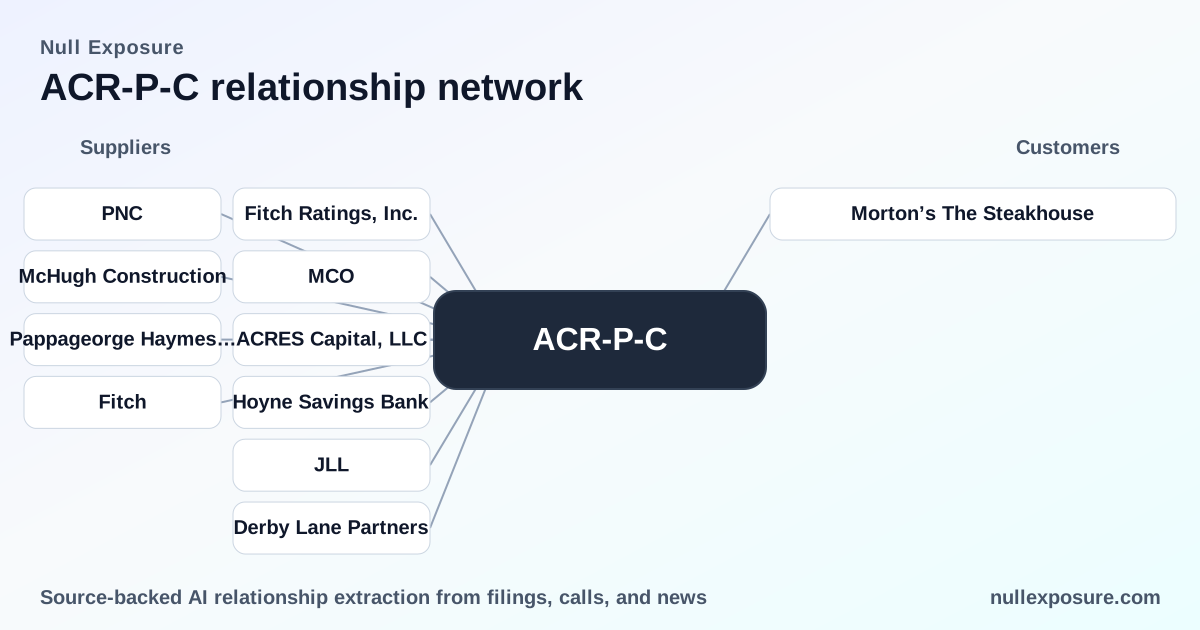
The dataset returned two items, both identifying Morton’s The Steakhouse as a continuing ground-floor tenant at 65 E Wacker Place (Wacker Place). Below are concise, investor-oriented summaries for each recorded result.
- Morton’s The Steakhouse (ReBusiness Online, March 2026) — Reporting notes that Morton’s will continue its tenancy on the ground floor of the building targeted for conversion to a 252-unit residential project, preserving an established restaurant lease that supports street-level revenue and amenity value. According to ReBusiness Online (March 9, 2026), the tenancy continuity reduces near-term vacancy risk for core commercial spaces in the conversion.
- Morton’s The Steakhouse (Urbanize Chicago, May 2026) — Urbanize Chicago confirmed that Mavrek Development and ACRES Commercial Realty Corp. closed financing for the conversion at 65 E Wacker, and Morton’s remains the ground-floor tenant, reinforcing that the commercial footprint will remain active through redevelopment and financing events. Urbanize Chicago (May 2, 2026) frames the tenancy as a stabilizing element for lender and investor underwriting tied to the project.
What these relationships imply about ACR-P-C’s asset exposures
The two news items converge on a single point: an established, credit-worthy restaurant tenant occupies the ground floor of a building undergoing a major conversion financed by developers and commercial realty interests. For investors in a preferred security, this is important because such retail continuity supports rental income stability, improves borrower covenants in property-level financings, and reduces short-term liquidity pressure on assets that feed parent-level distributions.
Company-level constraints and operating-model signals
No explicit contractual constraints or additional relationship constraints were disclosed in the reviewed material; therefore the following are company-level signals that flow from the observed customer relationships and the preferred-class context:
- Contracting posture: Asset management exposure is supplemented by leased commercial real estate where long-dated, operating leases with legacy tenants reduce turnover risk; these leases typically embed landlord protections and predictable cash flows favored by credit-focused investors.
- Concentration: Tenant concentration at specific physical assets can create localized earnings sensitivity — a high-quality tenant like Morton’s mitigates risk, but reliance on a small set of marquee tenants concentrates downside if a tenant vacates or renegotiates.
- Criticality: Ground-floor commercial leases are commercially critical for mixed-use conversions because they preserve street-level appeal, influence appraisal values, and support lender underwriting; loss of such tenants would be materially adverse to short-term asset performance.
- Maturity and stability: Presence of established national/legacy brands as tenants is a positive maturity signal for the underlying asset pool, improving refinancing prospects and moderating volatility in distributable cash to preferred holders.
These signals should be read as systemic characteristics of the asset-backed exposure underlying a preferred claim, rather than discrete contract terms tied to any one tenant.
Investment implications and risk checklist
- Positive income resilience: Continued tenancy by Morton’s improves near-term cash flow stability for 65 E Wacker Place, which supports asset valuations and lender confidence around conversion financing.
- Concentration risk remains: Despite the tenant quality, reliance on a single marquee ground-floor tenant leaves the asset sensitive to idiosyncratic operational shocks (tenant bankruptcy, brand contraction, or lease non-renewal).
- Refinancing and exit optionality improved: The presence of committed financing and an operating tenant increases the likelihood of orderly refinancing or disposition at closer-to-expected valuations.
- Monitoring cadence: Investors should track lease renewal terms, rent escalations, and any covenant language disclosed in financing notices that could affect preferred-class distributions.
For continuing coverage and to monitor tenant- and lease-level disclosures that affect preferred and fixed-income exposures, see https://nullexposure.com/.
Bottom line for investors and operators
The two independent media reports confirm that Morton’s The Steakhouse remains the ground-floor tenant at the Wacker Place conversion, and project financing is in place, which is a net positive for near-term income stability tied to that property. For ACR-P-C stakeholders, the signal is clear: physical tenant continuity meaningfully supports distributable cash flows and credit metrics tied to real-estate-backed exposures, but tenant concentration requires active monitoring. Investors should incorporate lease renewal timing and financing covenants into their downside scenarios when valuing the preferred claim or assessing credit resilience.