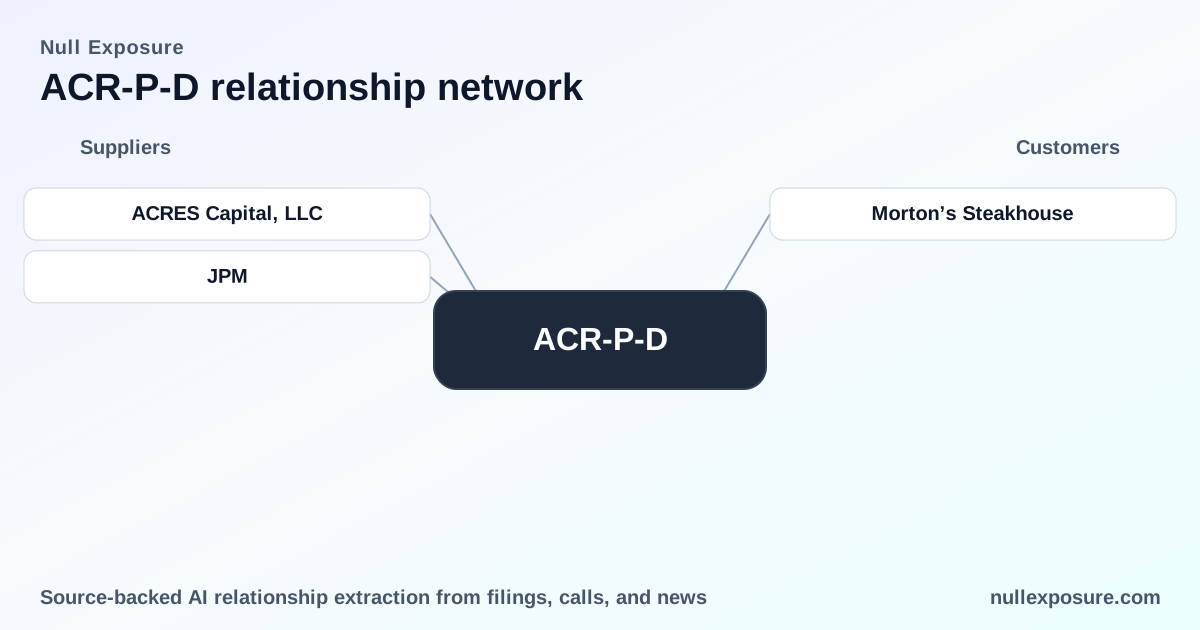
ACR-P-D Customer Map: What Morton's Steakhouse and Sparse Disclosures Mean for Investors
ACR-P-D is a preferred equity security listed on the NYSE that gives investors a claim on a corporate capital structure whose operating details are only intermittently revealed in public records. The issuer monetizes through operating assets and commercial relationships that generate contractually-derived cash flows, and the single disclosed customer tie — a commercial tenancy with Morton's Steakhouse — provides a narrow but tangible revenue touchpoint for credit and operational analysis. For investors and operators, the core question is whether limited public customer visibility translates into low counterparty concentration or unmanaged concentration risk.
If you want a concise research packet and alerts on further customer disclosures for ACR-P-D, visit https://nullexposure.com/ for continued tracking and context.
What the public record actually shows about customers
Public filings and summary profiles for ACR-P-D are unusually sparse: the company is listed as ticker ACR-P-D on the NYSE, but routine corporate fields such as sector, industry, revenue, shares outstanding and most balance-sheet metrics are not disclosed in the available summary. That opacity itself is an investment signal — it forces reliance on discrete local and media reports to map counterparty exposure rather than on a standard investor relations feed.
Morton's Steakhouse — the single disclosed customer tie
Morton’s Steakhouse is referenced as the commercial tenant occupying the first two floors of a converted property at 65 E. Wacker, and the relationship is presented in the context of a zoning and residential conversion approval. Morton’s is therefore an active commercial tenant tied to the issuer’s property interests in that transaction. According to a Chicago Urbanize news item dated March 9, 2026, “Morton’s Steakhouse will remain as the commercial tenant on the first two floors.” (Chicago Urbanize, Mar 9, 2026).
Every public customer relationship (no omissions)
- Morton's Steakhouse — A Morton's location is publicly recorded as the commercial tenant on the first two floors of the asset referenced in a zoning-and-conversion article; this is the only customer-level relationship captured in the public results for ACR-P-D. The Chicago Urbanize post from March 9, 2026, explicitly notes the tenancy and was the first and only observed public mention in FY2024–FY2026 reporting windows.
Constraints and company-level signals that shape the operating model
Because the constraints feed returned no explicit contract excerpts, we treat the following characteristics as company-level signals rather than relationship-specific findings:
-
Transparency and reporting posture: Several core data fields are blank (revenue, shares outstanding, sector/industry), which is a signal that public reporting and investor communications are minimal or highly aggregated. For credit investors, this translates into heavier reliance on external reporting (local news, lease filings, municipal records) to reconstruct revenue and tenancy profiles.
-
Concentration risk: With only a single customer tie visible, customer concentration is a material analytic consideration. The absence of an expanded customer list is a signal of either low disclosure or a genuinely concentrated counterparty base; both scenarios elevate sensitivity of cash flows to a small number of relationships.
-
Contracting posture and counterparty type: The documented tie is a commercial landlord–tenant relationship rather than a recurring service contract. That suggests revenue recognition and credit risk are tethered to lease terms, physical occupancy, and local real estate cycles rather than subscription or product diversification.
-
Criticality to operations: A commercial tenant occupying ground-floor retail in a mixed-use conversion is functionally important to asset valuation and operating cash flow, since retail anchors contribute to foot traffic, visibility and NOI. The single disclosed tenant therefore has outsized value to property-level economics.
-
Maturity of the business profile: Listing a preferred share (ACR-P-D) indicates an established capital structure, but the operational maturity of the underlying business cannot be validated from public metrics; capital claims exist in the absence of routine operating transparency.
What investors and operators should prioritize in diligence
Given the composition of public evidence, the practical implications are direct:
-
Obtain lease abstracts and rent rolls. If cash flows hinge on a small set of tenants, underwriters and investors need explicit lease lengths, escalation clauses, and tenant covenant strength rather than reliance on press mentions.
-
Verify tenant credit and local foot traffic metrics. Morton's Steakhouse is a brand-level credit; confirm the specific franchise/location financials and local demand drivers for downtown Chicago retail.
-
Confirm ownership, encumbrances and waterfall priority. Preferred securities depend on the structure of senior claims; absent public balance-sheet detail, title reports and lien searches are essential.
-
Monitor municipal and local reporting. Local planning notes and zoning approvals (the source of the Morton's mention) will be recurring indicators for tenant stability and asset repurposing risk.
Bold operational levers for returns: secure long-term, investment-grade leases and diversify tenant mix to convert a concentrated NOI profile into a resilient income stream.
Risk checklist every investor should run before sizing exposure
- Absence of standard financial disclosures increases information risk and requires more intensive off‑market due diligence.
- Single-tenant publicity creates tenant-concentration risk and elevates sensitivity to the tenant’s operating performance and lease term expirations.
- Real estate tenant relationships are cyclical and local; macroeconomic shifts in consumer spending or downtown office/residential conversions materially affect ground-floor retail income.
Final takeaways and next steps
ACR-P-D is a publicly traded preferred instrument with a thin public customer footprint; the Morton's Steakhouse tenancy is the only customer relationship visible in public reporting. That concentration and the broader absence of operating disclosures elevate diligence requirements: investors should insist on lease documentation, title and lien confirmation, and periodic monitoring of local municipal reporting to track tenant stability.
For continued monitoring of customer disclosures and targeted research on ACR-P-D, visit https://nullexposure.com/ — we aggregate and surface these discrete public signals so you can convert sparse disclosures into actionable investment insight.