Enact Holdings (ACT): How Fannie, Freddie and Lender Relationships Drive Premium Income and Risk
Enact Holdings (ACT) operates as a private mortgage insurer that monetizes by selling credit protection to mortgage lenders in return for premiums, plus fee-based underwriting services and investment income on reserves. The company sets premium rates at loan issuance—collected as monthly payments or single upfront charges—and transfers risk to a diversified pool of lenders while also depending on access to the secondary market channels that buy or guarantee mortgages. Investors should view Enact as a premium-collection business whose revenue cadence and growth depend on origination volumes, GSE access, and the stability of large lender relationships.
For a strategic snapshot of customer exposures and relationship signals, see additional resources at https://nullexposure.com/.
What the operating model looks like in practice: contract terms, counterparties and concentration
Enact’s customer-facing business is structured around long-term economic exposure with some short-term revenue recognition mechanics. The company’s premium rates for a mortgage insurance certificate are fixed at issuance and cannot be adjusted; single-premium contracts are recognized over the estimated policy life, while monthly contracts generate revenue over the coverage period—a mix that creates locked-in economics for existing books and revenue sensitivity to new issuance.
Enact sells into a mix of large banks, non-bank lenders, national and local mortgage bankers, community banks and credit unions, and it also operates under standards that tie it to the government-sponsored enterprises (GSEs). The GSE relationship is a structural counterparty type: PMIERs and similar GSE requirements impose capital and rating thresholds that are critical to Enact’s ability to insure loans destined for Fannie Mae and Freddie Mac. Company filings for 2024 disclose these dependencies and the financial covenants that govern GSE access.
Concentration is material but manageable: the largest customer generated roughly $133 million (about 11% of Enact’s 2024 revenues), indicating meaningful single-counterparty influence while leaving the remainder of revenue diversified across many lenders. The firm classifies its customer book as mature and active, reflecting long-standing partnerships and delegated underwriting arrangements that embed Enact in lender origination workflows.
How Enact’s core relationships interact with the secondary market
Enact’s product is a market-enabling layer: mortgage insurance reduces lender capital needs and facilitates the sale of loans into secondary markets. That dynamic makes Enact both a service provider (fee-based underwriting) and a seller of insurance (premium income), and it positions the company as a conduit to broader liquidity channels—particularly where loans are sold or guaranteed by GSEs or private investors.
A second perspective: because premiums are set at issuance and often applied to the original loan balance, Enact’s revenue profile is lumpy and skewed to origination cycles, while capital and ratings constraints imposed by the GSEs can directly affect new business flows.
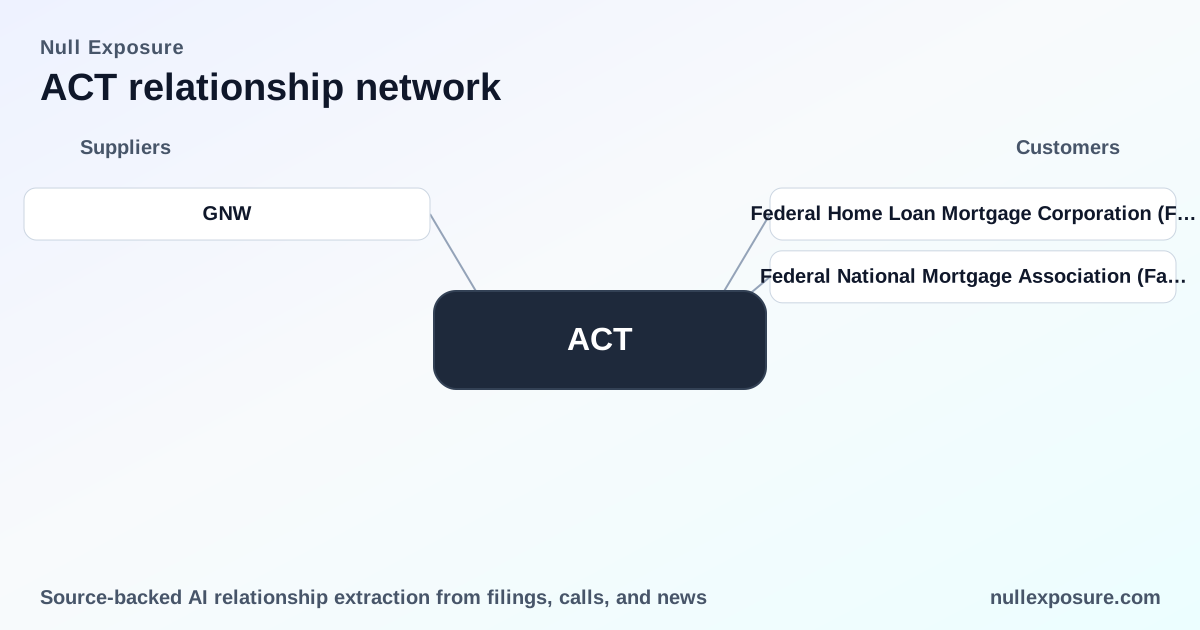
Federal Home Loan Mortgage Corporation (Freddie Mac)
Enact’s relationship with the Federal Home Loan Mortgage Corporation is operational: Freddie Mac is a destination for mortgages that Enact-insured loans can be sold to, and access to Freddie’s purchase channels underpins a portion of Enact’s insured loan placement strategy. This connection is described in a MarketScreener earnings flash dated March 9, 2026, which noted that Enact facilitates sale of mortgages to the secondary market including Freddie Mac (https://www.marketscreener.com/news/earnings-flash-act-enact-posts-q4-revenue-312-7m-vs-factset-est-317m-ce7e5bd3dc80f122).
Federal National Mortgage Association (Fannie Mae)
Similarly, Enact’s customer relationships include loans that are sold to or guaranteed by the Federal National Mortgage Association; access to Fannie Mae purchase pipelines is a practical component of Enact’s distribution model and underwriting footprint. A MarketScreener earnings flash on March 9, 2026, specifically referenced Enact’s role in facilitating sales to Fannie Mae as part of the secondary market channels (https://www.marketscreener.com/news/earnings-flash-act-enact-posts-q4-revenue-312-7m-vs-factset-est-317m-ce7e5bd3dc80f122).
Why these relationships matter to revenue and regulatory exposure
-
GSE access is functionally critical. PMIERs and GSE contractual standards require insurers to meet minimum asset and rating thresholds; downgrades or capital shortfalls would directly restrict Enact’s ability to insure loans sold to the GSEs, reducing new insurance issuance and premium flow. This is a company-level constraint documented in Enact’s filings and reflected in regulatory disclosure language.
-
Revenue recognition mechanics lock economics. Because premiums are fixed on issuance, Enact benefits from book rolloff but depends on new originations to grow top-line premiums. Single-premium contracts amortize over long policy lives, while monthly contracts feed steady near-term revenue.
-
Concentration risk exists but is not dominant. The single largest customer accounted for about $133 million or 11% of revenue in 2024, creating a material counterparty signal that investors must monitor, particularly where that lender accounts for a large share of new insured production.
-
Counterparty mix tempers single-point failure but raises scale dependencies. Enact’s client base spans large money-center banks to community lenders, which diversifies credit and origination sources, though relationships with large enterprises and GSE-linked channels concentrate the firm's exposure to origination volume cycles and regulatory thresholds.
Explore deeper coverage and analytical tools at https://nullexposure.com/.
Investment implications: what to watch next and how to size risk
- Monitor GSE eligibility metrics and rating agency commentary closely; any sign of capital strain or rating pressure is a direct business lever that reduces Enact’s addressable new business sold into GSE channels.
- Track origination volumes and mix across Enact’s top lenders: rising market share with non-bank originators or regional banks changes credit composition and premium economics.
- Watch premium mix between single-premium and monthly contracts, since a shift toward single premium increases long-duration revenue recognition and reduces near-term cash recognition.
- Keep an eye on the top customer dynamic: a persistent concentration near or above ~10% of revenue is a governance and counterparty-risk metric that can affect valuation multiples if that relationship softens.
Final read: clear drivers, manageable but real dependencies
Enact is a tightly focused mortgage insurance franchise with clear monetization through premiums and fee income, operating under constraints that make GSE access and ratings central to its growth runway. The company’s relationships with Fannie Mae and Freddie Mac are not theoretical—these entities are practical channels for insured loan placement that underpin a meaningful share of the firm’s go-to-market strategy (MarketScreener, Mar 9, 2026). For investors, the core trade-off is between durable premium economics and exposure to origination cycles plus regulatory/rating thresholds. Monitor GSE eligibility, top-lender concentration, and premium mix as the primary levers that drive Enact’s earnings trajectory.