Acacia Research (ACTG): Customer relationships that drive one‑time licensing economics
Acacia Research monetizes intellectual property through a portfolio of operating subsidiaries that license patented technologies for predominantly one‑time, paid‑up fees, and supplements that licensing business with industrial and energy operations that sell manufactured goods and commodity production. For investors, the right‑way to value ACTG is as a hybrid intellectual‑property owner whose cash flow profile is lumpy and event‑driven (settlements and license events), with a secondary, lower‑margin manufacturing/energy base that produces more predictable but less material revenues.
For a concise view of Acacia’s customer relationships—settlements, licensees, and the handful of counterparties that generate headline cash flows—read on. If you want an at‑a‑glance hub of signals and relationship evidence, visit our research homepage: https://nullexposure.com/
What the relationship list tells investors in plain English
Acacia’s disclosed customer interactions in the available sources are dominated by patent licensing and settlement agreements with large technology manufacturers, and a recent disclosure of a mid‑size settlement in the consumer electronics supply chain. These relationships are not recurring subscriptions; they are contractually discrete license or settlement events that drive revenue recognition upon transfer of IP rights. Acacia’s operating posture therefore is licensing‑centric with manufacturing and energy businesses operating on conventional short‑term commercial terms.
Before we turn to the individual counterparties, two quick investor takeaways: Acacia’s revenue profile is lumpy, concentrated, and tied to enforcement/licensing outcomes, and the company retains exposure to manufacturing/energy markets where sales are typically short‑term or purchase‑order driven. If you track Acacia’s quarterly performance, focus on reported settlement amounts and effective dates.
Consider another view or services from our site: https://nullexposure.com/
The counterparties — what each relationship actually is
Below are short, plain‑English summaries for every relationship in the source results, each followed by the reporting source.
-
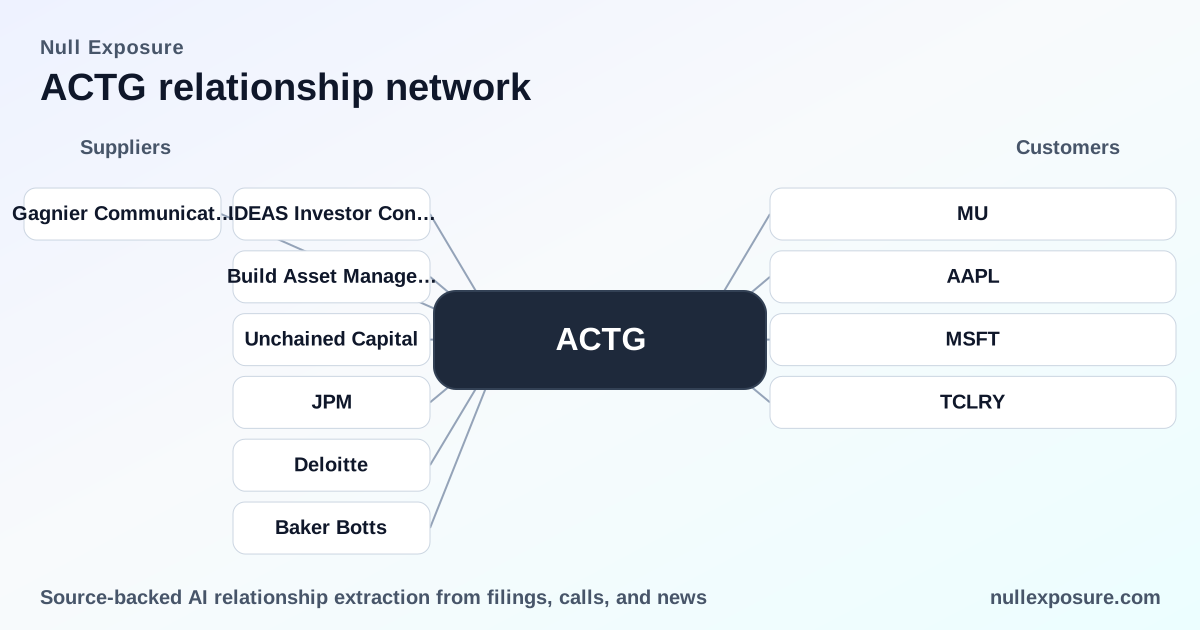
Micron Technology, Inc. — Acacia’s Advanced Data Access LLC, Smart Memory Solutions LLC and Semiconductor Technology LLC subsidiaries entered into a settlement and license agreement with Micron Technology in 2013, representing a classical paid‑up licensing arrangement that resolved asserted patent claims. (Source: Yahoo! video posting of the 2013 Acacia press release, FY2013.)
-
MU (inferred symbol MU) — The same Micron related mention appears under the ticker shorthand MU; it describes the 2013 settlement and license agreement between Acacia’s operating subsidiaries and Micron entities to license asserted technologies. (Source: Yahoo! video posting summarizing the 2013 settlement, FY2013.)
-
Apple — Historical reporting documents that Apple has both licensed patents from Acacia and later faced litigation connected to those assets; coverage of a 2016 decision and related damages highlights the licensing‑plus‑enforcement cycle that characterizes Acacia’s IP monetization. (Source: MacRumors coverage of Acacia’s 2016 patent enforcement outcomes, FY2016.)
-
Micron Semiconductor Products, Inc. — Listed explicitly in Acacia’s 2013 settlement disclosures, Micron Semiconductor Products, Inc. was a named counterparty in the settlement and license agreement that resolved asserted patent claims with Acacia’s subsidiaries. (Source: Yahoo! video posting of the 2013 press release, FY2013.)
-
Microsoft — Industry reporting notes Microsoft as another large technology firm that has both licensed and subsequently been subject to enforcement activity involving patents managed by Acacia’s vehicles, underscoring the company’s business model of licensing followed, when necessary, by litigation or settlement. (Source: MacRumors report referencing Acacia‑related licensing and enforcement activity, FY2016.)
-
AAPL (inferred symbol AAPL) — The AAPL mention mirrors the Apple coverage: Apple licensed patents and was later involved in enforcement activity that produced monetary awards and settlements in the mid‑2010s, illustrating Acacia’s pattern of extracting value through discrete license or settlement events. (Source: MacRumors article on the 2016 outcomes, FY2016.)
-
Micron Technology Texas, LLC — Named along with other Micron entities in Acacia’s 2013 settlement and license agreement, this local Micron affiliate was included in the multi‑entity resolution of patent assertions. (Source: Yahoo! video posting of the 2013 press release, FY2013.)
-
Vantiva — Acacia’s Q3 2025 commentary indicates a settlement with Vantiva that was included in a roughly $7.4 million aggregate patent settlement figure disclosed for that period, signaling continued monetization of its IP portfolio through negotiated resolutions with mid‑sized electronics suppliers. (Source: Q3 2025 earnings call transcript quoted on InsiderMonkey, FY2025.)
-
TCLRY (inferred symbol TCLRY) — The ticker‑level mention of TCLRY references the same Vantiva settlement disclosed in Acacia’s Q3 2025 remarks; the company counted that settlement as part of the quarter’s patent licensing receipts. (Source: InsiderMonkey coverage of the Q3 2025 earnings call transcript, FY2025.)
Operating model constraints and what they imply for valuation
Acacia’s contract and segment signals combine into a distinct operating profile:
-
Licensing‑led revenue recognition: The company recognizes revenue when IP rights transfer and most licensing contracts are one‑time, paid‑up license fees, generating non‑recurring but high‑margin cash events that dominate headline results.
-
Short‑term commercial exposure in industrial operations: The manufacturing and distribution businesses (e.g., Printronix and Deflecto descriptions) operate largely on purchase orders and channel sales rather than long, binding take‑or‑pay contracts, which produces short‑term, lower‑visibility cash flows.
-
Geographic breadth with North America concentration: Disclosures show a global footprint across APAC and EMEA for industrial operations, but material revenue concentration in North America for energy production and a global distribution network for printers and consumables.
-
Materiality and concentration risk: The company acknowledges dependence in certain segments on a small number of customers, a structural concentration that makes headline results sensitive to a handful of settlement outcomes or large industrial customer dynamics.
-
Mixed segment exposure: Investors benefit from diversification between services/licensing (event‑driven, high margin) and hardware/manufacturing/energy (operational, lower margin), but those sectors bring different contract tenors and commercial risk profiles that should be modeled separately.
Investment implications and risk checklist
- Model lumpy revenue: Forecasts should treat licensing events as binary triggers; use scenario analysis rather than smoothing these receipts into recurring streams.
- Watch legal and settlement cadence: Quarterly announcements about settlements or license deals materially influence free cash flow and should be the primary monitoring signal.
- Account for concentration: A single large settlement or the loss of a major manufacturing customer could materially swing near‑term results.
- Valuation focus: Assign a higher multiple to normalized manufacturing EBIT and treat IP monetization proceeds as stochastic cash inflections that warrant option‑style valuation or conservative probability‑weighted treatment.
For deeper signal aggregation and to monitor future counterparties and settlement notices, visit our research hub: https://nullexposure.com/
Bottom line
Acacia is a hybrid IP raiser and industrial operator where value realization is driven by event‑based licensing and settlements and complemented by steadier—but smaller—manufacturing and energy cash flows. Investors should price in lumpiness, concentration, and the legal enforcement cycle as central determinants of ACTG’s near‑term performance and long‑term upside.