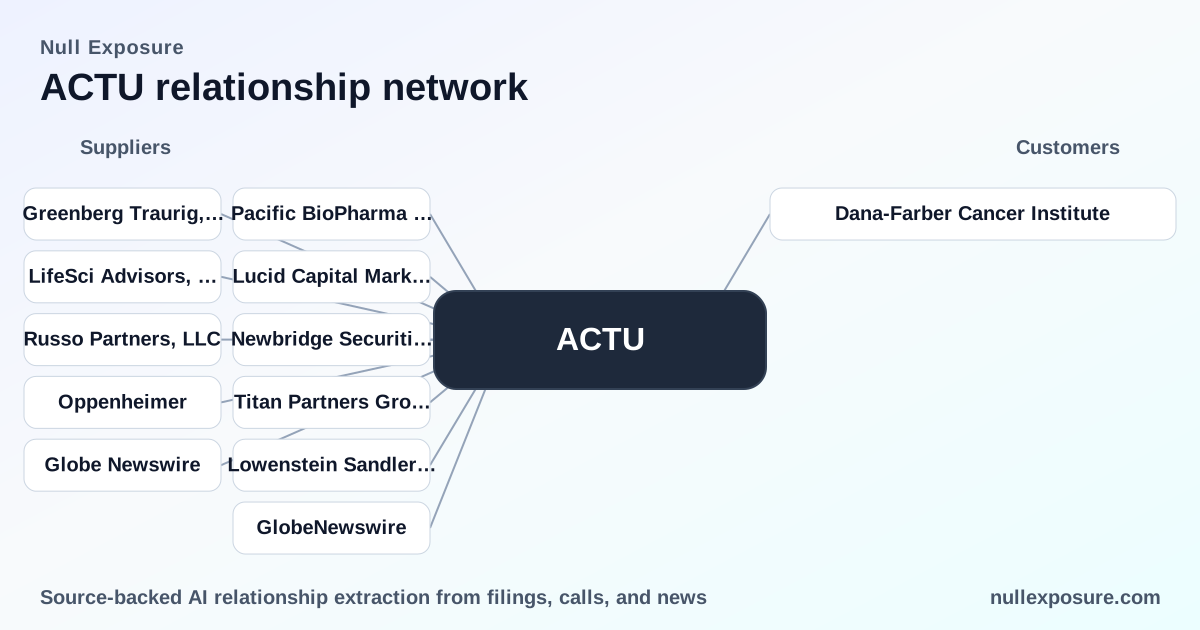
Actuate Therapeutics (ACTU): Clinical partnerships that advance pipeline value, not near-term revenue
Actuate Therapeutics is a clinical-stage oncology biopharmaceutical company that creates value by advancing its lead candidate elraglusib (9-ING-41) through investigator- and company-supported clinical trials, with monetization options tied to future product sales, licensing fees and milestone payments rather than current commercial revenue. Investors should evaluate Actuate primarily as a pipeline-valuation story: partnerships that accelerate clinical validation are value-enhancing signals, while reimbursement exposure and the transition to commercialization remain the defining execution risks.
For a consolidated view of customer and collaborator activity, see https://nullexposure.com/.
What the Dana‑Farber collaboration means for clinicians and investors
Actuate supported a clinical study at the Center for Head and Neck Oncology at Dana‑Farber Cancer Institute by providing doses of elraglusib and funding for the trial. According to a GlobeNewswire press release dated December 15, 2025, the company’s support underpinned publication of positive Phase II data for elraglusib combined with platinum chemotherapy and sequential immunotherapy in recurrent metastatic disease. This relationship is a direct endorsement of Actuate’s ability to supply investigational drug and fund investigator-led research, improving the credibility of its clinical program. (GlobeNewswire, Dec 15, 2025; captured by NullExposure Mar 9, 2026.)
Why that type of relationship is strategically valuable
- The Dana‑Farber collaboration provides independent clinical validation in a reputable academic center, which increases the utility of trial outcomes for future regulatory and commercial conversations.
- This activity is developmental capital, not revenue: providing drug and funding expedites enrollment and data generation but does not substitute for a commercial customer base or payer contracts.
Complete list of customer/collaborator relationships captured
Below is every customer-focused relationship identified in the NullExposure results for ACTU.
- Dana‑Farber Cancer Institute — Actuate supplied the investigational drug elraglusib and provided funding to support a Phase II trial at Dana‑Farber’s Center for Head and Neck Oncology, contributing to a published positive data set on combined chemotherapy and sequential immunotherapy in recurrent metastatic patients. (GlobeNewswire press release, December 15, 2025; NullExposure capture March 9, 2026.)
Company-level constraints that shape commercialization strategy
Actuate’s filings explicitly highlight dependence on third‑party payers, including government health programs, as a determinative factor for future sales. This is a company-level signal about the commercial environment rather than a statement tied to any single trial site or academic collaborator. Investors should interpret this constraint across several operational dimensions:
- Contracting posture: Actuate’s commercial trajectory will be conditioned by reimbursement negotiations and formulary decisions; coverage and payment rates set by government programs and insurers will determine net pricing power once an approval occurs.
- Concentration risk: While no specific payer is named, the mention of government programs signals that public reimbursement decisions could exert outsized influence on realized revenue and access for eligible patients.
- Criticality to business model: Given Actuate is pre‑revenue, reimbursement is a critical gating item for converting clinical success into sustainable cash flows; clinical collaborations are necessary precursors but not substitutes for payer coverage.
- Maturity: The company remains in the clinical-development phase; contracting with payers and establishing commercial infrastructure are future milestones that require demonstrable efficacy, safety, and cost‑effectiveness data.
For investors, this means clinical partnerships reduce scientific execution risk but do not reduce commercial reimbursement risk, which becomes the central focus as the company approaches pivotal trials and filing decisions.
Financial context and how partnerships map to valuation
Actuate is a pre‑commercial biotech with no reported revenue TTM and a market capitalization near $70 million. The balance of value is in the pipeline and the timing of clinical readouts; independent investigator studies at institutions like Dana‑Farber de-risk scientific hypotheses and can materially affect licensing or partnering leverage. Key financial and ownership signals from public filings:
- Pre‑revenue profile: RevenueTTM = 0; the company’s funding commitments to trials are an expense today and an investment in the value of future assets.
- Valuation anchors: Analyst consensus target price sits at $13.50, reflecting upside tied to successful clinical progression, while current market metrics show wide trading ranges (52‑week high/low: $11.99 / $1.58) and concentrated insider/institutional stakes (Insiders ~15.5%, Institutions ~57.7%).
Risk/reward and investor takeaway
- Clinical validation is progressing. The Dana‑Farber trial demonstrates Actuate’s capacity to execute and fund high‑quality investigator collaborations, which raises the probability that clinical signals will be robust and persuasive to partners or regulators.
- Reimbursement is the next frontier. Even with positive Phase II data, payers and government health programs will govern ultimate commercial returns, creating a non‑scientific but essential risk that investors must price into the stock.
- Capital intensity remains high. As a pre‑revenue biotech, Actuate will continue consuming cash for trials and operations until it secures partners, approval, or other monetization events.
Explore a consolidated view of ACTU’s collaborator signals and payer exposure at https://nullexposure.com/.
Bottom line
Actuate’s engagement with Dana‑Farber is a meaningful clinical endorsement that advances the scientific case for elraglusib and improves the company’s ability to negotiate future licensing or commercial terms. Investors should treat such academic collaborations as developmental value drivers rather than immediate revenue sources, while giving equal weight to the clear company-level exposure to government and third‑party payer decisions that will determine long‑term commercial returns.
Key actions for investors: track upcoming trial readouts and any formal partner/licensing discussions, and monitor payer policy developments that could frame future reimbursement dynamics.