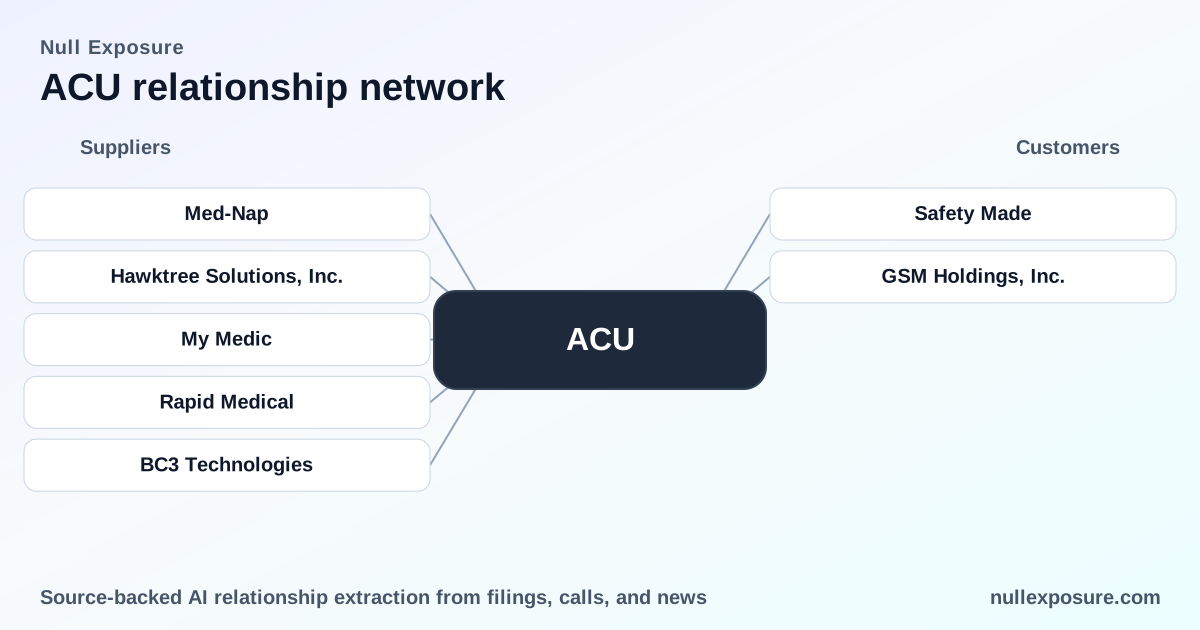
Acme United (ACU): Customer Relationships, Distribution Structure, and Investor Implications
Acme United monetizes a diversified mix of branded and private-label cutting, measuring, safety and first-aid products by selling through large retail chains, industrial distributors and direct-to-consumer channels. The company captures margin through product design and brand stewardship while outsourcing scale manufacturing and leveraging global distribution to serve school, home, office, hardware, sporting goods and industrial customers. Revenue is driven by a hybrid retail-plus-distributor model with meaningful customer concentration and a global footprint.
For a concise, data-driven view of commercial counterparties and their implications, visit https://nullexposure.com/.
How Acme’s commercial model works in practice
Acme United’s go-to-market posture is a mixture of wholesale distribution and direct retailing. The company sells finished products to mass-market and e-commerce retailers, industrial and office-supply distributors, and also direct-to-consumer through its own websites, which establishes a dual revenue stream and margin differentiation between bulk channels and retail margins. According to company disclosures, North America accounts for the bulk of revenue, with the United States and Canada explicitly highlighted in the revenue table, while Europe contributes a smaller but material share — supporting a truly global distribution footprint.
Key operating characteristics investors should internalize:
- Concentration: The company discloses that two customers individually exceeded 10% of consolidated net sales in both 2023 and 2024, representing roughly 14% and 13% of net sales in 2024 — a sign of customer concentration that elevates counterparty risk despite product diversification.
- Channel mix: Sales occur through mass retailers, e-commerce, industrial distributors and resellers, meaning Acme’s revenue sensitivity ties to retail shelf placement, distributor relationships and online positioning.
- Global reach: Reporting treats Acme as a worldwide supplier; revenue is attributed geographically, with explicit EMEA and North American line items, signaling global market exposure rather than single-market dependency.
- Core product orientation: First-aid/medical products and cutting technology are presented as core business segments, aligning product strategy and channel partnerships around those categories.
Two named commercial relationships and what they mean
Acme’s disclosed relationship mentions are limited in number but strategically informative for investors evaluating counterparty exposure.
Safety Made — private label / personalization partner
Acme referenced Safety Made on its Q4 2025 earnings call as a provider of personalized medical products, including first-aid kits, indicating Acme’s participation in customized or branded first-aid solutions sold to end customers or retailers. According to the 2025 Q4 earnings call (March 2026), the mention positions Safety Made as a partner in Acme’s first-aid product ecosystem and underscores the company’s engagement with niche suppliers that support product personalization.
GSM Holdings, Inc. — buyer of legacy product lines
A SimplyWallSt news item reported that GSM Holdings acquired the Camillus and Cuda hunting and fishing product lines from Acme United for $19.8 million (FY2025 disclosure, reported March 2026). This transaction reflects strategic portfolio reshaping: divesting non-core or lower-margin hunting/fishing lines to concentrate on first-aid, cutting and safety categories that align with Acme’s stated core product focus.
What these relationships reveal about risk and optionality
The Safety Made mention demonstrates Acme’s movement into personalization and medical-kit verticals, which supports higher perceived product stickiness and potential for higher-margin direct or branded channels. The GSM transaction signals active portfolio management and a willingness to monetize legacy brands that are not central to the strategic core. Together these items show a company tightening focus while maintaining partnerships across distribution and product development.
- Contracting posture: Acme operates primarily as a seller to intermediated retail and distributor channels, and as a direct seller to consumers via its own websites; contractual exposure is therefore split across large wholesale agreements and retail/e-commerce terms.
- Concentration and criticality: Two customers represent double-digit shares of sales, a structural concentration that increases commercial risk if large retailers change assortment or payment terms; conversely, those large accounts provide predictable volume and negotiating leverage for shelf placement.
- Maturity and scale: Acme reports multi-regional revenue lines and has the balance-sheet scale to execute divestitures like Camillus/Cuda, which is consistent with a mature, cash-generative consumer-defensive business model.
Financial context investors should pair with relationship analysis
Acme’s financial profile supports the narrative of a stable, modest-growth consumer-defensive business: TTM revenue roughly $202.9M, EBITDA about $20.5M, and a trailing P/E near 18. Profitability is moderate (operating margin ~3.3%, net margin ~4.7%), and institutional ownership is high (~73.5%), which amplifies the market impact of strategic announcements. The GSM sale for $19.8M is non-trivial relative to earnings and signals management willingness to reallocate capital away from less-aligned product lines.
Investment implications and action points
- Monitor customer concentration closely. Two customers contribute double-digit percentages of revenue; loss or re-pricing of those accounts would have a measurable EBITDA impact.
- Evaluate distribution resilience. The company’s mix of major retail partners, distributors and its own e-commerce channels creates diversification — but success depends on placement, promotional support and inventory management.
- Assess strategic focus after divestitures. The sale of Camillus and Cuda to GSM is a positive signal that management is focusing on core first-aid and cutting categories where brand strength and recurring demand are more defensible.
- Baseline valuation considerations. Given steady margins and a consumer-defensive revenue base, forward multiples (forward P/E ~14) reflect a value proposition tied to stable cash flow rather than high growth.
For a targeted analysis of counterparty risk, contractual concentration and how these relationships affect valuation scenarios, see our platform: https://nullexposure.com/.
Bottom line
Acme United runs a hybrid distribution model combining large wholesale accounts, distributors and direct online retailing, with notable customer concentration and active portfolio management actions that reduce non-core exposure. The Safety Made mention highlights product personalization opportunities in first aid, while the GSM transaction demonstrates capital discipline and focus on core categories. Investors should weigh the predictability of large retail accounts against concentration risk and track how divestitures translate into margin and growth stabilization.