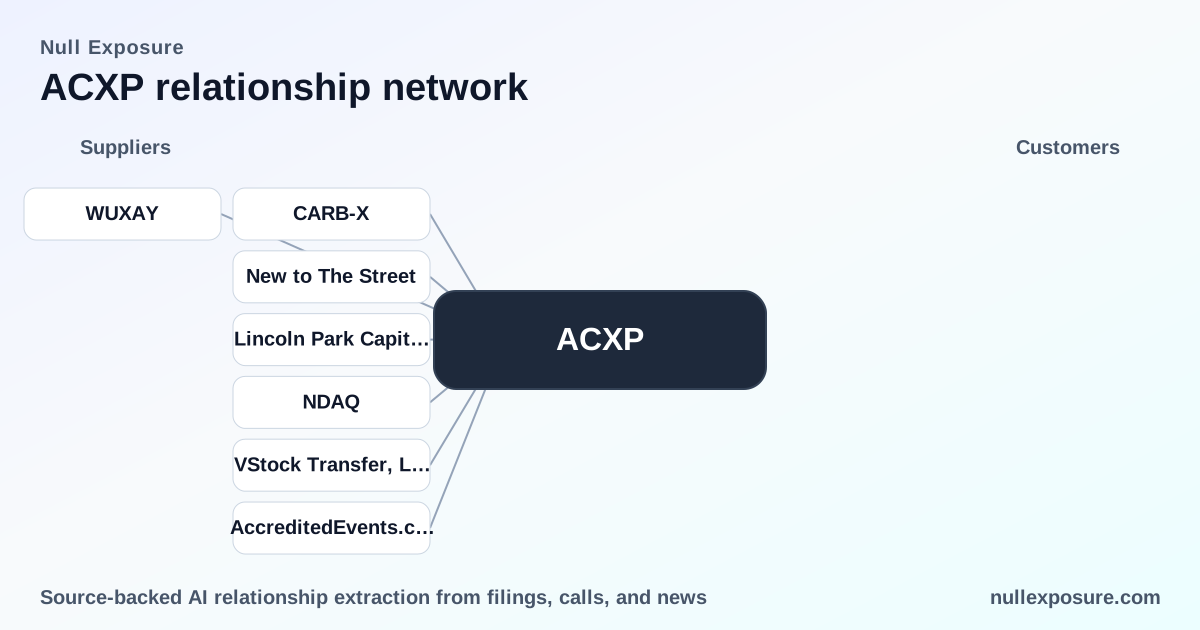
ACXP: How a Small Biotech Manages Financing and Commercial Exposure — Lincoln Park, payors, and commercialization signals
Acurx Pharmaceuticals (ACXP) is a clinical-stage antibiotic developer that monetizes through successful regulatory approvals and product sales, supplemented by equity financing arrangements to fund trials and operations. Revenue will ultimately depend on NDA approval, payer reimbursement, and the company’s ability to commercialize its lead asset; meanwhile Acurx uses equity purchase agreements and resale registrations to manage near-term liquidity and investor exit mechanics. For further counterparty and revenue-risk intelligence, see https://nullexposure.com/.
The single customer/partner relationship investors should know about
Acurx has a live financing relationship with Lincoln Park Capital Fund, LLC: the company is registering up to 750,000 shares of common stock for resale by Lincoln Park under an existing purchase agreement. This action enables resale of shares held by Lincoln Park and reflects a funding pathway tied to equity issuance arrangements rather than product revenue. Source: SEC filing disclosure reported on StockTitan, May 2, 2026.
Why this financing arrangement matters to holders and analysts
This resale registration does three things for market participants. First, it increases potential float liquidity, giving Lincoln Park the ability to sell shares into the market without running afoul of registration restrictions. Second, it signals a non-dilutive-to-product financing posture in the near term only insofar as Lincoln Park has previously purchased shares under an agreement; future purchases under the contract remain a potential source of dilution if exercised. Third, the structure reduces execution risk on upcoming clinical milestones by maintaining a visible capital partner that has a documented resale path. Source: SEC filing disclosure reported on StockTitan, May 2, 2026.
How Acurx’s operating model shapes counterparty relationships
Acurx’s business model is classic small-cap biotech: single core product pipeline, regulator-driven development, and a financing mix that substitutes equity for product cash flow. Several company-level signals govern how Acurx contracts and who its critical counterparties are:
- Government payors and reimbursement structures are central: Acurx’s commercial economics depend heavily on reimbursement decisions from government health authorities and private insurers, which makes payer negotiation a primary commercial battleground rather than simple wholesale distribution. Evidence: language on dependence on governmental and private payors for patient access and affordability.
- Large enterprise counterparty engagement is required: the company will interface with health maintenance organizations, managed care and pharmacy benefit managers, and other large enterprise payors that determine formulary placement and reimbursement levels.
- Global regulatory strategy but U.S. commercial focus: Acurx plans international Phase 3 sites to support approvals outside the U.S., while intending to commercialize in the U.S. with its own specialized sales force if ibezapolstat receives approval. This dual posture drives both clinical operational complexity and eventual commercial execution demands.
These attributes create a contracting posture that is complex, long-tailed, and negotiation-intensive, with critical counterparties including regulators, large payors, and structured capital providers rather than straightforward distributor networks.
Practical consequences: concentration, criticality and maturity
Acurx’s profile generates three investment-relevant characteristics:
- High concentration: The company is single-product focused; regulatory and clinical outcomes for ibezapolstat will determine revenue potential. This raises idiosyncratic risk and increases the importance of every regulatory interaction.
- High counterparty criticality: Relationships with government payors and large insurers are critical because reimbursement determines addressable market and pricing power; regulatory agencies (FDA, EMA) control entry to those markets.
- Counterparty maturity skewed toward sophisticated institutions: Most counterparties are institutional—regulators, payors, and large financing partners—requiring Acurx to demonstrate clinical rigor and commercial strategy competence rather than rely on retail distribution channels.
These company-level signals shape diligence priorities: assess payor access scenarios, quantify likely list vs. net pricing under various reimbursement outcomes, and model financing dilution assumptions tied to equity agreements.
Relationship-by-relationship breakdown
Lincoln Park Capital Fund, LLC — Acurx is registering up to 750,000 shares for resale by Lincoln Park under an existing purchase agreement, enabling Lincoln Park to liquidate holdings and providing Acurx with a visible capital partner tied to equity purchase mechanics. Source: SEC filing disclosure reported on StockTitan (May 2, 2026).
Key commercial and financing risks to monitor
Investors should watch a short list of high-leverage items:
- Regulatory milestones: Progress through Phase 3 and FDA/EMA interactions will directly shift valuation and the company’s ability to convert pipeline value into recurring revenue.
- Reimbursement dynamics: Market access negotiations with government payors and PBMs will determine effective price and patient uptake; Acurx’s economics depend on successful coverage decisions.
- Financing overhang and dilution: Equity purchase agreements and resale registrations provide capital flexibility but also create potential dilution pathways if the company requires further financing beyond existing cash.
- Commercial execution: The stated intention to self-commercialize in the U.S. creates execution risk related to building a specialized sales force and securing formulary placement against incumbent antibiotics and treatment regimens.
What investors should do next
- Model scenarios that explicitly price in payer negotiation outcomes and reimbursement levels rather than simple list price assumptions.
- Factor in potential share issuance under existing purchase agreements as contingent dilution when calculating enterprise value per share.
- Monitor regulatory communications from FDA and EMA and any new filings affecting commercialization strategy.
For a structured, counterparty-focused intelligence pack on small-cap biotech counterparties and financing arrangements, visit https://nullexposure.com/.
Bottom line
Acurx’s immediate customer/partner landscape is dominated by financing mechanics (Lincoln Park resale registration) and by the future imperative of payor relationships and regulatory approvals. The company’s revenue conversion depends on successful clinical outcomes, favorable reimbursement from government and large payors, and disciplined capital management to avoid punitive dilution. Investors evaluating ACXP should prioritize regulatory milestone tracking, reimbursement scenario analysis, and the terms and utilization of existing equity purchase agreements.