Array Digital Infrastructure: a transformed TowerCo monetizing spectrum and leasing scale
Array Digital Infrastructure operates today as a U.S.-focused tower company that monetizes two asset classes: physical tower sites through long-term Master License Agreements (MLAs) with national carriers, and leftover spectrum through opportunistic sales to major wireless operators. The company converted much of its operating risk into cash in 2025–2026—selling its wireless business to T‑Mobile, executing spectrum sales to AT&T and agreements with Verizon, and using proceeds to pay large special dividends and shore up the balance sheet. For a concise investor briefing and ongoing coverage, visit https://nullexposure.com/.
The strategic reset: from regional carrier to landlord and asset seller
Array completed a rapid strategic pivot in 2025. The company sold its regional wireless operations to T‑Mobile in August 2025 for roughly $4.3–$4.4 billion, a transaction that converted subscribers and operating complexity into cash and a long-term leasing relationship. Following that divestiture Array repositioned as a tower-focused business with roughly 4,400 sites and a concentrated tenant base of the major national carriers. Management has since pursued an explicit asset-monetization program, selling select spectrum licenses to AT&T for $1.018 billion in January 2026 and signing agreements to sell additional spectrum to Verizon and T‑Mobile. Sources include the company’s Q4 2025 earnings call and multiple press reports including TradingView and The Globe and Mail.
Customer relationships: who pays Array’s bills now
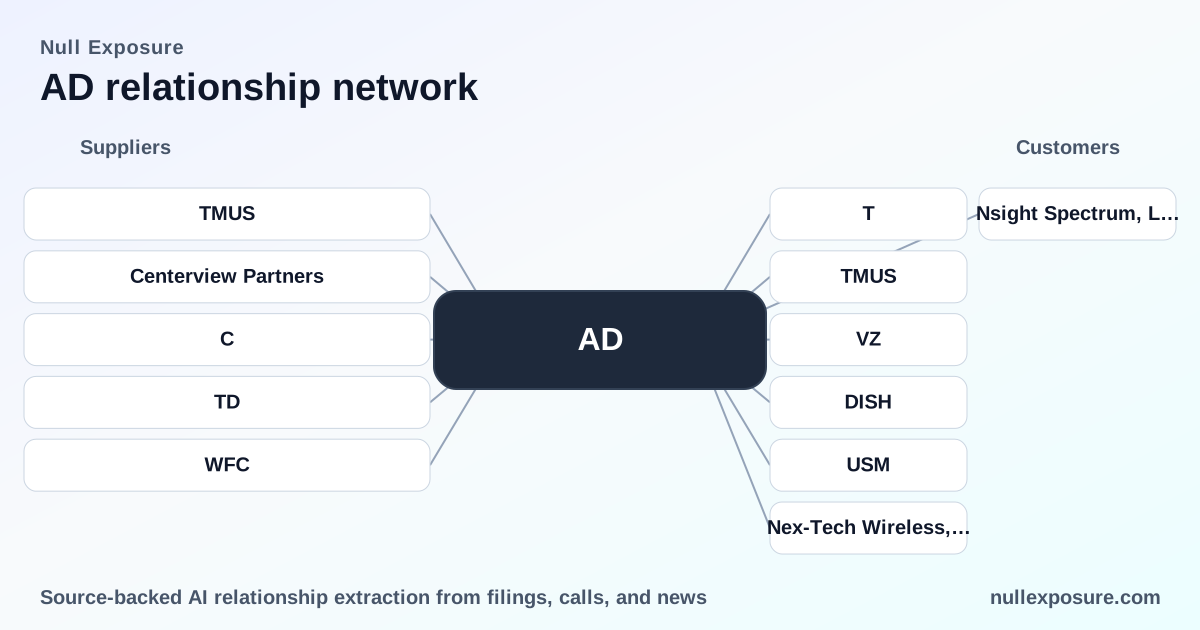
Below I catalogue every counterparty mentioned in the reporting set and state, in plain English, what each relationship contributes to Array’s economics and strategic posture.
AT&T (including New Cingular Wireless PCS unit)
Array closed a sale of 3.45GHz and 700MHz spectrum licenses to AT&T for $1.018 billion in cash on January 13, 2026, a transaction that funded a $10.25 per-share special dividend and materially improved liquidity. This is documented in Array’s Q4 2025 earnings call and company press releases cited by The Globe and Mail and Marketscreener.
T‑Mobile (TMUS / T‑Mobile US, Inc.)
Array sold its wireless operations to T‑Mobile in August 2025 for roughly $4.3–$4.4 billion and, as part of that transaction, entered a 15‑year Master License Agreement that secures rental commitments on over 2,000 towers—creating a durable base of site rental revenue. The divestiture, the MLA and follow-on spectrum sales to T‑Mobile for roughly $178 million are referenced in the Q2 and Q4 earnings calls and TradingView coverage.
Verizon (Verizon Communications, Inc.)
Array signed a License Purchase Agreement with Verizon in October 2024 to sell certain spectrum licenses, with closing expected in mid‑2026, and separately announced a multi‑year tower partnership that gives Verizon broad collocation rights across Array’s nationwide portfolio—supporting colocation revenue growth. These elements are reported in TradingView, TelecomTV and company investor communications.
Dish / DISH Wireless
Dish is a tenant under an MLA that generated about $7 million of site rental revenue for Array in 2025, and Dish’s contractual obligations under that MLA were referenced by management in public comments. The relationship is discussed in the earnings call transcript and in coverage by The Globe and Mail and DatacenterDynamics, which also records a management-level dispute over certain Dish assertions.
Nex‑Tech Wireless, LLC
Array has entered agreements to sell select spectrum licenses to Nex‑Tech Wireless, a regional buyer of spectrum—part of the company’s broader disposal program for non-core spectrum assets. This is noted in TradingView’s financial summaries of Array’s 2025 transactions.
Nsight Spectrum, LLC
Array likewise entered agreements to sell select spectrum licenses to Nsight Spectrum, another regional carrier purchaser, forming part of the spectrum monetization pipeline disclosed in company reporting and summarized by TradingView.
UScellular (UScellular / USM)
Historically the assets were built to support UScellular’s regional wireless business; after the corporate reorganization the tower portfolio remains concentrated in suburban and rural U.S. markets. The company’s historical connection and the geographic footprint are detailed in the Q4 2025 earnings call and related press releases compiled by The Globe and Mail.
(These summaries draw on Array’s Q2 and Q4 2025 calls and corroborating press coverage from TradingView, The Globe and Mail, Marketscreener, DatacenterDynamics and other outlets.)
Interpreting the constraints: what contract types, counterparty mix and segments tell us
Array’s publicly disclosed relationships form a consistent set of operating signals:
- Contracting posture: The company combines long‑term anchor MLAs (explicitly observed with T‑Mobile’s 15‑year MLA) with short‑term spectrum manager leases that provide exclusive operational control for transitional periods. That mix lets management lock in recurring tower cash flow while using short windows to extract spectrum value.
- Concentration and criticality: Revenue is now heavily concentrated among the major national carriers—T‑Mobile, AT&T and Verizon—making those tenants both critical to near‑term cash flow and powerful counterparty negotiators. At the same time, long MLA terms and standard escalators make that cash flow relatively predictable.
- Counterparty diversity: Historical business signals show a balanced customer mix across individual, mid‑market, large enterprise and government buyers for services and hardware; for tower leases the counterparty set is dominated by national carriers but supplemented by regional buyers (Nsight, Nex‑Tech) and DISH.
- Segment positioning: Array now sits primarily in infrastructure (tower leasing) with a meaningful secondary element of asset monetization (spectrum sales). Hardware and services exposure remain historical but smaller after the wireless divestiture.
- Deal scale and maturity: The company has executed transactions in the $100 million+ band (T‑Mobile divestiture, AT&T $1.018bn sale), signalling both the maturity of the asset‑monetization program and management’s willingness to crystallize value and return capital to shareholders.
For investors, the net result is a landlord business model with opportunistic asset sales, combining durable lease revenues with episodic, material cash inflows from spectrum monetization.
Visit https://nullexposure.com/ for additional diligence resources and model inputs.
Risks, upside and the investment takeaway
- Upside: Management has converted non‑core spectrum into substantial cash, funded large special dividends and reduced enterprise risk; long MLAs with national carriers underpin predictable tower cash flow and provide a path to margin improvement as colocation scales.
- Risks: The business is now concentrated on a handful of large tenants; any renegotiation of lease economics, slower-than-expected colocations, or regulatory delays on spectrum transfers (e.g., timing of the Verizon close) would compress growth and returns. Short‑term spectrum leases and transitional agreements introduce timing variability in cash generation.
- Net view: Array is a pivot story that has materially de‑risked its balance sheet while replacing operator complexity with recurring tower cash flows and one‑off monetizations. Investors should prioritize monitoring MLA performance (colocation ramps and escalators), the closing schedule for Verizon spectrum, and any further spectrum sales or dividend decisions.
Bottom line — what to watch next
- Quarterly disclosure of site rental growth and colocation uptake under the T‑Mobile and Verizon arrangements.
- Progress and timing of the Verizon spectrum close and any remaining spectrum disposals.
- Management guidance on capital allocation following material special dividends.
Array’s repositioning is now a capital‑markets story as much as an operations story: predictable tenant cash flows plus episodic asset monetization will determine valuation multiple re‑rating. For ongoing coverage and scenario analysis tools, see https://nullexposure.com/.