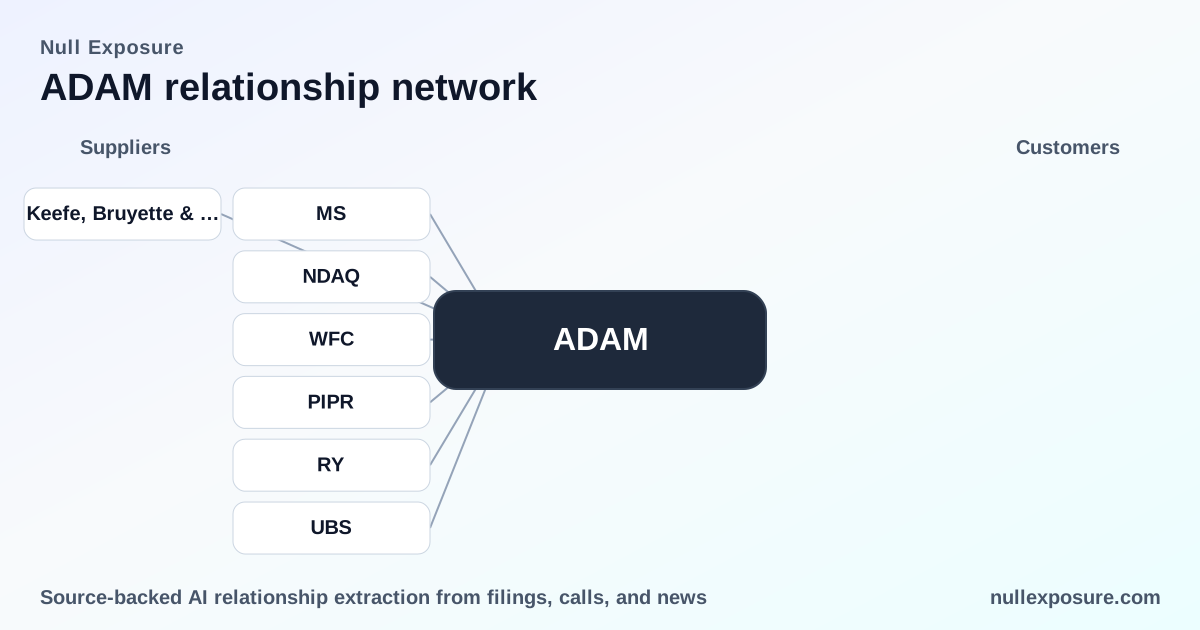
ADAM — Customer relationships and what they mean for investors
Adamas Trust, Inc. (ticker: ADAM) acquires, finances and manages mortgage-related single-family and multi-family residential assets and monetizes through portfolio yield and fee income from asset management; the company generates cash via rental streams, mortgage receivables and third-party management contracts while returning capital to shareholders through a modest dividend. Investors should treat ADAM as a yield-oriented REIT with operating leverage tied to residential rental performance and third‑party management revenues. Learn more at https://nullexposure.com/.
How ADAM makes money and how that shapes customer relationships
ADAM’s revenue model is twofold: direct investment income from owned residential properties and ancillary fee income for managing assets. The company explicitly states that it “derives its revenues from management of the investment portfolio,” and it also contracts to manage assets for third parties that fall within its expertise. That combination produces a hybrid asset-holder / service-provider profile: balance-sheet exposure to property cash flows plus recurring management fees that scale with assets under management.
This business mix creates a contracting posture where ADAM is both a counterparty to renters and governmental housing programs and a vendor to institutional or private clients that outsource property-management tasks. Control over operations and standardized management processes are core competitive assets because they determine the company’s ability to retain management mandates and preserve yield on owned assets.
Customer relationships uncovered — the full list
This review covers every relationship returned in the data payload.
ADAMG — proxy mechanics and shareholder services (FY2026)
ADAMG’s filing details proxy handling and shareholder services: Broadridge Financial Solutions is handling proxy receipt and tabulation for non‑routine votes, Equiniti Trust Company, LLC serves as transfer agent for registered shareholders, and stockholders will vote to ratify Grant Thornton LLP as the independent registered public accounting firm for 2026. According to the definitive proxy statement posted in FY2026, these are routine shareholder-administration arrangements documented for the annual meeting (source: FY2026 definitive proxy statement via StockTitan, May 2026 — https://www.stocktitan.net/sec-filings/ADAM/def-14a-adamas-trust-inc-definitive-proxy-statement-34f83ccf3ec8.html).
What the relationship set tells investors about ADAM’s operating model
The single relationship disclosed in the results is administrative in nature and centers on shareholder services and governance mechanics; it does not list major clients or outsourcers of property-management at scale. Use that observation cautiously: public filings emphasize governance and shareholder services in the proxied disclosure, not the full commercial customer roster.
From the constraints and company disclosures, several company-level signals emerge that are material to evaluating customer risk and contract durability:
- Government counterparty exposure: ADAM participates in the U.S. Department of Housing and Urban Development Housing Choice Vouchers program administered by local PHAs, where the company acquires and rents single‑family homes to eligible voucher recipients. This creates a direct revenue link to public program funding flows and policy continuity. (Company disclosure, FY2026).
- Geographic concentration: The majority of single‑family rental properties are located in specific states — notably Illinois and Maryland — with 526 single‑family rental properties reported as of December 31, 2024. Geography concentrates both asset risk and operating relationships (Company disclosure).
- Service-provider posture: ADAM is explicitly a manager of mortgage-related residential assets and can manage third-party investments that fit its expertise; this indicates recurring service revenue potential and a vendor relationship with institutional owners of housing assets (Company disclosure).
- Revenue segment orientation: The company lists management of the investment portfolio as a revenue source, signaling a business model that combines asset yield with fee-for-service revenue streams.
These signals together imply a mixed concentration and criticality profile: contracts with public agencies (PHAs) and institutional clients are potentially critical to cash flow but geographically concentrated, creating both stability from government-backed payments and sensitivity to local market dynamics.
Operational constraints and investor implications
Translate the disclosures into investor-relevant constraints on choice and execution:
- Contracting posture: ADAM operates as both principal and service-provider, meaning counterparty negotiations can vary from landlord-tenant agreements to longer-term management contracts; renewal risk exists primarily on the management side where mandates can be lost to competitors.
- Concentration: State-level concentration in Illinois and Maryland raises portfolio-level vulnerability to regional employment, housing demand and regulatory change.
- Criticality: Participation in HUD voucher programs makes a portion of cash flow dependent on federal and local funding and program administration; this creates revenue predictability but also policy exposure.
- Maturity: The company reports established operations (hundreds of SFRs and ongoing management activity), indicating a mature REIT operating model rather than an early-stage asset aggregator.
Key commercial risk factors investors should monitor
- Policy and funding: Changes in HUD voucher program funding or PHA administration practices could shift tenant eligibility and payment timing.
- Geographic shocks: Local downturns in Illinois or Maryland housing markets will disproportionately affect portfolio performance and local management revenues.
- Management-fee retention: The company’s ability to win and retain third-party mandates will determine the growth trajectory of fee income.
- Governance and shareholder services: While administrative relationships (Broadridge, Equiniti, Grant Thornton) are standard, they serve as proxies for institutional governance and audit quality—factors that institutional investors watch closely.
Financial context and market multiples
ADAM is priced as a yield vehicle: market capitalization around $782 million with a dividend paid in 2026 and valuation metrics consistent with income-focused real estate names (trailing P/E ~7.6, price-to-book ~0.87, and a forward P/E in the mid-sevens). Revenue and profitability metrics suggest the business is generating positive operating margins and modest earnings growth, while balance-sheet and geographic concentration demand active monitoring.
Bottom line for investors
ADAM combines asset-backed cash flow with fee-based management revenues; its customer relationships include public housing program counterparties and third-party management clients. The only customer-related item surfaced in the proxy results is administrative and governance-focused (ADAMG’s proxy handling), but company filings reveal substantive operational ties to HUD voucher programs and geographic concentration in Illinois and Maryland. Investors should weigh the stability of government‑linked rental income against the concentration risks embedded in a regional SFR portfolio.
For a broader view of similar relationship intelligence and to track changes to ADAM’s commercial network, visit https://nullexposure.com/.
Bold takeaways:
- Revenue = asset yields + management fees.
- Government program participation reduces volatility but increases policy risk.
- Geographic concentration is material to portfolio risk.