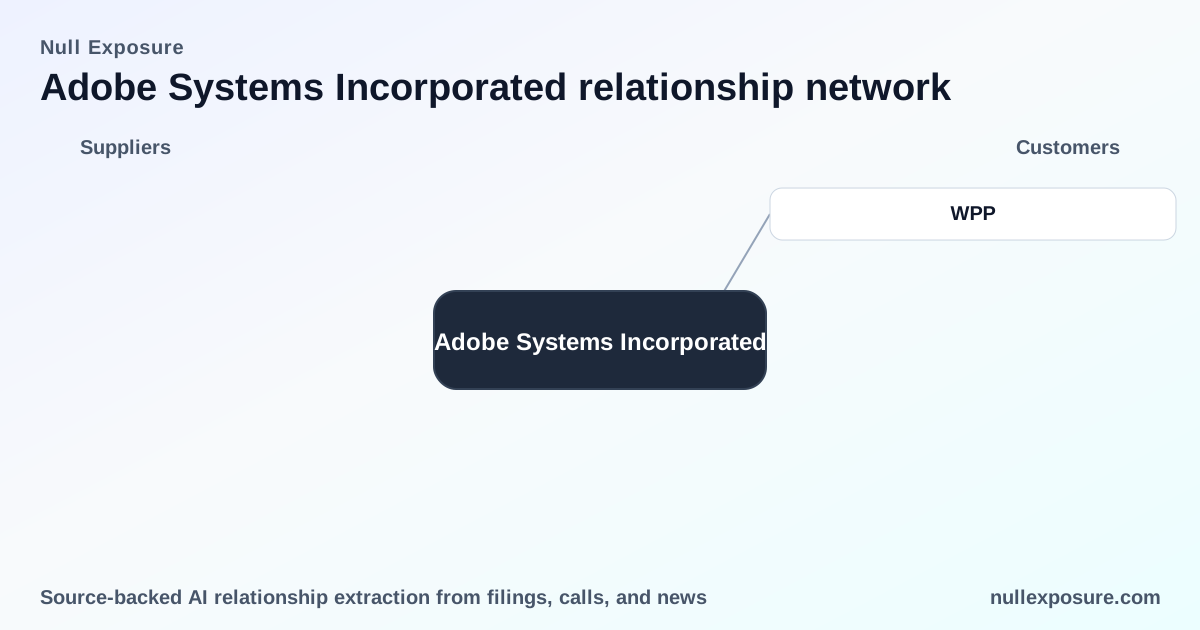
Adobe (ADBE) — Customer Relationships and Commercial Footprint
Adobe sells creative, document and marketing software as a service, monetizing primarily through subscription licenses, enterprise agreements and professional services. The business converts entrenched product franchises (Photoshop, Acrobat, Experience Cloud) into recurring revenue streams, supplemented by usage-based cloud services and consulting that expand total contract value and stickiness. Investors should evaluate Adobe through the lens of subscription economics, global distribution, and strategic embedding with large marketing and retail customers.
If you want a single place to monitor how Adobe’s customer network translates into commercial risk and opportunity, visit https://nullexposure.com/ for structured relationship analytics.
How Adobe’s commercial model shapes risk and durability
Adobe operates with a subscription-first contracting posture: its SEC disclosures show the company recognizes the majority of revenue from multi‑period subscriptions and reports large deferred revenue balances that reflect committed future cash flows. The firm also sells cloud-hosted services on fee-per-period and consumption bases, so contracts range from fixed multi‑year licenses to usage-sensitive arrangements—creating a blended ARR and consumption profile.
Adobe’s customer mix spans individuals, small businesses, large enterprises and government entities, producing low single-customer concentration (no customer >10% of revenue) while embedding products across marketing and content workflows. That combination produces fragmented revenue sources but high structural criticality, because Adobe products are frequently integrated into enterprise marketing platforms and agency workflows. Geographically the business is global (Americas, EMEA, APAC) and presents a mature vendor profile: established product franchises, recurring billing, active deferred revenue, and an expanding services layer that increases total contract value.
Key operating implications for investors:
- Contracting posture: subscription-dominant with growing usage elements and multi‑year enterprise commitments.
- Concentration: low customer concentration but high customer count, which reduces single‑counterparty revenue risk while keeping churn and acquisition economics material.
- Criticality: Adobe is often embedded in marketing/creative stacks and agency ecosystems, increasing switching costs for enterprise customers.
- Maturity: Legacy product leadership (Photoshop, Acrobat) coupled with rapid AI feature adoption drives steady monetization with incremental services revenue.
Relationship roll call: partner and customer highlights
Below are the customer relationships surfaced in public reports and press—each entry includes a concise plain-English takeaway and the cited source.
Box (BOX) — default editor integration
Adobe Express will become Box’s default image editor, enabling Box users to create content inside Box without leaving the platform; this tightens workflow integration between content storage and Adobe’s creative tooling. Source: Adobe press release (Box partnership announcement, Dec 2024) — https://news.adobe.com/news/2024/12/121024-adobe-express-and-box-partner-to-bring-industry-leading-creativity-and-ai-tools-to-businesses
Omnicom Group (OMC) — enterprise marketing AI partnership (note: multiple mentions)
Omnicom is integrating its data and AI agents with Adobe’s marketing and creative stack to deliver agentic, industry‑specialized marketing workflows that are harder for clients to replace internally. Source: SahmCapital analysis (Apr 2026) — https://www.sahmcapital.com/news/content/did-omnicoms-q1-results-and-new-ai-partnerships-just-shift-omnicom-groups-omc-investment-narrative-2026-04-29 and https://www.sahmcapital.com/news/content/omnicom-stock-lags-as-new-ai-alliances-with-google-and-adobe-emerge-2026-04-28
Stagwell (STGW) — content management and data services tie-up
Stagwell and Adobe are deploying advanced content management capabilities that Stagwell positions as part of a broader data-and-content services suite to clients, signaling agency-level integration with Adobe’s enterprise tools. Source: Stagwell press release (2025 investor announcement) — https://www.stagwellglobal.com/stagwell-stgw-will-host-2025-virtual-investor-day-and-announce-5-billion-revenue-target-by-end-of-fy29/
DICK’S Sporting Goods (DKS) — retail personalization with enterprise Adobe solutions
DICK’S announced it will leverage a suite of Adobe enterprise solutions and its own domain expertise to tailor athlete experiences and improve customer engagement with AI-driven personalization. Source: Adobe press release (Apr 2026) — https://news.adobe.com/news/2026/04/dicks-sporting-goods-partners-with-adobe and related market coverage (Finviz, Quantisnow)
CDW (CDW) — reseller/vendor inclusion
CDW lists Adobe among its major vendor partners, indicating Adobe’s presence in broad IT distribution channels that reach enterprise and public sector buyers. Source: TradingView summary of CDW filings (Mar 2026) — https://www.tradingview.com/news/tradingview:94284136f28e3:0-cdw-corp-sec-10-k-report/
Walt Disney Company (DIS) — large enterprise AI adoption
Time magazine noted that major Fortune 100 companies, including Walt Disney, have used Adobe’s AI-enabled apps for marketing—underscoring Adobe’s penetration into global enterprise creative programs. Source: Time (2026 Time100 profile) — https://time.com/collection/time100-most-influential-companies/2026/adobe/
WPP (WPP) — expanded agency integration and Firefly Foundry embedding (multiple mentions)
WPP has expanded its global partnership with Adobe to integrate Firefly Foundry into WPP Open and to launch a Transformation Practice focused on agentic AI marketing workflows, deepening Adobe’s role inside global agency operations. Source: TIKR market commentary and WPP/earnings disclosures (Mar 2026), plus WPP sustainability report — https://www.tikr.com/blog/adobe-rose-6-this-week-heres-where-the-stock-could-go-in-2026; https://www.insidermonkey.com/blog/wpp-plc-nysewpp-q4-2025-earnings-call-transcript-1705329/; https://www.wpp.com/en/sustainability/sustainability-report-2023
Hooker Furnishings (HOFT) — co‑developed platform
Hooker Furniture worked with Adobe and Jola to develop a retail platform, signaling Adobe’s role in bespoke commerce solutions for vertical retailers. Source: FurnInfo industry report (Mar 2026) — https://www.furninfo.com/furniture-industry-news/25722
Wyndham Hotels & Resorts (WH) — marketing and personalization integration
Wyndham described embedding Adobe across the guest engagement journey to increase personalization, drive direct bookings, and compress acquisition costs—an example of Adobe’s impact on travel & hospitality economics. Source: Wyndham earnings call transcript (May 2026) — https://www.insidermonkey.com/blog/wyndham-hotels-resorts-inc-nysewh-q1-2026-earnings-call-transcript-1752029/
Haverty Furniture Companies (HVT / HVT-A) — Edge delivery and platform usage
Haverty’s earnings commentary notes conversion of key web pages to Adobe’s Edge delivery service to improve site performance and conversion; earlier calls referenced using the Adobe platform to improve customer experience. Sources: Investing.com transcript (HVT Q2 2025 recap) — https://www.investing.com/news/transcripts/earnings-call-transcript-haverty-furniture-q2-2025-beats-expectations-93CH-4164084 and historical Fool transcript (HVT-A, Q3 2021) — https://www.fool.com/earnings/call-transcripts/2021/10/29/haverty-furniture-companies-inc-hvt-q3-2021-earnin/
Coursera (COUR) — course content referencing Adobe generative AI
Coursera course analytics cited Adobe’s “Generative AI Content Creation” as an example of practical GenAI content, indicating Adobe’s role in training and developer ecosystems that support customer adoption. Source: Intellectia.ai summary of Coursera content (2026) — https://intellectia.ai/news/stock/udemy-udmy-investigated-for-proposed-sale-to-coursera-cour-at-08-shares-per-share
Strategic takeaways for investors
- Recurring revenue and deferred cash are central to Adobe’s valuation: deferred revenue balances translate into visible short‑term cashflows that support profitability and margin expansion.
- Enterprise embedding through agencies and distributors (WPP, Omnicom, Stagwell, CDW) increases customer stickiness and creates cross‑sell pathways into Experience Cloud and marketing automation.
- Retail and hospitality case studies (DICK’S, Wyndham, Haverty, Hooker) demonstrate how Adobe leverages product + services bundles to capture higher contract value and operational dependency.
- Low single-customer concentration reduces headline counterparty risk, but high criticality in marketing stacks increases switching costs and pricing power.
If you want a structured view of these relationships and how they affect Adobe’s customer concentration, renewal risk and revenue durability, explore the curated analytics at https://nullexposure.com/.
Investors should treat Adobe as a subscription-first software company with strategic agency and distribution partnerships that materially reinforce retention and upsell economics.