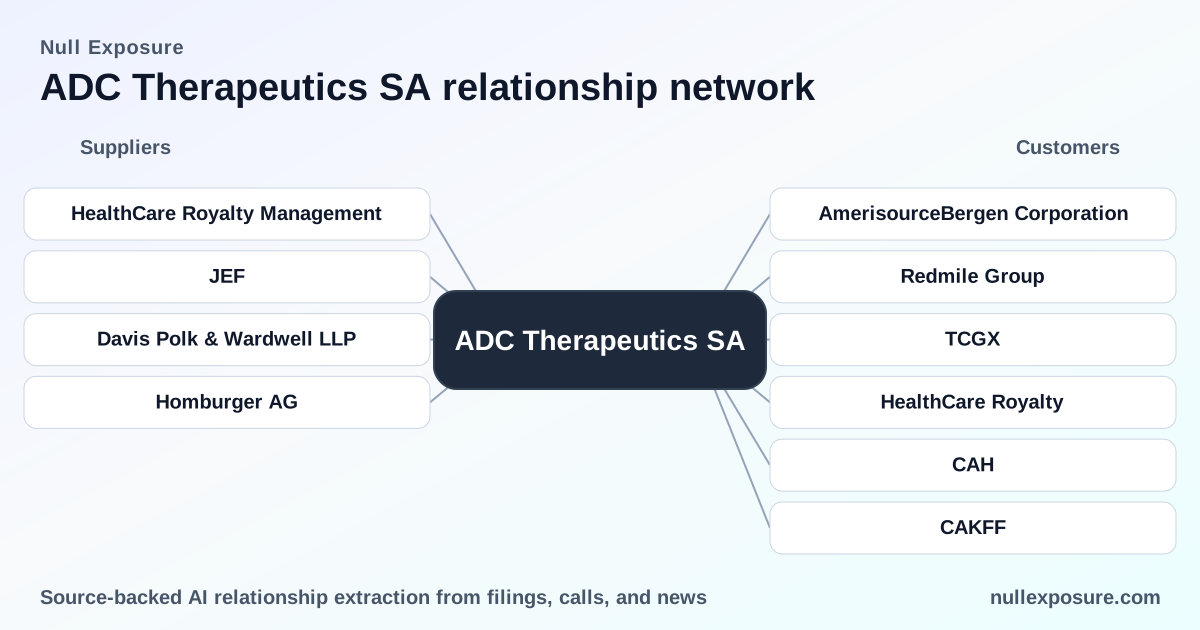
ADC Therapeutics (ADCT): customer map, concentration risk and partner dependencies
ADC Therapeutics develops and commercializes antibody–drug conjugates, with ZYNLONTA as the single currently approved product that drives product revenue. The company monetizes through U.S. product sales (distributed primarily via wholesale distributors), license fees and milestone payments from regional partners, royalties outside of core territories, and supply agreements for development and commercial use. Investors should evaluate ADC’s commercial concentration (three U.S. distributors account for the bulk of product revenue), partner-driven international rollouts, and contractual supply/licensing commitments as the primary drivers of near‑term cash flow and counterpart risk. For a full view of customer exposure and partner contracts, see https://nullexposure.com/.
How ADC makes money and what that implies for counterparties
ADC’s operating model is a hybrid of direct U.S. commercialization and outsourced international commercialization. Direct sales in North America are sold primarily through wholesale distributors, creating a concentrated revenue base; internationally, ADC monetizes via upfront payments, milestones and tiered royalties granted to licensees and partners. This structure produces four salient business-model characteristics:
- Contracting posture: ADC retains manufacturing and supply obligations for licensed products in several agreements and sells product into distribution channels under standard gross-to-net adjustments, including government rebates and chargebacks. These contractual obligations increase ADC’s operational exposure when partners control commercialization in key territories.
- Concentration: A small number of wholesale distributors account for more than 10% each of product revenues — a concentrated receivable and revenue profile that links ADC’s cash flow directly to distributor ordering and inventory behavior.
- Criticality: With a single approved product as the core revenue generator, partner performance, regulatory milestones and distributor uptake are critical to ADC’s near-term financial trajectory.
- Maturity: Commercial activity is early but active — direct U.S. commercialization is ongoing while international launches progress via licensees, producing a mix of product and license/milestone revenue rather than stable, diversified sales.
If you want a consolidated feed of relationships and documents for diligence, visit https://nullexposure.com/.
Customer and partner relationships — line by line
AmerisourceBergen Corporation (also referenced as Cencora)
AmerisourceBergen is reported as a customer from which ADC derives more than 10% of total product revenue, accounting for roughly 39% of product revenues for the year ended December 31, 2025 (39% in 2025 vs. 35% in 2024). This concentration places AmerisourceBergen among the three distributor counterparts that dominate ADC’s U.S. product receipts, per ADC’s FY2026 disclosure filed on StockTitan and referenced in ADC’s customer concentration notes. (Source: ADC FY2026 filing, StockTitan mirror, May 2026.)
McKesson
McKesson is another distributor named as contributing about 39% of product revenue in 2025 (41% in 2024), underscoring a duopoly-like concentration with AmerisourceBergen in ADC’s U.S. revenue streams, according to ADC’s FY2026 customer-revenue schedule. (Source: ADC FY2026 filing, StockTitan mirror, May 2026.)
Cardinal Health
Cardinal Health is listed as a third major wholesale distributor, representing roughly 22% of product revenue in 2025 (24% in 2024), completing the concentrated distributor trio that accounts for the majority of U.S. product sales. This is documented in ADC’s FY2026 filing and mirrored in the 2024 Form 10‑K customer concentration schedule. (Sources: ADC FY2026 filing and ADC 2024 Form 10‑K.)
CAH (filing identifier)
The filing references CAH in the 2024 Form 10‑K customer concentration entries; CAH is an alternative label used in the disclosures for Cardinal Health. ADC’s 2024 Form 10‑K tags this counterparty in the customer‑concentration table. (Source: ADC 2024 Form 10‑K.)
McKesson listed under CAKFF
ADC’s customer-concentration disclosures also include McKesson under an alternative identifier (CAKFF) in the 2024 Form 10‑K; this is a filing-level reflection of McKesson’s role as a concentrated distributor for ADC product revenue. (Source: ADC 2024 Form 10‑K.)
TCGX (PIPE lead investor)
TCGX led a PIPE financing round in March 2026 that included participation from other investors; while not a customer in the classical sales sense, the financing relationship injects capital and alters ADC’s financial flexibility. The PIPE announcement was reported on Yahoo Finance in March 2026. (Source: Yahoo Finance press release, March 9, 2026.)
Redmile Group (PIPE participant)
Redmile participated in the March 2026 PIPE alongside TCGX and other existing investors; this investor support is material to ADC’s capital structure and liquidity profile. (Source: Yahoo Finance press release, March 9, 2026.)
Overland ADCT BioPharma
ADC signed a supply agreement to provide product to Overland ADCT BioPharma for its development and commercialization activities; ADC is required to supply the party at cost for development requirements, indicating a contractual manufacturing/supply obligation. This appears in the FY2026 disclosures. (Source: ADC FY2026 filing, StockTitan mirror, May 2026.)
Overland ADCT BioPharma (CY) Limited
A related legal entity, Overland ADCT BioPharma (CY) Limited, is explicitly named in the filing with a clause obligating ADC to manufacture and supply licensed products for Overland’s development and commercialization activities at ADC’s manufacturing cost, and requiring Overland to purchase its requirements from ADC. This creates a committed off-take and manufacturing cadence. (Source: ADC FY2026 filing, StockTitan mirror, May 2026.)
Swedish Orphan Biovitrum AB (Sobi / SOBI)
ADC has an exclusive license agreement with Sobi for territories outside the U.S., greater China, Singapore and Japan; ADC received upfront payments (aggregate $105 million across two payments in July 2022 and February 2023) and is eligible for up to $332.5 million in milestones plus tiered mid‑teens to mid‑twenties royalties, with license revenues and milestone recognition reported in 2025. The arrangement transfers commercialization responsibility (and related reimbursement risk) to Sobi in covered territories. (Source: ADC FY2026 filing and 2025 license‑revenue disclosure.)
Sobi (alternate mentions / trading commentary)
Trading commentary and secondary reporting reiterate Sobi’s role in international commercialization and revenue recognition; ADC’s public filings and market summaries highlight that international roll‑out is “progressed via partnerships, including Sobi.” (Sources: ADC FY2026 filing and TradingView summary, May 2026.)
Tanabe Pharma Corporation (TPC)
ADC granted Tanabe an exclusive license to develop and commercialize ZYNLONTA in Japan under a 2022 agreement, transferring commercialization rights for Japan and enabling ADC to monetize via upfront and potential milestone payments and royalties in that territory. (Source: ADC FY2026 filing, StockTitan mirror, May 2026.)
HealthCare Royalty
ADC amended a royalty purchase agreement with HealthCare Royalty in March 2026, reducing the change‑of‑control payment from $750 million to $150 million until the end of 2027 (and $200 million thereafter), a restructuring that improves ADC’s strategic flexibility and alters contingent cash‑out expectations tied to a potential sale. (Source: Intellectia.ai coverage of the March 2026 amendment.)
What the relationship map means for investors: risks and levers
- Revenue concentration risk is high: three distributors (McKesson, AmerisourceBergen/Cencora, Cardinal Health) together represented the majority of product revenue in 2025, which concentrates receivable and inventory risk into distributor decisions. (Company disclosure, FY2026.)
- Partner-driven international rollouts create commercialization and reimbursement risk: Sobi and Tanabe hold exclusive commercialization rights in major territories and therefore control coverage, pricing and net sales outcomes that feed ADC’s milestone and royalty streams. (Company disclosure, FY2026.)
- Contractual supply commitments raise operational exposures: supply obligations to Overland entities at manufacturing cost create guaranteed production demand and margin pressure on any supplied volumes. (Company disclosure, FY2026.)
- Government exposure and gross‑to‑net mechanics: ADC’s revenue recognition is adjusted for government rebates, chargebacks, and a discarded drug rebate under recent U.S. legislation, making public‑payer dynamics and rebate calculations a material input to net sales. (Company disclosure excerpt on GTN and Infrastructure Investment and Jobs Act obligations.)
- Geography and FX: the business remains North America‑centric today (majority U.S. revenue) while operating globally via partners, exposing ADC to FX volatility and partner execution variability. (Company disclosure on revenue by region and FX exposure.)
Bottom line for investors
ADC’s revenue profile is highly concentrated and partner‑dependent, anchored by one approved product and three primary U.S. distributors. Key value drivers are successful partner commercialization outside the U.S., milestone recognition from licensees, and distributor ordering behavior; key risks are distributor concentration, partner-controlled reimbursement outcomes, government rebate exposures, and single-product dependency. For an organized, citation‑backed view of counterparty relationships and filing references, visit https://nullexposure.com/.